Wednesday, December 15, 2010
Imaginationland posted by Richard Seymour

Imagine it was North Korea, says China. Imagine it was Iran or Zimbabwe or Burma. Among scenes of 'violence', with police lashing out at protesters landing one in hospital with a serious brain injury, there is some shocking footage:
The scene: a mass demonstration in Tehran/Harare/Rangoon/Pyongyang/&c. The police are filmed shoving a 20-yr-old demonstrator with cerebral palsy from her/his wheelchair & dragging her/him across the pavement, to the horror of onlookers. Footage of this event is sneaked out & publicised. Accordingly, Iranian/Zimbabwean/Burmese/North Korean/&c state broadcasters cannot ignore it. Forced to report it, they stress, however, that there ‘is a suggestion’ that said demonstrator was ‘rolling towards the police’.
Oh yes, imagine. Hold your breath. Make a wish. Count to three. And enter a world of pure imagination. And now imagine if the chief of police in the capital city of any of those countries, having claimed that the protesters were fortunate not to have been shot dead, announced that it was planning to ban all marches against the government on the spurious pretext of ‘violence’ by protesters. Imagine this isn’t the normal response of capitalist states to dissent outside of anomalously stable periods of class compromise. Imagine that the already impoverished political democracy is about to take a nasty turn to the methods of the police state. Imagine… imagine… imagine…
Labels: education, education maintenance allowance, liberal democrats, metropolitian police, police, police brutality, police state, students, tories, tuition fees, universities
8:01:00 pm |
Permalink |
Comments thread |
|
Print |
Digg |
del.icio.us |
reddit |
StumbleUpon |
 Tweet|
Share|
Tweet|
Share|

Thursday, December 09, 2010
More Day X 3 pictures posted by Richard Seymour


Labels: austerity, capitalism, capitalist crisis, cuts, education, education maintenance allowance, liberal democrats, liberals, students, tories
8:23:00 pm |
Permalink |
Comments thread |
|
Print |
Digg |
del.icio.us |
reddit |
StumbleUpon |
Tweet|
Share|
Monday, June 14, 2010
On ruling class self-satisfaction posted by Richard Seymour
| — | Danny Dorling, Injustice, Policy Press, 2010, pp. 1-2 |
Labels: capitalism, class struggle, david cameron, evolutionary socialism, inequality, liberal democrats, meritocracy, new labour, ruling class, tories
9:44:00 pm |
Permalink |
Comments thread |
|
Print |
Digg |
del.icio.us |
reddit |
StumbleUpon |
Tweet|
Share|
Sunday, May 30, 2010
Tomorrow belongs to them posted by Richard Seymour
Labels: david cameron, liberal democrats, neoliberalism, new labour, the meaning of david cameron, tories, yuppy scum
9:31:00 am |
Permalink |
Comments thread |
|
Print |
Digg |
del.icio.us |
reddit |
StumbleUpon |
Tweet|
Share|
Friday, May 21, 2010
Bourgeois, property-based rights and their exclusions posted by Richard Seymour
 The other day, Clegg was making grandiose comparisons between his little bundle of reforms and repeals, and the Great Reform Act of 1832. The analogy would seem to be as absurd as the spectacle of a bunch of rather grey, suited Whigs trying to impart some sort of radical edge to their Grey-era liberalism. On the other hand, Paul Foot used to mockingly point out that the 1832 reforms left the vote concentrated among 2% of the population - thus were only 'great' in the sense of unavoidably shifting political power from the landed gentry to the urban bourgeoisie. The changes abolished some rotten boroughs, and created new constituencies for rising industrial centres, but maintained a property-based voting system which ensured that those who voted were also those who ruled. So, the legacy to which Clegg is appealing is not particularly democratic - if anything, it was a legislative effort to contain the revolutionary democratic pressures of both workers and middle class radicals who, it was feared, might withhold their taxes and use the dough to purchase an arsenal or two. It marginalised rather than empowered the working class majority.
And whatever reform agenda that Clameron's cluster coalition ultimately spews up will also exclude workers in a very particular way: there will be no talk of repealing undemocratic anti-union laws. The laws as they stand enable employers to pursue vexatious legal challenges to workers' right to strike on the grounds of balloting irregularities. According to the Labour Research Department, this has been the single most important means by which employers seek to bring an injunction against a union since the first anti-union act was passed in 1983. The complexity of strike laws, and the increasing number of specificities as to procedure, have made it possible for employers to win injunctions on the basis of absurd technicalities. This week's victory for BA in the courts, overturned on appeal, was precisely an example of such - the employers alleged that the union had broken the law by failing to advise members of twelve spoiled ballots. You'll recall that there was a similar case where the RMT were hit with an injunction when a court decided that the union had failed to specify the exact location and details of the workplaces at which workers were based, though the union was using data supplied by the employers. There is only one purpose for such laws, and that is to decisively compromise the democratic right of all workers to withdraw their labour.
Moreover, aside from the letter of the law, there is always a battle over interpretation. Judges are not mere verdict-vending machines. They may be independent of party control, but they are not independent of the class relations in which they are situated. The ideological biases imparted to them by their class status, as heads of a highly conservative legal profession, are hardly of negligible import in their verdicts on such matters, whatever the high-minded abstractions they imagine themselves to be motivated by. The fact that in a number of high profile disputes at the beginning of what is likely to be a period of intensified class conflict the courts have decided to openly interpret the law in such preposterously biased ways suggests that there is an attempt by many in the judiciary to set a precedent that makes it almost impossible to hold a legal ballot. To put it another way, these decisions constitute class conscious acts of repression, facilitated by - but not determined by - existing anti-union legislation.
The underlying issue here is that the democratic right of workers to withhold their labour is one that conflicts with the property-based right of capitalists to invest, and managers to manage. The Thatcherite mantra was to restore the primacy of the latter at the expense of the former. (The Tories have tended to obscure the class basis of such arguments by insisting that they are also upholding the rights of consumers to consume, unimpeded by recalcitrant unions). All members of the cabinet are committed to this orthodoxy, and the prevailing view is that the class power of the employers - with respect to employment law, regulation, taxes, etc. - is still insufficiently buttressed. So, we have progress to look forward to alright - progress to 1832, and the the great zenith of liberal reformism, in which the industrial capitalists were empowered and the workers put in their place.
Labels: civil liberties, clameron, liberal democrats, liberalism, new labour, strikes, tories, union-busting, unions, whiggery, working class
8:39:00 am |
Permalink |
Comments thread |
|
Print |
Digg |
del.icio.us |
reddit |
StumbleUpon |
Tweet|
Share|
Tuesday, May 18, 2010
Cameron, the 'progressive' posted by Richard Seymour
Yours truly in this week's Socialist Worker, on the 'progressivism' of David Cameron. The book will be out in time for the Housmans event next Wednesday, but it can be pre-ordered online here (and, since I have been asked about this, by American readers here).Labels: 'progress', 'progressive', capitalism, liberal democrats, neoliberalism, red toryism, the meaning of david cameron, tories
9:03:00 pm |
Permalink |
Comments thread |
|
Print |
Digg |
del.icio.us |
reddit |
StumbleUpon |
Tweet|
Share|
Why neoliberalism persists posted by Richard Seymour
 Obviously, the commentators are right. Spending cuts transfer the costs of economic failure from the agents principally responsible for it onto the majority who did nothing to cause it, while also threatening a 'double dip' recession. Destroying half a million public sector jobs is an excellent way to suck demand out of the economy and ensure that investment grinds to a halt again.
This obvious absurdity is one reason why the parties went into this election refusing to be straight with voters as to just exactly what the cuts entailed. The Lib-Con coalition that has emerged has subsequently tried to hedge its cuts announcements with charming little gestures of solidarity, such as reducing ministerial pay by 5%. (They feel our pain.) Now, as cuts are announced, there is a tendency to frame the matter as an issue of good husbandry and fiduciary integrity - a framing assisted in no small measure by push-polls asking people questions about which party or leader would be most effective at 'cutting the deficit'. Moreover, the government has been talking down the public finances, attempting to insinuate - so far with little real foundation - that the last government indulged in wildly profligate spending commitments and covered up the dire state of public finances. This feels like an attempt to create panic in the markets, and thus add urgency to the alleged need for spending cuts. It would not be the first time.
There is an obvious question that arises here: in what way are these cuts good for capitalism? After all, what is being proposed here is that approximately £150bn should be taken from the public sector over the next four or five years, and redistributed to the financial sector. This could be regarded as an example of what David Harvey has called "accumulation by dispossession", since the assumption of the government is that reduced public sector investment will be matched by increased private sector investment. In an economic landscape increasingly marked by the dearth of profitable investment opportunities, the privatization of public wealth and industries have facilitated some of the few opportunities for growth that have manifested themselves. But this particular act of redistribution is different in the sense that it does not of itself produce the investment opportunities that, say, the privatization of the utilities and public transport did. And it is highly unlikely that it will actually stimulate any new productive investment; rather, it is likely to be reinvested in debt, property speculation, and currency trading. The net effect would actually be to deprive capital of a substantial portion of its army of consumers, thereby removing its ability to realise the surplus value produced by its investments, and thus deterring further investment. It is, though, a cardinal rule of neoliberalism to protect the financial system at all costs - those who mistook the bank nationalizations and bail-outs for a break with neoliberalism missed this basic point.
So why, given a deeper crisis than any capitalism has experienced for decades, threatening to outdo the Great Depression, does neoliberalism persist? Some theorists posit a "social structure of accumulation" (SSA) theory to explain alternating periods of growth and stagnation in capitalist economies. In this view, political and economic elites contrive a set of institutions favourable for capital accumulation, setting off a period of sustained growth until such time as they exhaust themselves, and an intractable crisis results in a paradigm shift. This is said to account for long cycles of capital accumulation and by shifts between "liberal" and "regulatory" paradigms. Neoliberalism, then, would be just such a SSA, a coherent institutional structure that facilitates rapid capital accumulation. However, neoliberalism has been very poor at facilitating capital accumulation, with world growth sluggish by historical standards. Its durability calls into question this conception of long cycles of capital accumulation enabled by SSAs.
Another approach treats neoliberalism as the hegemonic doctrine of one fraction of capital: thus, neoliberalism has been defined as "the ideological expression of the reassertion of the power of finance". (Duménil & Lévy) This might seem to reduce neoliberalism to one of its aspects, but it does point to the specific class character of the project. The neoliberal period has, after all, done nothing to restore the robustness of non-financial corporations. It has produced a balance of trade deficit in those nation-states where finance is dominant, as investment has remained sluggish, and manufacturing has entered precipitous decline. It has left national states serially indebted, and raised private sector borrowing to perpetual crisis proportions. Growth has been poor, and instability the rule, as demand is systematically weakened and counter-cyclical public investment renounced. In many ways, neoliberalism would seem to be dysfunctional for all but a narrow sector of capital. This raises the question of why there has never been serious resistance to financialisation on the part of other sectors of capital, and why there has never been a party of industry to oppose the party of finance - why, in other words, neoliberalism is a hegemonic doctrine.
Finance has enjoyed hegemony in the past partially on account of its role in the British empire. Britain's overseas trading companies such as the East India Company or the Hudson Bay Company were based in the City of London, and it was the City's activities which financed the planters and traders. The capital's financial centre was the nexus between domestic producers and the colonies. Undoubtedly, finance has a similar role in today's imperialism, the mechanism by which surplus extracted in the 'periphery' is transferred to ruling classes in the 'metropole'. In fact, one of the reasons why the British government started to take a keen interest in consolidating the City's global role in the late 1960s was due to the loss of the colonies and the need to take on rising financial competitors, not least Wall Street. But - then as now - a more pressing factor in the hegemony of finance is the growing integration between finance and industry. For sure, the City of London was once an oppositional bastion of support for, in Polanyian terms, 'market liberalism' as opposed to 'embedded liberalism', and its assertion of dominance . Financialisation has not just meant that one fraction of capital is dominant: it has meant that all other sectors of capital increasingly turn to financial instruments to bolster their profits. David Harvey writes:
"Since 1980 or so it has not been uncommon for corporations to report losses in production offset by gains from financial operations (everything from credit and insurance operations to speculating in volatile currency and futures markets). Mergers across sectors conjoined production, merchanting, real estate, and financial interests in new ways to produce diversified conglomerates. When US Steel changed its name to USX (purchasing strong stakes in insurance) the chairman of the board, James Roderick, replied to the question 'What is X?' with the simple answer 'X stands for money.'" (A Brief History of Neoliberalism, OUP, 2005, p. 32)
So it continues today. Look at the manufacturing giants Ford and GM, who have made a great deal of their profits from rentier activities, not least their credit divisions which offer loans to dealers and buyers. GM lost its credit division in the recent financial crisis, but 40% of Ford's recent quarterly profit came from credit. The fact of the matter is that there often hasn't been enough profit to be had in productive investment, while high-risk speculation has consistently delivered, and will continue to do so as long as the public bails the bankers out at moments of crisis. Just how much neoliberalism has delivered is suggested by the fact that by 2006, two fifths of all corporate profits in the US were accumulated in the financial sector - more than double the ratio at the height of 'Reagonomics' two decades before.
If the government pays off the bonds traders and consolidates the power of finance, it will also be bolstering those sectors of capital with extensive investments in financial institutions - and, I might add, those state agencies that have turned to financialisation in order to raise money for service delivery. It will be supporting the incomes of a significant layer of the middle class that derives some of its income from investments and rentier activity - whether they own property or have private pensions. Obviously, this pay off cannot be accomplished by expropriating the very financial sector it is intended to benefit, ie by means of a windfall tax on speculation. In just the same way, higher taxes on corporate profits would be counter to its ends - indeed, the idea is to further relieve downward pressure on profits by cutting corporation taxes, as the new government is indeed in the business of doing. It doesn't matter how much misery this produces, how many social pathologies such policies produce, and how much real economic stagnation it results in. Until the neoliberal accumulation model is threatened by a class insurgency, or is consumed in a war of such a magnitude as to destroy much existing capital and re-open currently closed investment opportunities, the ruling class will not part with it.
Labels: clameron, cuts, finance capital, financial sector, liberal democrats, neoliberalism, public spending, rent, tories
12:51:00 pm |
Permalink |
Comments thread |
|
Print |
Digg |
del.icio.us |
reddit |
StumbleUpon |
Tweet|
Share|
Thursday, May 13, 2010
What the coalition means. posted by Richard Seymour
 I have been somewhat alarmed and depressed to see a number of perfectly sane liberals, by no means leaning to the right-wing of liberalism, applauding - or at least offering measured approval of - the Clameron coalition. Even on Labour List, there's a commentary suggesting that this will allow Cameron to fulfil his genuinely progressive aspirations and sideline the Tory right. Others are talking about the tax measures that have been included, such as rises in capital gains tax, dropping the cuts on inheritance tax, raising the tax threshold to £10k per annum. And there has been some excitement over the possibility of Vince Cable socking it to the banks. The liberals, it has to be said, think they have won. Perhaps they have - but if so, it is a victory at the expense of many of their voters.
Cameron is not a progressive. He is an old school Thatcherite whose record on economic as on social issues is reactionary - from demanding tax cuts for the rich to support for homophobic legislation. He and his party spent the 2010 general election race-baiting on immigration. Cameron himself is an opponent of multiculturalism, and he was quite happy to participate in the Muslim-bashing fiasco when it reached a nasty crescendo in 2006. His foreign policy is impeccably neoconservative, and William Hague is already sending out the policy signals - eg, he wants to change legislation that might be used against Israeli war criminals. When Nick Clegg was in opposition, he suggested that Britain might stop arming Israel for as long as it was using those weapons to engage in wholesale butchery in Gaza that shocked even some of Israel's most unwavering supporters. Now he is part of a government that will be, if anything, more fanatically pro-Israel than the last.. On the whole, Cameron is a man who instinctively identifies with wealth and privilege, and oozes disdain in every nuance of his speech and comportment for the poor and oppressed. If Cameron's policy record, rather than his broken record PR spin, is what is at issue here, then calling him a progressive is as perverse as labelling the Pope a member of the Saviours Sect.
The idea of Vincent Cable laying into the banks may have a certain allure, and a British equivalent of Glass-Steagall may be a surprising development to come from any Tory-led administration. After all, the Tories fought the election on a manifesto that seemed to confirm that they were determined to protect the bankers' dominant position. By allowing the Bank of England to be the main regulator of the City (thus effectively allowing the City to be self-regulating), and by delegating a minister to fight for the City's interests in Europe, they showed no sign of Cable's reforming zeal before they cut an agreement with the Liberal Democrats. But the Tories have actually given themselves considerable room for manoeuvre here. All they've agreed to on this score is an independent commission to investigate the possibility of one day separating retail and investment banking "in a sustainable way" (ie in a way that doesn't offend the City). Meanwhile, Larry Elliott reports that a factional struggle is already under way between Osborne and Cable over who will have final say over any banking reform. This is a fight that Osborne is likely to win since Cable is in his position as a member of a junior partner in a coalition. The Liberals have agreed with the Tories that the B of E will become the key regulator of the City although the FSA will continue to operate, presumably as a subordinate body. That basically does mean effective self-regulation for the City. Both parties had already been in agreement on the idea of some sort of banking levy, but its terms lack any specificity, so that any policy that finally emerges is likely to be the result of domestic and international lobbying and horse-trading. In general, the City has breathed a collective sigh of relief at the terms of this agreement, as well they should.
Much is made of the fact that the coalition's current tax policy is an improvement on the Tory original, though even superficially laudable ideas such as a higher tax threshold are actually regressive in their impact. More importantly, when it comes to the big fiscal issue, the tax changes are small beer, and their overall effect is to increase cuts in public spending. And this is where it becomes most interesting. The coalition is committed to speeding up the reduction of Britain's structural deficit. This is in its agreement, and both parties favoured this before the election. Yet, they have not said how they will do this. Beyond some placatory noises on protecting key public services, there are tens of billions of pounds simply unaccounted for here. Today's FT reports:
You heard that - cuts of more than a fifth in all non-protected departments. That's what the coalition means: education, transport, justice, and welfare will all experience unprecedented cuts. Only the NHS as a department is protected, though there are protected 'frontline' areas in education that will not be cut. John Lanchester, as I've mentioned in previous posts, has spelled out the implications of even smaller cuts than these - it would be equivalent in justice to closing all courts; in transport to cutting a third of Network Rail grants. In defence, it would be equivalent to closing down the armed forces. Since the coalition is explicitly committed to Trident and implicitly committed to the on-going occupation in Afghanistan, I can't see that happening - which means deeper cuts for other departments. As for schools and welfare, the mind boggles. Losing a fifth of the non-protected education budget hasn't even been tested to my knowledge. Research on a hypothetical 2% cut, prompted by Ed Balls' drive for 'efficiency savings', suggests that it will lead to a serious reduction in the quality of education as lay offs led to bigger classes.First, the Treasury’s existing plans for public spending already imply cuts to government departments of £37bn (2.5 per cent of national income) a year by 2013-14.
Added to this, the coalition agreement has committed the parties to increases in spending on overseas aid with an annual cost of £4bn; fresh income tax cuts with a price tag of about £5bn, as a downpayment on the Lib Dem plan to raise income tax thresholds; £3bn a year for avoiding some Labour tax increases; faster deficit reduction, which implies additional spending reductions of about a further £8bn; a jobs package at £600m; more funding for poor school pupils at £2.5bn; and higher old-age pensions costing about £2bn.
Set against this are near-term plans to raise taxes on aviation of £3bn and capital gains tax of about £2bn.
Put this together and Mr Osborne will have to announce public spending cuts of £57bn a year by 2013-14 from a non-protected budget of about £260bn – cuts of about 22 per cent. [emphasis added]
The welfare system is likely to be one of the most contentious areas where cuts are introduced. Given that pensions are projected to rise, and the link with earnings eventually restored, the main brunt of any cuts will probably fall on benefit claimants, whether they are on the risibly low job-seekers allowance or disability allowance. The Liberals and Tories have agreed on bringing forward workfare proposals. At the moment, private companies are given lucrative contracts to harrass and bully the unemployed back to work on the assumption that unemployment is voluntary and results from a lack of moral fibre. Such schemes begin within 12 months of one having been on the unemployment rolls, as things currently stand. The new government will ensure that people are immediately transferred to one of these schemes, as soon as they start to claim. As I understand the Tories' policies on workfare, they intend to build on New Labour schemes to hound the disabled and single mothers to seek work, and force those on job seekers allowance to perform menial labour for private contractors so that they remain 'in the habit' of working. (Of course, those doing the work won't be entitled to the minimum wage, much less the 'Living Wage', or employee protections). In the long run, the Tory-Lib coalition anticipates a reduction in benefits due to these measures. So, I would guess we're talking about a serious attack on the welfare state, an attempt to force more and more people off welfare rolls, and mass redundancies in the civil services as the welfare system is 'streamlined' and downsized. In addition, since both Liberals and Tories are ideologically committed privatizers, we can also look forward to state assets such as the Royal Mail being auctioned off at bargain basement prices.
Obviously, this entails a highly confrontational government, one whose outlines are not disclosed in the soothing bromides about strong and stable government that the coalition partners are laying on us. The Tories had already warned in opposition that they were prepared to take on the unions in a big way to ensure that the cuts go through, and the Liberals will back them. And the fact is that what they will be fighting for involves cutting slashing core services that are needed most by the poorest, then throwing hundreds of thousands of people on the dole, while at the same time introducing more punitive measures to drive them off the benefit rolls. It won't be long before this manifests itself with brutal clarity, at which point the government's "progressive" well-wishers will have some uncomfortable choices to make.
Labels: 'progressive', cuts, education, liberal democrats, neoliberalism, new labour, privatisation, public spending, taxation, tories, welfare
8:43:00 am |
Permalink |
Comments thread |
|
Print |
Digg |
del.icio.us |
reddit |
StumbleUpon |
Tweet|
Share|
Tuesday, May 11, 2010
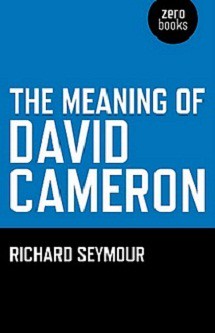
The Meaning of David Cameron posted by Richard Seymour
 Well, well. That's the liberals' progressive reputation finished, along with their ability to take Labour heartland seats. And you'll have to buy my bloody book now, won't you? If you want to get a copy and hear me talk about the scum - no offense intended - who have just taken over, come along to this:
Date: Time: Location: Street: City/Town: Description
Richard Seymour, blogger of ‘Lenin’s Tomb’ fame, and author of ‘The Liberal Defence of Murder’ will be in store discussing his latest publication, ‘The Meaning of David Cameron’.
The Tories are posing as a 'progressive' and 'radical' alternative to New Labour. Drawing from George W Bush's 'compassionate conservatism', they maintain that the 'Big Society' can do what 'Big Government' cannot - produce a cohesive, mutually supportive, happy society. Cameron's court intellectual, Philip Blond, maintains that this is a viable alternative to the failures of the egalitarian left and the excessively pro-market right. But is this more than campaign mood music? And are the conservative traditions that they draw on - from the bucolic, pseudo-medievalism of G K Chesterton to the anti-statism of Friedrich Hayek - really a bulwark of progress and radicalism?
Richard Seymour argues that such ideas can only seem 'progressive' in light of New Labour's acquiescence to Thatcherism. To understand the Cameronites, it is necessary to understand how the social landscape and corresponding political language was transformed by the collapse of post-war social democracy and its more radical competitors. To resist the Cameronites, he argues, it is necessary to attack the neoliberal consensus on which all major parties found their programme.
The cabinet announcements being drip-fed to the media include Osborne as chancellor, Hague as foreign secretary and Clegg as Deputy PM. That means, respectively: cuts; "liberal interventionism"; and tea with two sugars.
Labels: capitalism, clameron, cuts, liberal democrats, neoliberalism, new labour, public spending, the complete and utter works of richard seymour, the meaning of david cameron, tories
9:20:00 pm |
Permalink |
Comments thread |
|
Print |
Digg |
del.icio.us |
reddit |
StumbleUpon |
Tweet|
Share|
The ratings agencies speak posted by Richard Seymour
From Though Cowards Flinch:The banks have pronounced which party they want to govern us, and the Credit Rating Agencies are preparing to tell us who’s really in charge
An alliance of the Labour and Liberal Democrat parties to form a British coalition government would “almost guarantee” a credit downgrade, BNP Paribas SA said, recommending investors sell the pound against the dollar.
A cut in the rating is likely “since both parties agree that early expenditure cuts could harm the economy,” a team at BNP Paribas led by London-based Hans-Guenter Redeker wrote in a research note today. “A Labour/Liberal government is the least- liked option by markets.”
You know, I really don’t know why we bothered with an election.
I predict this will be all over the Tory media within an hour.
I still can't muster much enthusiasm for the Lab-Lib-nats rainbow coalition, but it would be nice to see the bankers forced to work that bit harder for their pound of flesh (or, rather, their 167 billion pounds of flesh), and a delicate coalition of the 'progressive' parties would be just the ticket on that score.
Labels: bankers, credit crunch, credit ratings agencies, cuts, liberal democrats, new labour, public spending, tories
1:32:00 pm |
Permalink |
Comments thread |
|
Print |
Digg |
del.icio.us |
reddit |
StumbleUpon |
Tweet|
Share|
Sunday, May 09, 2010
There are no good options posted by Richard Seymour
The bankers and bond traders want cuts introduced as rapidly and quickly as possible, and appear to believe that a coalition of Tories and Liberals would be just the ticket in the present circumstances. That much was made clear by the sudden upsurge in share values when Clegg announced that he would prefer to deal with the Tories, duly reported by the BBC immediately after Clegg had made his statement. If the bankers want to impose cuts on the electorate as quickly as possible, and with as authoritative a mandate as possible, then the prospect of social turmoil, strikes and protests greeting a government with a weak mandate is a problem for them. This is why capital threw its weight behind the Conservatives, why the right-wing press went crazy over the Liberals' brief moment in the sun, and why Cameron warned of calamity in the event of a hung parliament. Despite Ashcroft's millions, Cameron's soft-sell, and a media frenzy that actually involved making Cameron out to be the new Obama, the public declined to give them the authoritative mandate for cuts that they required. At this moment, the worst option for capital and particularly for that politically powerful fraction of capital centred on the City, is a Lab-Lib pact (with the support of centre-left nationalists) which would be led by a party which stood explicitly on the idea that it was opposed to the worst of the cuts and would make the rich pay for a little bit more of the deficit.
The issue of the deficit and who pays for it is the single biggest issue in this electoral morass. There is nothing that comes close to how important this is for the City, for British capitalism, and for the future of welfare and public services in this country. It is in this light that we have to judge the available options now. No one on the left can afford to take their eye off that ball - it isn't fundamentally about PR, though I don't dismiss the issues underlying the demands for PR. It's the economy, stupid. (Or, in a more marxist idiom, it's the class war, stupid.) I hope that this is one issue on which socialists and left-liberals can agree. If we do, then perhaps I can also persuade liberals of two other things: 1) the best outcome is a government with Labour in it, however much we rightly despise their wars, their pandering to the rich, and what they have done to social democracy, because a government with Labour in it is one that has a mandate to at least limit the ferocity of any cuts; 2) it is important that the government should have a weak mandate, not a strong mandate, because a stronger government will be far more effective in imposing cuts. If those are basically correct points, then a Lab-Lib pact would probably be better than either a Con-Lib pact.
Allow me to say that I have no particular enthusiasm for a Lab-Lib pact. I can well see that it would also introduce deep cuts, that it could be exhausted within months, and that it risks letting the Tories back in after less than a year. I can also see that the media are going to use all the ideological power at their disposal to attack such a coalition, and that speculative attacks would likely greet any indecision or reluctance on imposing a rapid agenda of deep cuts to pay the bonds traders. It could produce such a serious crisis that a new general election would put a majority Tory administration in power. Perhaps worst of all, it might give trade union leaders an excuse to frustrate resistance to the cuts on the grounds that it might let the Tories in.
The possibility of rapid enervation and a collapse of a Lab-Lib government is one reason why some liberals think a Clegg-Cameron cabinet would be beneficial. Unsurprisingly, Nick Cohen endorses a Con-Lib government. He has no particularly good grounds for favouring it, other than that Brown is a rather unpleasant sort of chap whom no one could be expected to work with. But given that he voted for Boris Johnson to defeat Ken Livingstone, I take this to be part of his extended journey to the right. There is a better argument on Liberal Conspiracy, and it proceeds from some premises that I mostly agree with. Yet it is not one I am persuaded by, not least because it says absolutely nothing about the central political issue involved - that of the cuts. This is rather like a survey of the New Testament that doesn't note that Jesus is said to have been murdered as a political criminal and then resurrected a mere three days after his death. And it betokens a complete failure by most political commentators to seriously engage with how deep we are in the shit, and how little the future is going to resemble the last two decades. If you can't make the left-wing case for a Con-Lib government on the basis of how it would impact the struggle over public sector cuts, then you can't make the case.
Allow me to briefly review what's at stake here. Thatcher achieved zero growth for a brief period in some areas of public spending, and has a reputation for starving the public sector of necessary investment because of it. Any government that gets in now will not just freeze spending, but cut public spending by 11% across the board, and that's based on optimistic assumptions about growth. The damage this will do is hard to even project. For example, if New Labour cut over a hundred thousand civil service jobs during a period of sustained growth, the contraction of the public sector implied by these cuts is many magnitudes greater. Would anyone care to imagine the chaos of a system that seriously under-manned? Local councils are already experimenting with models for severely reduced provision, with Barnet's Tories leading the way: having already sacked a quarter of their workforce over a seven year period, their new 'easyCouncil' model seeks to further cut and privatize public services, reducing bin collections, closing libraries, privatizing the housing and refuse departments, etc. Those who suffer most will be pensioners, children and the poor. The social landscape in Barnet is likely to be very bleak in these circumstances, though resistance is helping to hold back some of the cuts.
There is bipartisan talk of protecting frontline services, and in many constituencies (my own included), both Tories and Labour pretended for the duration of the election to be fanatically committed to protecting local public services such as hospitals from closure. This is naked hypocrisy. Deep spending cuts are already in the works for both health and education. To the extent that these departments are 'ringfenced', then it simply means that cuts in other departments will be deeper. No party has been completely honest about the nature of the cuts it plans, but a likely target is welfare, at a time when unemployment is soaring (and soaring in part because of the cuts being introduced in the public sector), and when child and pensioner poverty has been increasing. The social calamity that cuts of the magnitude being contemplated would unleash is just unimaginably grave. So, if you can't tell me how a Tory-led government would help delay, mitigate or otherwise undermine that calamity, then I don't see how you have a case.
One other argument I should like to see the back of is the idea that a Lab-Lib government would be less democratic than a Con-Lib government. This has been repeated in some surprising quarters. Not to overstate the Liberals' "progressive" credentials, but they got many of their 7 million votes on the grounds that they weren't Tories but - as Cleggy himself claimed - were a progressive party that had more in common with Labour than the Conservatives. For them to climb into bed with the Tories would be a betrayal of the millions of voters whom they successfully wooed with that line. It certainly wouldn't be democratic. A Lab-Lib pact would more accurately reflect the basis upon which people voted for each respective party, a point borne out by the polls showing that most Conservative supporters want nothing to do with the Lib Dems.
There is one other option. A Tory minority government, unstable and depending on opposition support to carry its policies through, might well be an easier opponent to take on than a working majority led by Labour. Moreover, whoever actually imposes the cuts could destroy their political credibility - thus, if we give the Tories enough rope they might hang themselves, just as the public has inadvertently hung parliament. A slight majority of the public, 53%, favours this outcome - interestingly, taking the margin of error into account, probably as many people favour this as favour a Lab-Lib coalition (52%), while only 46% support a Tory-Liberal coalition. I can see the attractions of this position, but there is one drawback. A Tory minority government would undoubtedly have the support of the Liberals to impose an emergency cuts programme in its first six months. The Lib Dem economic spokesperson Vince Cable is quite clear in supporting cuts in health, education and welfare, and privatization and asset sales - and doesn't even favour the ring-fencing that the two biggest parties claim to support. A Tory government that offered cuts and privatizations would get the support of the Liberals. And you can be sure that the media would work hard to sell this as "what people voted for". On balance, I tend to think that a government led by a party that is constrained in its cuts agenda because of its dependency on working class votes and its connections to the trade union movement is a better opponent to have. But the main point I wish to reinforce is that whatever the left ultimately favours should be based first and foremost on an appreciation of the terrifying scale of the crisis that is ahead of us, not on what's good for the Labour Party's long-term electoral chances or on what will deliver PR.
Labels: capitalism, cuts, finance capital, liberal democrats, neoliberalism, new labour, socialism, spending cuts, tories
2:01:00 pm |
Permalink |
Comments thread |
|
Print |
Digg |
del.icio.us |
reddit |
StumbleUpon |
Tweet|
Share|
Friday, May 07, 2010
Oh, what the fuck? posted by Richard Seymour
Nick Clegg talking about a coalition with the Tories? Are you fucking serious? I see on Sky News that this is the result the bankers wanted, and that share values have gone up, but it's definitely not the result that most Lib Dem voters wanted. It just goes to show that anyone who believed that the Liberals were a progressive alternative was being sold a pup. The Liberals are run by the most right-wing faction, the Orange Book crowd, and an alliance with Thatcherites is entirely natural for them. So much for all their blustering over the bankers. So much for the Liberals taking Labour's place as the Tories' "progressive" opponent. So much for the progressive alliance for the 21st Century. Seriously, dude, fuck the Liberals.Labels: elections, finance capital, liberal democrats, neoliberalism, new labour, tories
10:59:00 am |
Permalink |
Comments thread |
|
Print |
Digg |
del.icio.us |
reddit |
StumbleUpon |
Tweet|
Share|
Election summary posted by Richard Seymour
Not only did a wave of enthusiasm not bring Tory voters surging out to overthrow Labour in the marginals, but in some seats the dread of a Tory victory produced a strong swing back to Labour, mostly in areas where Labour already had a solid majority. It means that there will not be a Tory government with an emergency budget passed into law in the first six months of their rule. Of course, the alternative Lib-Lab coalition will certainly impose steep budget cuts, but there isn't a clear and authoritative mandate for it in the way that there would be had the Tories won an outright majority. Even if all parties are committed to cuts, this result places us in a better position to resist them.
Neither Labour nor the Lib Dems individually has any right to boast about these results. However, both parties can now form a coalition based on the clear anti-Tory majority that the results express. New Labour ministers and officials have been talking up this clear progressive majority all night. Indeed, the combined vote for Labour and the Lib Dems is easily more than 50%, which would give them a legitimate basis for such a coalition. If they're going to do this, however, then they will have no choice but to deliver electoral reform as a minimum in the next term. That means they will have to live with the possibility of smaller parties finding it easier to emerge and challenge their hegemony over all the left-of-centre votes. Also note that the basis on which such a coalition is being raised by Labour MPs is that it will avoid rapid and deep public spending cuts and thus protect the economy. This being the case, they will experience some severe difficulties when they try to push through the cuts.
Relatedly, the results for almost all left-of-Labour candidates were either disappointing or appalling. The best result of the night was Caroline Lucas' excellent victory in Brighton Pavilion, but there's not much to celebrate beyond that. Salma Yaqoob came a strong second in Birmingham Hall Green - but given Yaqoob's profile, and the backing of Lynne Jones among others, one might have expected her to do better. She has been squeezed by the rush back to Labour in working class heartlands. As yet, there is no word on Galloway's result, but right-wing Twitterers have been perhaps prematurely dancing on his electoral grave all night - ah but, as I write, a banner on BBC News says Labour has held Poplar and Limehouse... Beyond that - well, look at the results for TUSC and those Respect candidates not based in Birmingham or the East End. On the disappointing side are results like Sheridan's 3%, but most of the votes are at an appalling fraction of 1%. I suppose on the bright side, the Solidarity/TUSC candidate in Inverness soundly thrashed the 'Joy of Talk' candidate by gaining fifty percent more votes than him. Let no one say that I don't know how to accentuate the positive. You might think it's as well that the Left did not go into these elections grandstanding and talking up its chances, but the fact is that even where the Left had localised prospects the returns have been a disappointment.
The only realistic conclusion is that the window for left-of-Labour electoral challenges has been gradually shutting since 2005, and will not dramatically widen short of the emergence of a social movement on which to base it. These are objective limitations which can't be overcome with a command economy of movement-building in which the grassroots is badgered and cajoled into hyperactivism. What can be achieved in the immediate term is the working out an emergency coalition against the coming public sector cuts. And that is exactly what is needed as soon as possible.
The news about the fascist vote is on balance good. It could have been gruesome, but instead its merely ugly. As it turns out, it looks as if the BNP was easily defeated in Barking, despite Griffin gaining more than 6,000 votes. Griffin tried to say in the run-up to the result that he'd only really aimed to get second place. Actually, he was driven to third place. He's now reportedly blamed his misfortune on the "harrassment" of his bootboys by UAF activists. I'm happy to be among those noisome intruders that Griffin can blame for his defeat. The BNP was also driven into fourth place in target seats like Stoke Central and Stoke South. They did, of course, gain some strong votes even where they were clearly defeated. Overall, they gained about 2% of the vote nationally, a slight improvement. I'm not sure how to interpret this as yet, but with UKIP's vote at 3% (not much in the way of gains for them) that makes a 5% vote for right-of-Tory forces. It does possibly suggest that they were unable to capitalise on the really nasty atmosphere over immigration, which would mean that people were more inclined to vote on class issues than they were mobilised by racism.
Lastly, the turnout is being talked up, but at most it is projected to reach about 70%, less than in 1997 which was then the lowest turnout in the post-war period. The turnout has been driven up by the closeness of he contest, but it's still consistent with the longer term popular disengagement with electoral politics. The legitimacy of the state is entering into a long-term crisis, as its representative features look increasingly unconvincing as bases for popular participation. Whitehall is well aware of this, and that PR isn't going to fundamentally reverse this trend. For a full discussion of the reasons for this, see chapter one of The Meaning of David Cameron, perhaps shortly to be renamed, What Was the Point of David Cameron?
Labels: bnp scum, elections, fascism, liberal democrats, new labour, respect, socialism, tories, tusc
8:41:00 am |
Permalink |
Comments thread |
|
Print |
Digg |
del.icio.us |
reddit |
StumbleUpon |
Tweet|
Share|
Wednesday, May 05, 2010
Reinventing egalitarianism posted by Richard Seymour
Fortunately, there is an intellectual backlash against this trend underway. Two recent books make an explicit and compelling case for egalitarianism: The Spirit Level by Richard Wilkinson & Kate Pickett, which has been widely celebrated and even cited by David Cameron to the authors disdain; and Injustice by Danny Dorling. Each deals with different aspects of the argument. While Pickett and Wilkinson, experts in health and social epidemiology, deal with forensic statistical analysis of inequality and its baleful effects on various aspects of social well-being, Dorling, a geographer at Sheffield University, tackles the corrosive beliefs which support inequality, and which the powerful go to great efforts to reproduce through various institutions from education to the media.
So, while The Spirit Level makes the case for equality on the basis of the social advantages it brings, Injustice makes the case for equality as a demand for political justice. Not to lapse into caricature, I should stress that it is clear that Pickett and Wilkinson believe that inequality is inherently unjust aside from being disadvantageous, but that is not the focus of their treatise. Their main focus is to show that almost every aspect of our lives, including educational attainment, our susceptibility to imprisonment, mental and physical health problems, community relations, and everything that makes up for the quality of life, is related to inequality. The authors note that in the last 'epidemiological shift', the focus of healthcare moved toward seeing stress as a major factor in long-term and fatal illnesses. And stress, as an occupational hazard, is something that mostly affects the majority who are lowest in the hierarchy, and who have the least control over their work. So, there's a multi-dimensional account of inequality here - it isn't just about inequalities of wealth; it is also about status and power, especially power over one's own destiny. They attack politicians for attempting to decouple the symptoms of inequality from their cause, thus leading to moralistic, socially authoritarian drives to get people to change their behaviour. Whether it is an insistence that parents be more feckful, or the heart disease-prone get more exercise, policies built in such a basis have consistently failed in their objective. Only a materially more egalitarian society will produce the desired effects.
Dorling argues that there are five chief kinds of inegalitarian belief that are encouraged by the powerful, perhaps only really believed by the powerful, but which exert real social effects because of their role in shaping official doctrines and policy. Worse is that they come in a language that deliberately softens their edges, prettifies them, and neutralises their political charge. Thus, Dorling engages in a sustained attack on the intellectual bases for inequality, from the superstition that elitism is efficient to the claim that prejudice is natural. All of the arguments he discusses are ones that have become, in different ways, hegemonic, and all of them have been involved in one way or another in this election campaign. Moreover, the effects that such beliefs have are evident in the arrogant self-satisfaction of the rich, their contempt for the poor and unemployed, and their belief that any government interference with their wealth is a betrayal of the extraordinary few who make things work for the rest of us. Given that the rich don't believe they should be forced to pay for any of the recession for which they are chiefly responsible, from the proceeds of the growth that they did least to create and most to benefit from, making the case against public sector cuts and for a socialist response to the crisis requires a fundamental break from the ruling dogmas of the past generation.
Labels: class, elections, inequality, liberal democrats, neoliberalism, new labour, poverty, tories
7:45:00 am |
Permalink |
Comments thread |
|
Print |
Digg |
del.icio.us |
reddit |
StumbleUpon |
Tweet|
Share|
Tuesday, May 04, 2010
Election prediction posted by Richard Seymour
 Pointlessly indulgent, but also compulsory. I've been trying to work out the likely result of the election, based on a mixture of polling reports. The polling points to a hung parliament with the Tories 43 seats short of a majority, the Lib Dems being massively under-represented despite beating Labour in votes. However, my 'instinct' - a compound of expectations based on past disappointments, unrealistic aspirations and a sense of sheer dread - has other ideas. Furthermore, my 'ego' - an obese monkey that incessantly pleasures itself while I carry it around on my back - leads me to believe that my 'instinct' has superior access to voters' preferences. Said instinct therefore expects a last minute Labour surge giving them just under a third of the vote, a squeezed Lib Dem vote, closer to the low than the high twenties, and a very slight overall Tory majority - about 330 seats of 646, based on just over a third of the vote. I would also expect Plaid Cymru and SNP to pick up a few seats. Having negotiated a compromise between my instinct and psephological science, I therefore offer the following:
- Conservatives ≈ 320 seats based on 36% of the vote
- Labour ≈ 200 seats based on 28% of the vote
- Liberal Democrats ≈ 90 seats based on 26% of the vote
- That leaves ≈ 36 seats and 10% of the vote to be distributed among the nationalist parties (SNP & Plaid Cymru), the sectarian (Norn Irish) parties, the left-of-Labour parties (Respect, Green) and possibly the BNP. Of these, I would distribute ten to the SNP, 5 to Plaid Cymru, one to Respect (Salma), and the rest to the sectarians and the hard right.
If this post serves any useful purpose, though, it will be to get some of you who know what you're talking about to explain what's so hopelessly wrong with my projections, and the assumptions underlying them.
Labels: elections, liberal democrats, neoliberalism, new labour, tories
10:16:00 am |
Permalink |
Comments thread |
|
Print |
Digg |
del.icio.us |
reddit |
StumbleUpon |
Tweet|
Share|
Monday, May 03, 2010
The leaders' debate posted by Richard Seymour
The group had developed a six-point "manifesto" that it asked each leader to discuss and respond to, and this involved an interesting triangulation. The underpinning ideology was basically Cameronite. The first manifesto point, championing civil society vs the government and markets, is pure 'Big Society'. The demand for a government framework to support community organisers is close to Cameron's idea of government-sponsored 'social entrepreneurs'. The demand for a cap on 'usurious' interest and its replacement with micro-credit is most congruent with Phillip Blond's distributist agenda of capitalising the poor. The introduction to each leader's contribution made it clear that the organisation favoured 'free and competitive markets'. The demand for community land trusts to facilitate cheaper owner-occupied housing was specifically opposed, by one of the speakers, to the alternative of building more council houses. The ambivalence-cum-suspicion toward socialised provision was palpable. Despite this overall ideological thrust, there were some laudable policies, and most of the specific proposals were probably closest to Liberal Democratic policy. These included an amnesty for illegal immigrants, and the end of detention of migrant children. They also included demands for the implementation of a Living Wage (set at £7.60), which every leader evaded in different ways, though all said it was an attractive idea. So, the ideology was Cameronite, and the policies Cleggite. But the leader that was most popular, by far, was Gordon Brown.
Cameron's performance was confident, but ultimately flat and salesy. He made as much as he could of the fact that the ideological presuppositions of the organisers were so close a match for his own 'compassionate conservatism'. "I talk about the Big Society," he enthused, "you are the Big Society." Oh, Jeez - really? I had thought of that line while I was still an epididymal pre-life form. There are extinct species that saw that line coming. He spoke insistently of his 'progressive goals', emoted about the need for greater 'equality of opportunity', made some vague nod in the direction of capping interest rates on debt ("we'll start with store cards, then see from there..."), sounded firmly in favour of a Living Wage, and even took credit on behalf of the Tories for having implemented it in London - I believe it was actually initiated by Livingstone. But though the 'Big Society' stuff was an open goal for him, he had great difficulty connecting his goals with those of his hosts. Clegg, though he had a clear political advantage over the other leaders, was eerily weightless. He was cheered to the rafters when he agreed to an amnesty for illegal immigrants living in the UK, and to an end to child detention. But other than that, my impression of him as a lacklustre candidate who happens to be in the right place at the right time was confirmed. His much vaunted sincerity and directness was belied by the evasiveness of his responses on issues such as the Living Wage - asked about whether his vague murmurs approving the idea of a Living Wage meant that he would legislate it, he said something to the effect that he wasn't sure if it should be compulsory as he didn't know if the money could be found for it.
Brown, who entered to wild applause and hooting of a kind I haven't seen since I was a WWF fan, revealed himself as an effective manipulator and button-pusher. He simulated passion and urgency, laid it on thick with references to the anti-slavery struggle, the civil rights movement, the suffragettes - to whom Citizens UK were compared. When asked about introducing a cap on usurious interest rates, he quipped "well, we all know what the Bible says about the moneylenders! They should be thrown out of the temple." Thrilled applause, as if no one had noticed the last thirteen years go by. Then he gave a very general nod to the idea of capping interest rates on loans. He mentioned a few modestly decent policies such as child tax credits, and said that the Tories inheritance tax plans would hand £200k to the 3,000 richest families (this is true, but it was also true of his own government's earlier inheritance tax cuts). He reminded the audience who had introduced the minimum wage, and spoke of the 'vawlyews' that his father had imbued him with. And he would have completely evaded the issues on which he was at odds with the assembly, such as child detention and immigrants, with the complicity of the organisers, had one contingent of the audience not heckled and demanded an answer. He still didn't really answer, and the organisers didn't press him even though they had, politely but firmly, pressed the other candidates for more specific answers where necessary.
Brown is not the shambling sadsack that he sometimes appears to be on television. He was a smooth, calculating performer, very adept at deflecting potentially problematic issues with off-the-cuff remarks and the invocation of struggle. He said that those struggling for 'fairness' would always find a 'brother' in him, and he finished his speech with this line: "When Cicero made a speech in ancient Rome, they said: 'good speech'. But when Demosthenes spoke in ancient Greece, they said: 'let's march'!" I don't know if it was wise for an incumbent PM whose government has been embroiled in several imperialist wars to compare himself to an insurgent against Alexander the Great.
In the end, what I had thought might be a Cameronite 'Big Society', and then a collective Cleggasm, turned out to be a Labour rally. The organisers, though noisily non-partisan and offensively civil toward their guest speakers, were ultimately facilitators for the Prime Minister's travelling stage show. Their questioning of him was laughably meek, and laudatory. The only moment of real interest in the event was when a protester, whom I have since learned was an anti-nuclear campaigner, disrupted Brown's speech. The protester was pretty roughly man-handled and the audience booed the poor chap as he was being bundled off, before going on to chant "Gordon Brown, Gordon Brown, Gordon Brown..." until it reached a critical mass of embarrassment and everyone shut up. The sympathy for him was unreal. It was like: "first Gillian Duffy, now this...". Brown eventually recovered from the shock and said, "I've had worse". And I watched in bewilderment as thousands of people laughed and cheered as if it was the funniest thing ever. It was like being stuck in a Joe Pasquale gig. It was like being stuck in one of those 'British Comedy's funniest moments' videos, with the scene of Del Boy falling over being played on a continuous loop, and the same galactically disproportionate canned laughter repeating itself ad nauseum. It was gruesome.
So, to return to my original point. There was definitely something of an evangelical atmosphere about this event. If religion is the sigh of the oppressed creature, the heart of a heartless world, and the spirit of spiritless conditions - in a word, the opiate of the masses - then this event could be said to have had the same function. Just as with the previous debates, and doubtless all the hustings going on up and down the country, there was a conspicuous absence from the proceedings of any realism about the devastating social upheavals that are ahead of us - what with unprecedented and corrosive spending cuts, and the consequences that shall have. It was airbrushed out, and instead the party were asked to discuss some basically humane policies in an antiseptic atmosphere. The assembly wasn't designed to discuss urgent policy matters in a direct and challenging way, no more so than the fiascos hosted by Sky, BBC or ITV. It was designed to pump up the assembled viewers, simulate democratic participation (though the only participation from the audience that was welcome was applause - no questions or contributions were accepted from the floor), and finally provide a fairly decisive religious and 'civil society' mandate for one Gordon Brown.
This obvious fix-up, by the way, is being reported as a "triumph" for Gordon Brown.
Labels: david cameron, gordon brown, liberal democrats, neoliberalism, new labour, nick clegg, religion, tories
7:37:00 pm |
Permalink |
Comments thread |
|
Print |
Digg |
del.icio.us |
reddit |
StumbleUpon |
Tweet|
Share|
Monday, March 22, 2010
BA strike can and should win, and they deserve your support posted by Richard Seymour
For this plan to work, the strike must go ahead and the strike must be defeated. That is why BA has spent inordinate amounts on ways to break it and why it has spent months intimidating cabin crew out of striking.
It might also explain why BA has not sought an injunction again to stop the strike. Months of planning for the showdown would not lead to the outcome it wants if it won an injunction.
BA may even sense it has Unite on the run, given the union's willingness to look more favourably on a deal it rejected last week. Unite may feel on the run after being attacked by not just the Tories but by the party it funds.
In industrial relations jargon, this is a classic "reforming conflict". The employer engages in a set-piece showdown, inflicts a massive defeat on the union, divides the workforce and thus re-orders the power relations between management and union.
This is a gamble by BA's management. However much the union leadership doesn't want this strike - and it's clear that they're worried about any political fall-out for the Labour government, even if this shows no sign of affecting voting intention - staff overwhelmingly support strike action. This is despite repeated court interference that blocked previous strikes. The strike also has extensive international union support. Despite some bullish reports from BA management, which I saw doggedly reproduced as fact by Sky News this weekend, the strike has reduced BA's normal capacity considerably, and management now admit they will lose £7m each day the strike takes place. In order to demoralise workers, BA have gone to some extraordinary lengths. They have reinstated twenty routes, and sent dozens of empty "ghost flights" with no cabin staff or passengers. If this looks rather desperate, I suspect that is because BA management do in fact despair. As Gall points out, BA needs to end this strike in its favour quickly. It can lose tens of millions if the result is a deal that establishes a weaker union, job cuts and reduced pay. But it can't go on for any duration at this rate. However conciliatory the union bosses wish to be, they certainly have the resources to fund a prolonged strike and support workers on the picket lines.
The Tories and their supporters have used the strike to launch a new line of attack on the government, deflecting criticism of the 'Cashcroft' scandal. The basic argument is that even if the Tories are in hock to big business interests, Labour remains just as beholden to the unions. There is even an effort to confect a ridiculous 'money laundering' scandal in which Labour is held to be sending public money to the unions, which is then transferred back to the governing party in the form of political donations. It is drivel. Nick Clegg, further signalling his Orange Book credentials, has argued that there is no difference between the Tories' being in league with millionaires and Labour being funded by the unions. New Labour is deeply embarrassed by the strike, and has gone out of its way to denounce the action and the union from which it still receives significant funds.
What this expresses in electoral terms is the basic class antagonism over how to respond to the recession. With the usual array of euphemisms, the ruling class and its major political representatives advocate reducing working class consumption to restore profitability: cut jobs, cut wages, cut public spending, and drive up productivity with longer and more intense working days. In generalising from the strike in the way that they have, they have demonstrated an acute awareness that this isn't just about BA workers. It is about the future of class relations in this country, and particularly about who will pay for the crisis. If the strikers win, that sets an example and gives confidence to other workers who are faced with similar cuts. If they lose, a different example is set. So, if you're horrified by the prospect of deep public spending cuts, soaring unemployment, pay cuts, and a Tory government, then you really have no choice but to support this strike. It doesn't matter what your views are on trade unions or any other matter. Your interests are at stake here. They're being fought over and defended by those workers who have resisted months of intimidation and bullying by BA management to take this action. You need them to win, and they need your support.
Labels: british airways, capitalism, labour, liberal democrats, militancy, new labour, recession, strike, tories, working class
7:53:00 pm |
Permalink |
Comments thread |
|
Print |
Digg |
del.icio.us |
reddit |
StumbleUpon |
Tweet|
Share|
Thursday, October 08, 2009
Selling the furniture posted by Richard Seymour

The cross-party consensus favours massive public spending cuts. Cameron promises that such cuts will be "painful", though "savage" is the word preferred by Nick Clegg. I won't bore you with whatever Brown said, as he's yesterday's man. The question is why? We are told that it is because of the budget deficit, and a great deal of the commentariat has been going along with this idea. Yet not everyone is persuaded. The right-wing economic commentator Samuel Brittan has pointed out that public debts have been much higher before, in more prosperous periods, and bankruptcy has not resulted. Instead, debt was gradually managed down without any extraordinary gestures. Brittan remarks: "If we have a normal economic recovery the red ink will diminish remarkably quickly. If we don’t, it won’t and won’t need to." Johann Hari gets in on the same act today, pointing out that the most successful economies in the world have been in far higher levels of debt than are projected for the UK, for several decades.
Cutting the debt is not even particularly good for profits. Chris Dillow argues that the budget deficit is, in fact, what is sustaining healthy profits despite the slump for the service industries. The former Monetary Policy Committee member David Blanchflower warns of dire consequences if spending is cut:
The time for cutting public spending is not now, not next year and not the year after… Unemployment is going to continue to rise this year and may keep on rising … If spending cuts are made too early and the monetary and fiscal stimuli are withdrawn, unemployment could easily reach four million If large numbers of public sector workers, perhaps as many as a million, are made redundant and there are substantial cuts in public spending in 2010, as proposed by some in the Conservative Party, five million unemployed or more is not inconceivable. They could be our lost generation...
What the likely next government is promising to do is raise the retirement age, so that people aged 65 have to work for another year, or claim benefits at a rate well below what their pension entitlement would have provided. This brings forward plans already outlined by New Labour, which weren't supposed to come into effect for a decade. More people on incapacity benefits will be forced onto Job Seekers Allowance too, thus costing them £25 a week. Companies will be paid to 'employ' people on benefits, though they will not be expected to pay them a wage - again, a Tory version of something New Labour has already contemplated. And public sector workers can expect pay freezes which, in real terms, amount to pay cuts. In general, if Brittan's analysis of the statistics holds, then we're talking about an average of 3% cuts across all departments on the basis of current Tory plans. That's probably going to involve a lot of privatization, with Royal Mail in the frontline. The cumulative effect of all this will be to reduce aggregate demand at a time when the economy is still weak and susceptible to sudden collapse; reduce employment at a time when unemployment is already soaring; and, ironically, probably increase the cost of labour in the long-term by driving up the costs of previously cheap, socialised services. In a particular light, this doesn't even work by capitalist standards. Even the CBI is deeply dubious about this whole business of rapid, savage cuts, not least because the public sector is one of the big customers for the private sector.
So, what is going on? The centre-left criticisms rightly focus on the threat of the Tories, but they are just the most aggressive exponents of the slash-and-burn doctrine. What accounts for this extraordinary cross-party consensus on spending cuts and privatization? The answer can only be that the deficit is a pretext for other priorities. All three parties are committed to removing whatever blockages there are for capital accumulation in the UK, to make it more competitive and more powerful in the world system. The growth formula to which they still cleave says that a low-tax, low-wage economy produces more investment, more jobs, higher growth and ultimately more revenues for the state. That means a shared commitment to reducing spending on pensions and welfare, for which purpose successful businessmen like David Freud have been recruited. It means a shared belief that the private sector should take on as any of the traditional roles of the public sector as possible - and, indeed, such accumulation-by-dispossession does provide opportunities for profitable investment. It matters less what the parties' ultimate goals are in this respect than that they are all committed to a healthy capitalist economy, and all accept the received wisdom of neoliberalism.
Take the issue of industrial relations. We are about to hear a lot of moral blackmail on this question, as the postal workers' strike will be used to show that strong trade unions frustrate necessary reforms, and cause businesses to retain outmoded and inefficient practises. We will be told that unions erode price competitiveness and discourage investment, and that if the more recalcitrant elements of the labour movement can be broken, then the more 'sensible' trade unions can be integrated into a new model in which they help facilitate reforms and increased labour productivity, smoothing out differences between workers and management rather than waging class struggle. That, the Tories will say, should lead to resumed growth with low inflation and more foreign direct investment. (This isn't actually true, of course - see David Coates' Models of Capitalism for a survey of the evidence). All of the terrifying stories about 'bankrupt Britain' give this neoliberal narrative some much needed support. Even if big business is alarmed by the speed and savagery of proposed spending cuts, moreover, the overall approach is one which they applaud, as is evidenced by the CBI's demand that students should have to pay more to fund the education system. And perhaps there is an attempt to set the bar too high as far as cuts and rollbacks are concerned, so that there is less resistance and perhaps even some relief when the cuts turn out to be less immediately savage than was promised.
Labels: david cameron, gordon brown, liberal democrats, neoliberalism, new labour, nick clegg, public sector pay, public spending, social democracy, tories
11:34:00 am |
Permalink |
Comments thread |
|
Print |
Digg |
del.icio.us |
reddit |
StumbleUpon |
Tweet|
Share|
Monday, August 24, 2009
It's all over, bar the firing posted by Richard Seymour
Nouriel Roubini gives even more reasons to be cheerless:
Employment is still falling sharply in the US and elsewhere – in advanced economies, unemployment will be above 10 per cent by 2010. This is bad news for demand and bank losses, but also for workers’ skills, a key factor behind long-term labour productivity growth.Second, this is a crisis of solvency, not just liquidity, but true deleveraging has not begun yet because the losses of financial institutions have been socialised and put on government balance sheets. This limits the ability of banks to lend, households to spend and companies to invest.
Third, in countries running current account deficits, consumers need to cut spending and save much more, yet debt-burdened consumers face a wealth shock from falling home prices and stock markets and shrinking incomes and employment.
Fourth, the financial system – despite the policy support – is still severely damaged. Most of the shadow banking system has disappeared, and traditional banks are saddled with trillions of dollars in expected losses on loans and securities while still being seriously undercapitalised.
Fifth, weak profitability – owing to high debts and default risks, low growth and persistent deflationary pressures on corporate margins – will constrain companies’ willingness to produce, hire workers and invest.
Sixth, the releveraging of the public sector through its build-up of large fiscal deficits risks crowding out a recovery in private sector spending. The effects of the policy stimulus, moreover, will fizzle out by early next year, requiring greater private demand to support continued growth.
Seventh, the reduction of global imbalances implies that the current account deficits of profligate economies, such as the US, will narrow the surpluses of countries that over-save (China and other emerging markets, Germany and Japan). But if domestic demand does not grow fast enough in surplus countries, this will lead to a weaker recovery in global growth.
As for the UK, the Bank of England has pumped £175bn into the economy, and kept interest rates at historic lows of 0.5%. The total amount of money released into the economy under the policy of 'quantitative easing' is equivalent to about 12% of the UK GDP. The total spent on fighting the recession, including bail-outs, is £350bn, or approximately 25% of the UK GDP. Even with that, it is expected that they won't keep to the target inflation rate of 2% - prices will remain low because demand will remain weak. Despite an uptick in spending, borrowing has hardly increased. The reason for this is that banks are hoarding the money dished out by the Bank of England to protect themselves against future losses, rather than increasing lending. As Paul Mason points out, to save the City, economic recovery has been delayed. And when the recovery does come, it will be weak and fragile. (The Left Banker has a really splendid analysis of the figures).
There is also the additional complication of elections. The current state of UK public finances is, thanks to the bail-outs, very poor. The Tories propose, in the very likely event that they win the elections, to immediately embark on public spending cuts of at least 10%. Their more 'radical' councils are leading the way in this, with Barnet council slashing spending on sheltered housing, parks, libraries, welfare advice, etc. Both New Labour and the Liberal Democrats are also committed to cuts, even if the government faces some limited pressure from the unions on this point. But the Tories want to be very aggressive about this once in office. They want to start the cuts much earlier, go much deeper, and I suspect that they want to take on the public sector unions in a major way. To attack public spending at a time in which unemployment continues to rise, and in which demand remains weak is, as the MPC's David Blanchflower argued, a sure way to scupper any potential recovery. But it wouldn't be the first time that the Conservatives have preferred a deep and painful recession in order to weaken and attack the labour movement.
Labels: banks, capitalism, crash, economy, liberal democrats, new labour, public spending, recession, socialism, tories
1:02:00 pm |
Permalink |
Comments thread |
|
Print |
Digg |
del.icio.us |
reddit |
StumbleUpon |
Tweet|
Share|