Jobs, water, debt, poverty, food, forests, war… Is single issue campaigning missing the wood for the trees? Global justice campaigners in the developing world lament what they see as the increasing depoliticisation of British activism. This session asks if the two ‘C’s are still relevant to UK politics.
Speakers
Doreen Massey, Professor of Geography, Open University
Richard Seymour, Lenin’s Tomb
Phil McLeish, legal advisor to Climate Camp
Anthony Painter, author of Barack Obama: Movement for ChangeTime and venue
15:00-16:30; Rich Mix venue 2, Bethnal Green
Tuesday, June 19, 2012
The Liberal Defence of Murder paperback posted by Richard Seymour
This will be formally launched in July, but the hard copies are out there. They include a brand new Afterword approximately 16,000 words in length, which takes us up to the Middle East revolutions and the Libyan war. I have also made various corrections - including some responding to the more bilious critics, recalling the old saw about stopped clocks. And they have a swell looking new cover with lots of press recommendations. You know the deal: if you want to fight the warmongers, you need this book.

Labels: cruise missile liberals, imperial ideology, liberal imperialism, liberalism, the complete and utter works of richard seymour, the liberal defence of murder, the liberal defense of murder
2:14:00 am |
Permalink |
Comments thread |
|
Print |
Digg |
del.icio.us |
reddit |
StumbleUpon |
 Tweet|
Share|

Saturday, May 26, 2012
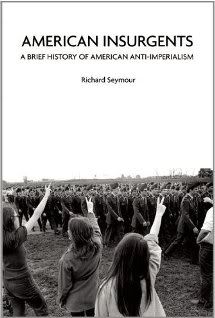
American Insurgents reviewed posted by Richard Seymour
Znet has what I think is the first review of American Insurgents:American Insurgents is a fantastic synthesis of a rich but often-neglected history. It offers inspiring stories of past US anti-imperialists as well as important advice for present-day organizers. At a time when the US government and ruling class remain committed to global domination and roguishly disdainful of international law and opinion, the book merits close attention from readers living in the belly of the imperial beast.
Labels: american anti-imperialism, american insurgents, anti-imperialism, liberalism, socialism, the complete and utter works of richard seymour, US imperialism
3:18:00 pm |
Permalink |
Comments thread |
|
Print |
Digg |
del.icio.us |
reddit |
StumbleUpon |
Tweet|
Share|
Wednesday, August 10, 2011
On Russia Today posted by Richard Seymour
Yours truly interviewed on Russia Today:Labels: austerity, metropolitan police, police shooting, racism, riots, the complete and utter works of richard seymour, tories, tottenham
9:17:00 pm |
Permalink |
Comments thread |
|
Print |
Digg |
del.icio.us |
reddit |
StumbleUpon |
Tweet|
Share|
On Democracy Now posted by Richard Seymour
You can have a look at myself and Darcus Howe talking about the London riots on today's Democracy Now - about 14 mins in, I think.Labels: darcus howe, democracy now, metropolitan police, police shooting, racism, riots, the complete and utter works of richard seymour, tottenham
3:29:00 pm |
Permalink |
Comments thread |
|
Print |
Digg |
del.icio.us |
reddit |
StumbleUpon |
Tweet|
Share|
Friday, July 01, 2011
Marxism 2011 posted by Richard Seymour
Please note that Marxism 2011 has started. Last night's opening rally with Kemal Abu Aita of the Egyptian Tax Collectors' Union was reportedly electric. Don't forget my meeting, which is on Monday: 'David Cameron & the “big society”, Gustave Tuck, 10-11.15am. Look, here's a map:
Bring money.
Labels: anticapitalism, class struggle, events, marxism 2011, socialism, the complete and utter works of richard seymour, the meaning of david cameron
12:55:00 pm |
Permalink |
Comments thread |
|
Print |
Digg |
del.icio.us |
reddit |
StumbleUpon |
Tweet|
Share|
Tuesday, June 28, 2011
The Tories: An Anatomy posted by Richard Seymour
Myself in the ISJ on the Tories, and their dirty little tricks:After 13 years of exile the Conservative Party has returned to office, but weaker than ever and dependent on a coalition with the Liberals. Amid a global crisis, with a weak incumbent and against a widely disliked government, the Tories only managed to add 3 percentage points to their 2005 share of the vote, bringing them up to 36 percent. This took place amid the ongoing boycott of elections by millions of disappointed Labour voters. As Ed Miliband has acknowledged, most of the five million voters lost by Labour between 1997 and 2010 didn’t switch to other parties, but stayed at home. Still the Tories, under a “modernising” leadership which styled itself as socially liberal and distanced itself from the Thatcherite past, barely exceeded a third of the vote. What explains the Tories’ weakness?
Part of the answer, perhaps, is that the Tories “turned nasty” again following the 2008 recession, talking spending cuts and targeting welfare recipients in their election propaganda. But this raises further questions. Why did it take the Tories so long to adapt to the new terrain, adopt a “moderate” leadership and attempt to carve out a conservatism occupying much the same ground as New Labour had staked out since 1994? And why would it squander the fruits of this effort, which had seen the Tories restored to over 40 percent of popular support in polls for the first time since the early 1990s? Why are they determined now, governing with weak legitimacy, to impose widely unpopular policies such as privatisation in healthcare and tuition fee rises, which hurt parts of their electoral base? The answers must be sought in the Tories’ relationship to capitalism, its crisis, and their long-term decline...
Labels: conservatism, eurocommunists, isj, neoliberalism, socialism, thatcherism, the complete and utter works of richard seymour, the meaning of david cameron, tories
8:11:00 pm |
Permalink |
Comments thread |
|
Print |
Digg |
del.icio.us |
reddit |
StumbleUpon |
Tweet|
Share|
Thursday, April 21, 2011
Marxism 2011 posted by Richard Seymour
This year's Marxism is coming up, and you should probably book your tickets soon. Highlights include speakers from Egypt and Tunisia, discussions on Libya (one featuring the families of Lockerbie victims, who I believe will debunk the idea that Libya was the perpetrator), discussions of resistance to austerity featuring union leaders such as Len McCluskey, Mark Serwotka, Billy Hayes and Matt Wrack, arguments on the student movement from Mark Bergfeld, Jody Macintyre and Laurie Penny, Alberto Toscano on universities, Ilan Pappe and Ghada Karmi on Palestine, Paul Gilroy on race and racism, and - as ever - 'many more'. I will be speaking on David Cameron and the 'big society' on Monday 4th July at 10am, and I expect you to fill out the meeting hall. I don't care what your excuse is, work, injury, won the lottery, live half way round the world, whatever, just get in there.
I will also be appearing at Marxisme 2011 in Amsterdam, discussing 'humanitarian intervention'. This will take place over the weekend of 21st and 22nd May, so I'll let you know the exact day and time when I have the details. Turn it into a holiday, why not?
I will also be appearing at Marxisme 2011 in Amsterdam, discussing 'humanitarian intervention'. This will take place over the weekend of 21st and 22nd May, so I'll let you know the exact day and time when I have the details. Turn it into a holiday, why not?
Labels: austerity, events, marxism, marxism 2011, middle east, revolution, socialism, students, the complete and utter works of richard seymour, the meaning of david cameron, trade unions
2:30:00 pm |
Permalink |
Comments thread |
|
Print |
Digg |
del.icio.us |
reddit |
StumbleUpon |
Tweet|
Share|
Friday, March 25, 2011
The Liberal Defence of Murder posted by Richard Seymour
A friendly reminder from Verso:THE LIBERAL DEFENCE OF MURDER
By RICHARD SEYMOUR
Published October 2008
-----------------------------
“Imperialist intervention, strenghtening the former regime elements and the most retrograde components of the revolt, was the worst thing to have happened to the Libyan revolution.”
As British and American planes begin bombing another Arab country, now is the time to revisit THE LIBERAL DEFENCE OF MURDER, Richard Seymour’s searing critique of the doctrine of ‘liberal interventionism’.
Richard Seymour blogs at Lenin’s Tomb - http://leninology.blogspot.com/.. You can read his blog posts on Libya there. See also this recent piece on the GUARDIAN website:
http://www.guardian.co.uk/commentisfree/2011/mar/22/gaddafi-demonology-media
------------------------------
In THE LIBERAL DEFENCE OF MURDER, Richard Seymour takes apart the mechanisms employed by liberals to justify the violence of this past decade, and shows us how appeals to the public to support war for ‘humanitarian’ reasons can often result in disastrous consequences.
Seymour examines the arguments of a range of left and liberal commentators, from Christopher Hitchens and Nick Cohen to Susan Sontag and Thomas Friedman, and provides a powerful indictment of their support for the Iraq war. He charts how such commentators represented American military power as an ally of progress rather than its enemy and were instrumental in mobilising public support for a misguided and illegal war.
Seymour also tackles the arguments of the ‘pro-war Left’ and demonstrates how they readily equated radical Islam with totalitarianism and refused to acknowledge the broader, and more complex, geopolitical climate that surrounded the attacks of 9/11.
Tracing colonial exploits in the nineteenth century and war mongering in the twentieth and twenty-first, Seymour shows how liberalism, a doctrine that appears to emphasise human equality and universalism, has often been implicated in violent systems of domination and exploitation.
Seymourexcavates the origins of liberal apologies for empire and tracks their development over three centuries, on both sides of the Atlantic, thereby providing an essential account of the many wars that have come to define the contemporary political landscape.
-------------------------------
Praise for THE LIBERAL DEFENCE OF MURDER:
“A great deal of damning material on the apologists of recent illegalities” Philippe Sands, GUARDIAN
http://www.guardian.co.uk/books/2009/feb/21/richard-seymour-liberal-defence-review
“A powerful counter-blast against the monstrous regiment of ‘useful idiots’” THE TIMES
“A powerful critique of ‘humanitarian intervention’ and of those liberal intellectuals who support it.” INDEPENDENT
http://www.independent.co.uk/arts-entertainment/books/reviews/the-liberal-defence-of-murder-by-richard-seymour-1649105.html
“An excellent antidote to the propagandists of the crisis of our times.” INDEPENDENT ON SUNDAY
http://www.independent.co.uk/arts-entertainment/books/reviews/the-liberal-defence-of-murder-by-richard-seymour-1488515.html
“Essential reading” Owen Hatherley, NEW STATESMAN
http://www.newstatesman.com/books/2008/12/liberal-defence-seymour-murder
“Among those who share responsibility for the carnage and chaos in the Gulf are the useful idiots who gave the war intellectual cover and attempted to lend it a liberal imprimatur. The more belligerent they sounded the more bankrupt they became; the more strident their voice the more craven their position. As the war they have supported degrades into a murderous mess, Richard Seymour expertly traces their descent from humanitarian intervention to blatant islamophobia.” – Gary Younge
“Indispensable ... Seymour brilliantly uncovers the pre-history and modern reality of the so-called 'pro-war Left.'” – China Mieville
------------------------------
Richard Seymour runs the popular Lenin’s Tomb blog, which comments on the War on Terror, Islamophobia and neoliberalism and has developed a cult following since it was founded in 2001. He also writes for other publications, including THE GUARDIAN. He is the author of several books, including THE LIBERAL DEFENCE OF MURDER and THE MEANING OF DAVID CAMERON.
Labels: books, the complete and utter works of richard seymour, the liberal defence of murder, the meaning of david cameron
11:56:00 pm |
Permalink |
Comments thread |
|
Print |
Digg |
del.icio.us |
reddit |
StumbleUpon |
Tweet|
Share|
Sunday, March 20, 2011
The Return of the Public posted by Richard Seymour
While I'm posting talks, I see that my discussion with Dan Hind at the Cafe Oto in Hackney last month has been broadcast as an audio file by Resonance FM. You can listen here (via NLP).Labels: capitalism, events, media, neoliberalism, public sphere, socialism, the complete and utter works of richard seymour
12:05:00 am |
Permalink |
Comments thread |
|
Print |
Digg |
del.icio.us |
reddit |
StumbleUpon |
Tweet|
Share|
Saturday, March 19, 2011
Towards a new model commune posted by Richard Seymour
I was asked to post this online, so here it is:Towards a New Model Commune
talk at ICA 19.03.11
(25 minutes in, if you want to watch).
What are we fighting for? I think we're fighting for self-government. I think all of our efforts so far have been a way of saying that we should be collectively in charge of our own lives. I think, whether we conceive it in this way or not, this means trying to move beyond the public; not so much new publics, but post-public. This is not just because notions of publicity are gendered and historically elitist - and by the way, Dan Hind's recent book 'The Return of the Public' is an excellent account of this - but because the public-private dichotomy is part of the means by which we are maintained as dependents. As public citizens we exercise a franchise, but in the private sphere we accept bondage: the discipline of the market compels us to accept it. For most of our waking hours, we cede executive control over our bodily and mental powers to someone else – in the vain hope of one day retiring with a decent pension. Whoops, that’s gone. You’ll just have to save more. But you’ll have to borrow more, because the economy needs you to spend. And we find that in all but the most mundane matters, when it comes to the activities and processes that constitute the major part of our lives, we have no autonomy. We do not govern ourselves.
Even our free time is not really ours. Much of it is spent commuting for a start - the average person's commute is equivalent to four weeks out of a working year. Four weeks - on that tube, that bus, that motorway lane. Think about what that's costing you psychically. Much of the rest is spent recuperating, essentially recovering our ability to labour so that we can go into work and do it all again the next day. And don't forget, of course, that even your free time isn't necessarily your own, because companies now want to organise your fun. Dress-down Friday - because Friday is funday; birthday parties, and office drinks, team-building outings, sporting days. Your fun, your enjoyment, your affection, often your time - on their orders. Awkward socialisation with middle and senior managers, stressful, moronic conversations, and long-winded explanations of what goes on in different departments that you didn't ask for, and you don't need. Then there's voluntary, unpaid overtime, worth £29bn a year to the employers - that's called flexibility, and what a good sport you are for doing that.
No more do we govern ourselves in our home lives which all too often become tiny kingdoms, patriarchies in which, among other things, children are acculturated to being ruled by others, and in which the first springs of what I would call 'capitalist guilt' are lodged in place - capitalist guilt is that gut-wrenching anxiety you feel when you're late for work, even though you probably won't get in too much trouble for it; it's the sickly shame that ruins your day when you throw a sickie, and immediately, absurdly start to think "should I go in anyway?" I'm just clarifying my terms.
So, we must be alert to the ways in which, when something beautiful starts to happen, people begin to declare their independence. They begin to run their own lives, to take their rightful part in the running of the whole of society. They exercise their due franchise fully, in every sphere of life. I will not exhaust you with utopian blueprints or detailed analysis of the Paris Commune, or the Russian Revolution, though these repay analysis. But look at the history. In almost every revolution, there are workers' committees, cordones, shurahs, soviets, popular councils, cooperatives, collectives, syndicates of some kind, some attempt to work out the protocols for self-government. Even in protest movements and rebellions short of outright revolution, people always confront the problem of how they organise themselves properly, democratically; sometimes that has to confront issues of oppression, sexual, gendered or racial oppression that can operate within movements; sometimes it just has to do with developing procedures that genuinely include everyone, avoiding majoritarian tyrannies (this is why in the students' occupations, we've seen experimentation with things like consensus decision-making); in striving toward self-goverment, toward the commune in other words, we always encounter unanticipated levels of complexity, but the basic problem remains one of self-government.
So, I want to look at the materials that are available to us to flesh out a 'new model commune', and it seems to me that the best starting point is to look at the tendencies immanent in recent struggles in the Middle East. Here, for example, are some of the features of the revolutionary movement that overthrew Mubarak, and even now is still fermenting in Egypt. First of all, they took over a nominally public space which the state wished to exclude them from access to, Tahrir Square. Having taken it over, and affirmed that they wouldn't simply go home at the end of the day - something we might want to think about - they saw off wave after wave of assault on the protests, from police and plain clothes thugs. They set up committees to keep watch for government men. They set up barricades, and routine ID checks for everyone attempting to enter the square. They set up a network of tents for people to sleep in - it's freezing overnight, so some of them jog round the square to get their temperature up. There are toilet arrangements - no small logistical matter when there are routinely hundreds of thousands of people occupying the capital's main intersection. They rig up street lamps to provide electricity. They set up garbage collection, medical stops - they occupy a well-known fast food outlet and turn it into somewhere that people shot at or beaten by police can get treated.
They set up a city within a city, and collectively coped with many more challenges than the average city would have to face in an average day. There was of course commerce, people hawking food and cigarettes, confident that the whole system of exchange wasn't being overthrown. Yet, far more of their actions were driven by solidarity, collective decision-making, and democratic delegation, than is ever usual for a city. Tahrir Square was the beginnings of a commune. Beyond that spectacular exercise in the capital, the labour movement that had been kicking since the 2006 strikes in Mahalla, was doing something that labour movement's usually don't do. It was starting to strike to demand a change in management. It was striking over the exercise of authority. This had happened in Tunisia, and usually it was because the CEO was some ruling party stooge. But it was the people who normally have no say in the running of the company - and Egypt's private sector economy is overwhelmingly informal, and insecure - seeking to exercise a sort of limited franchise. They did not seek to replace the management of the company with themselves, which would have been the ultimate statement of their confidence in their ability to rule themselves. But they were trying to have a say, and usually succeeded in that. And when the government withdrew the police from local communities and encouraged looting and thuggish behaviour, the people - instead of panicking, and deciding that we can't do without the police after all, please send the uniformed thugs back in Mr Mubarak - organised self-defence committees. Just as in Tahrir, they set up checkpoints, ID checks, and they made decisions about how their community would be run.
Now, this isn't socialism. Socialists were a current in the revolution, but not a big one. The major currents were Nasserists, Islamists, and liberals. And there are all sorts of political struggles that still have to continue - the horrible attacks on women in Tahrir Square on international womens' day shows that this fight has to occur within the revolution. And there's now the prospect that the army leadership will seek to consolidate a conservative ruling bloc with the assistance of the Muslim Brothers, who were an invaluable part of the revolutionary coalition but always the most right-wing element of it. While many Brothers will have been shaken up, radicalised and blasted with ecstasy by this revolution, their core base of small businessmen are probably anxious to get back to making money, and leave the commune behind. Still, the utopian moment of Tahrir Square and beyond showed us some of the lineaments of what a commune might look like. It demonstrated that with opportunity comes competence: that we can, if given the chance, quickly learn and apply the techniques of cooperation, solidarity and self-government.
Lately, our Party of Order - the Tories, the right-wing media, the police, the agents of authority and control - has been most vexed about the challenge posed by the mob, the student protesters. Cameron denounces them as 'feral', and the ideological frame that the media sought to apply, of selfish, solipsistic vandals disrespecting democracy, was ultimately supplied by one totemic incident, that of a fire extinguisher being lobbed from the top of Conservative Party headquarters. This 'mob', they said, clearly doesn't respect democracy. But democracy is not law and order. Democracy is the mob; the mob is democracy.
Democracy is supposed to mean popular sovereignty, not the unimpeded rule of a no-mandate government. It is supposed to mean that the will of the majority governs, not the interests of the rich. It is supposed to mean at minimum that people get the policies they vote for, not those they are overwhelmingly hostile to. In liberal democratic theory, the people are sovereign inasmuch as their aspirations and prerogatives are effectively mediated through a pluralist party-political state. They may not get all that they want all of the time, but the decision-making process will be guided by the public mood, which rival parties must compete to capture and express. Yet this system has only ever been effective to the limited extent that it has been when it has been supplemented by militant extra-parliamentary pressure, by the threat of disruption to stable governance and profit-accumulation. To the extent that the parliamentary system is ever really democratic, it is parasitic on a much more fundamental popular democracy. This reality, be it ever remembered, should exhort us to go further than we have, to turn our mobs into committees, shuras, soviets, communes. Let us, in future struggles, pose in practise the material possibility of our self-government.
It is, of course, a long-standing ruling class prejudice that we cannot govern ourselves. Trotsky once said, perhaps incautiously, that the Russian revolution was a gamble on the idea that ordinary working class people could rule themselves, and against the filthy aristocratic prejudice that they could not. His recent biographer, Robert Service, aligns with the Party of Order, insisting that Trotsky was foolish ever to have believed such a stupid thing. No surprises there. Trotsky, and the movements he inspired, hated the Stalinist regime for its savage despotism, the complete lack of genuine autonomy enjoyed by the mass of people. What the Party of Order hate about communism, however, is not what went catastrophically wrong with it, but what is right about it, what is admirable, just, plausible and emulable about it. It is the same thing that they hate about us - and we should welcome their hate, and their natural fear. It shows that their right to govern is no longer assured.
talk at ICA 19.03.11
Watch live streaming video from icalondon at livestream.com
(25 minutes in, if you want to watch).
What are we fighting for? I think we're fighting for self-government. I think all of our efforts so far have been a way of saying that we should be collectively in charge of our own lives. I think, whether we conceive it in this way or not, this means trying to move beyond the public; not so much new publics, but post-public. This is not just because notions of publicity are gendered and historically elitist - and by the way, Dan Hind's recent book 'The Return of the Public' is an excellent account of this - but because the public-private dichotomy is part of the means by which we are maintained as dependents. As public citizens we exercise a franchise, but in the private sphere we accept bondage: the discipline of the market compels us to accept it. For most of our waking hours, we cede executive control over our bodily and mental powers to someone else – in the vain hope of one day retiring with a decent pension. Whoops, that’s gone. You’ll just have to save more. But you’ll have to borrow more, because the economy needs you to spend. And we find that in all but the most mundane matters, when it comes to the activities and processes that constitute the major part of our lives, we have no autonomy. We do not govern ourselves.
Even our free time is not really ours. Much of it is spent commuting for a start - the average person's commute is equivalent to four weeks out of a working year. Four weeks - on that tube, that bus, that motorway lane. Think about what that's costing you psychically. Much of the rest is spent recuperating, essentially recovering our ability to labour so that we can go into work and do it all again the next day. And don't forget, of course, that even your free time isn't necessarily your own, because companies now want to organise your fun. Dress-down Friday - because Friday is funday; birthday parties, and office drinks, team-building outings, sporting days. Your fun, your enjoyment, your affection, often your time - on their orders. Awkward socialisation with middle and senior managers, stressful, moronic conversations, and long-winded explanations of what goes on in different departments that you didn't ask for, and you don't need. Then there's voluntary, unpaid overtime, worth £29bn a year to the employers - that's called flexibility, and what a good sport you are for doing that.
No more do we govern ourselves in our home lives which all too often become tiny kingdoms, patriarchies in which, among other things, children are acculturated to being ruled by others, and in which the first springs of what I would call 'capitalist guilt' are lodged in place - capitalist guilt is that gut-wrenching anxiety you feel when you're late for work, even though you probably won't get in too much trouble for it; it's the sickly shame that ruins your day when you throw a sickie, and immediately, absurdly start to think "should I go in anyway?" I'm just clarifying my terms.
So, we must be alert to the ways in which, when something beautiful starts to happen, people begin to declare their independence. They begin to run their own lives, to take their rightful part in the running of the whole of society. They exercise their due franchise fully, in every sphere of life. I will not exhaust you with utopian blueprints or detailed analysis of the Paris Commune, or the Russian Revolution, though these repay analysis. But look at the history. In almost every revolution, there are workers' committees, cordones, shurahs, soviets, popular councils, cooperatives, collectives, syndicates of some kind, some attempt to work out the protocols for self-government. Even in protest movements and rebellions short of outright revolution, people always confront the problem of how they organise themselves properly, democratically; sometimes that has to confront issues of oppression, sexual, gendered or racial oppression that can operate within movements; sometimes it just has to do with developing procedures that genuinely include everyone, avoiding majoritarian tyrannies (this is why in the students' occupations, we've seen experimentation with things like consensus decision-making); in striving toward self-goverment, toward the commune in other words, we always encounter unanticipated levels of complexity, but the basic problem remains one of self-government.
So, I want to look at the materials that are available to us to flesh out a 'new model commune', and it seems to me that the best starting point is to look at the tendencies immanent in recent struggles in the Middle East. Here, for example, are some of the features of the revolutionary movement that overthrew Mubarak, and even now is still fermenting in Egypt. First of all, they took over a nominally public space which the state wished to exclude them from access to, Tahrir Square. Having taken it over, and affirmed that they wouldn't simply go home at the end of the day - something we might want to think about - they saw off wave after wave of assault on the protests, from police and plain clothes thugs. They set up committees to keep watch for government men. They set up barricades, and routine ID checks for everyone attempting to enter the square. They set up a network of tents for people to sleep in - it's freezing overnight, so some of them jog round the square to get their temperature up. There are toilet arrangements - no small logistical matter when there are routinely hundreds of thousands of people occupying the capital's main intersection. They rig up street lamps to provide electricity. They set up garbage collection, medical stops - they occupy a well-known fast food outlet and turn it into somewhere that people shot at or beaten by police can get treated.
They set up a city within a city, and collectively coped with many more challenges than the average city would have to face in an average day. There was of course commerce, people hawking food and cigarettes, confident that the whole system of exchange wasn't being overthrown. Yet, far more of their actions were driven by solidarity, collective decision-making, and democratic delegation, than is ever usual for a city. Tahrir Square was the beginnings of a commune. Beyond that spectacular exercise in the capital, the labour movement that had been kicking since the 2006 strikes in Mahalla, was doing something that labour movement's usually don't do. It was starting to strike to demand a change in management. It was striking over the exercise of authority. This had happened in Tunisia, and usually it was because the CEO was some ruling party stooge. But it was the people who normally have no say in the running of the company - and Egypt's private sector economy is overwhelmingly informal, and insecure - seeking to exercise a sort of limited franchise. They did not seek to replace the management of the company with themselves, which would have been the ultimate statement of their confidence in their ability to rule themselves. But they were trying to have a say, and usually succeeded in that. And when the government withdrew the police from local communities and encouraged looting and thuggish behaviour, the people - instead of panicking, and deciding that we can't do without the police after all, please send the uniformed thugs back in Mr Mubarak - organised self-defence committees. Just as in Tahrir, they set up checkpoints, ID checks, and they made decisions about how their community would be run.
Now, this isn't socialism. Socialists were a current in the revolution, but not a big one. The major currents were Nasserists, Islamists, and liberals. And there are all sorts of political struggles that still have to continue - the horrible attacks on women in Tahrir Square on international womens' day shows that this fight has to occur within the revolution. And there's now the prospect that the army leadership will seek to consolidate a conservative ruling bloc with the assistance of the Muslim Brothers, who were an invaluable part of the revolutionary coalition but always the most right-wing element of it. While many Brothers will have been shaken up, radicalised and blasted with ecstasy by this revolution, their core base of small businessmen are probably anxious to get back to making money, and leave the commune behind. Still, the utopian moment of Tahrir Square and beyond showed us some of the lineaments of what a commune might look like. It demonstrated that with opportunity comes competence: that we can, if given the chance, quickly learn and apply the techniques of cooperation, solidarity and self-government.
Lately, our Party of Order - the Tories, the right-wing media, the police, the agents of authority and control - has been most vexed about the challenge posed by the mob, the student protesters. Cameron denounces them as 'feral', and the ideological frame that the media sought to apply, of selfish, solipsistic vandals disrespecting democracy, was ultimately supplied by one totemic incident, that of a fire extinguisher being lobbed from the top of Conservative Party headquarters. This 'mob', they said, clearly doesn't respect democracy. But democracy is not law and order. Democracy is the mob; the mob is democracy.
Democracy is supposed to mean popular sovereignty, not the unimpeded rule of a no-mandate government. It is supposed to mean that the will of the majority governs, not the interests of the rich. It is supposed to mean at minimum that people get the policies they vote for, not those they are overwhelmingly hostile to. In liberal democratic theory, the people are sovereign inasmuch as their aspirations and prerogatives are effectively mediated through a pluralist party-political state. They may not get all that they want all of the time, but the decision-making process will be guided by the public mood, which rival parties must compete to capture and express. Yet this system has only ever been effective to the limited extent that it has been when it has been supplemented by militant extra-parliamentary pressure, by the threat of disruption to stable governance and profit-accumulation. To the extent that the parliamentary system is ever really democratic, it is parasitic on a much more fundamental popular democracy. This reality, be it ever remembered, should exhort us to go further than we have, to turn our mobs into committees, shuras, soviets, communes. Let us, in future struggles, pose in practise the material possibility of our self-government.
It is, of course, a long-standing ruling class prejudice that we cannot govern ourselves. Trotsky once said, perhaps incautiously, that the Russian revolution was a gamble on the idea that ordinary working class people could rule themselves, and against the filthy aristocratic prejudice that they could not. His recent biographer, Robert Service, aligns with the Party of Order, insisting that Trotsky was foolish ever to have believed such a stupid thing. No surprises there. Trotsky, and the movements he inspired, hated the Stalinist regime for its savage despotism, the complete lack of genuine autonomy enjoyed by the mass of people. What the Party of Order hate about communism, however, is not what went catastrophically wrong with it, but what is right about it, what is admirable, just, plausible and emulable about it. It is the same thing that they hate about us - and we should welcome their hate, and their natural fear. It shows that their right to govern is no longer assured.
Labels: communism, events, marxism, revolution, socialism, the complete and utter works of richard seymour
6:13:00 pm |
Permalink |
Comments thread |
|
Print |
Digg |
del.icio.us |
reddit |
StumbleUpon |
Tweet|
Share|
ICA event today. posted by Richard Seymour
I'll be speaking at this today:Radical Publishing: What Are We Struggling For?
19 March 2011£12 / £11 concessions / £10 ICA Members / £5 students and ICA Members under 26 (call box office to book)
Last year’s student protests saw a new generation take to the streets. Much was made of the vandalism and disruption that occurred, with some arguing it eclipsed the protests’ intentions—but were the students’ demands ever clearly articulated? Did the protestors know what they were struggling for? From pamphlets and theses to journals and zines—the relationship between protest and print goes back a long way and has helped galvanise and articulate dissent, but do radical publishers and radical thinkers still matter today and how do they relate to contemporary protest?
For one day, the ICA will host some of the UK’s most exciting radical thinkers, published by British radical publishers such as Verso, Zed Books, Zero Books, Pluto Press and AK Press, to grapple with these issues and more.
The event runs from 12–5pm.
Schedule
12–1pm, Tactics of Struggle: with John Holloway and David Graeber
1–2pm, New Public: with Peter Hallward, Hilary Wainwright and Richard Seymour
2–3pm, Break
3–4pm, New Psychic Landscapes: with Franco Berardi ‘Bifo’, Mark Fisher and Saul Newman
4–5pm, New Economics: with Andrew Simms, Milford Bateman and Ann Pettifor
Labels: communism, events, revolution, socialism, the complete and utter works of richard seymour
8:44:00 am |
Permalink |
Comments thread |
|
Print |
Digg |
del.icio.us |
reddit |
StumbleUpon |
Tweet|
Share|
Tuesday, March 15, 2011
Education Activist Network teach-in posted by Richard Seymour
I'll be speaking at this tomorrow:Education Activist Network - Teach-in for the resistance
On Wednesday 16 March 4-8pm, the EAN will have a teach- in at King’s College London and London School of Economics.
After the increase in tuition fees and abolition of EMA, a mass demonstration on 26 March could reinvigorate the fight for education – as could a lecturers’ strike, and protests and student action on Budget Day. But our movement also faces new challenges.
Universities have accepted blood money from dictators and invested heavily in the arms trade. Multiculturalism is under attack by those who would divide and undermine our movement, and students have been the target of horse charges, dawn raids, pepper spray and kettling for daring to protest for education.
Join students, education workers, academics, journalists and campaigners to debate the challenges facing our movement and the strategies to overcome them.
4pm – The fight for Education – Learning from Wisconsin – LSE SU Underground
Live video link-up with student and teacher from Wisconsin. Doors open 3:30pm
5pm Workshops
■Defending the Right to Protest (KCL)
Hosted by Stop Kettling Our Kids and Defend the Right to Protest – includes Alfie Meadows, arrested student Bryan Simpson, campaigning lawyer Matt Foot and Emma Norton from Liberty
■The role of social media in the movement (KCL)
Panel debate with Laurie Penny (journalist), Richard Seymour (blogger) and Aaron Peters (UK Uncut)
■Defending Multiculturalism (KCL)
Don’t let David Cameron divide us! With Liz Fekete, Institute for Race Relations and Martin Smith, Love Music Hate Racism
■Sleaze, Spooks and Saif Gaddafi: Can we make our universities ethical? (LSE SU Underground)
With LSE occupier Lukas Slothuus, journalist Simon Basketter and Hesham Zakai from KCL Action Palestine
6:30pm Rally – KCL Lucas Theatre
March 26th – Building for our Day of Anger
With:
■Billy Hayes CWU General Secretary
■Fightback author Guy Aitchinson
■Egyptian revolution eyewitness Wassim Wagdy
■Lois Clifton LSESU Environment & Ethics officer-elect
■Jim Wolfreys King’s College London UCU
■Krishna Sivakumaran, UCL student, Day X for the NHS
■Mark Bergfeld NUS NEC.
Labels: capitalism, cuts, education, events, neoliberalism, public spending, social media, socialism, socialism 2.0, the complete and utter works of richard seymour, tories
12:34:00 pm |
Permalink |
Comments thread |
|
Print |
Digg |
del.icio.us |
reddit |
StumbleUpon |
Tweet|
Share|
Friday, March 11, 2011
The Lenin's Tomb appeal posted by Richard Seymour
Dear readers. I would like, if I may, to button-hole you. Like a 'charity mugger' but without the put-on charm and breezy, outgoing demeanour. Or like an alcoholic evangelist without the sartorial elegance. I am currently in the business of writing my third book (you'll have to wait for the details). When that is done, I intend to write a fourth book, distributed as an ebook via this site - essentially, you'll be able to download it for free then pay what you like for it, if anything at all. Then there'll probably be a collaborative effort. In the meantime, I'll be working full-time on my PhD. And of course I'll be doing innumerable talks and events, two of which are coming up next week. Now, this is where it gets tricky. As a full-time student, I can neither work full-time nor claim any benefit. I must depend to some extent on what funding I may win from the Department, in which regard I have reason to be grateful this year. Yet, still here I am, still balling, and still broke. So, I'm throwing caution, pride and clothing to the wind, and launching an appeal. I'm not setting a target with one of those 'thermometer'-style meters advising readers how generous or mean they're being. I wouldn't embarrass you like that. But, just on the down-low, if you do happen to have a spare fiver, know how to use Paypal and know what's good for you, I will consider it a magnanimous gesture on your part if you'd subsidise my labour on this, your favourite political blog. If it helps, remember all the good times you've had here. Remember when I banned Christmas. Remember when I banned you all. Remember when I deleted your comment, assuming you were a troll when you only wanted to start a debate. Remember when I used to swear a lot more than I do now. Remember when I used to blog drunk on a Friday night. And, suitably intoxicated with nostalgia, give.
Labels: appeal, comments, lenin's tomb, lenin's tomb bans christmas, money, the complete and utter works of richard seymour
10:44:00 pm |
Permalink |
Comments thread |
|
Print |
Digg |
del.icio.us |
reddit |
StumbleUpon |
Tweet|
Share|
Tuesday, March 01, 2011
Capitalism and Class posted by Richard Seymour
I'll be speaking on this subject at the 6 Billion Ways event, a gathering supported by Friends of the Earth, War on Want, World Development Movement, Red Pepper, and People & Planet, this Saturday:Labels: capitalism, class struggle, events, middle class, profits, ruling class, the complete and utter works of richard seymour, the rate of exploitation, working class
10:26:00 pm |
Permalink |
Comments thread |
|
Print |
Digg |
del.icio.us |
reddit |
StumbleUpon |
Tweet|
Share|
Friday, February 25, 2011
The great £29bn rip-off posted by Richard Seymour
Me in The Guardian on the subject of unpaid overtime and the absolute increase in the rate of exploitation in Britain:You're being exploited in more ways than you know. The TUC reports, not for the first time and surely not for the last, on a form of exploitation that rarely gets attention in the media. Workers are contributing £29bn worth of free labour to British employers every year simply by working unpaid overtime. This surplus is being squeezed out of workers through market discipline – the threat of unemployment or reduced prospects.
Labels: capitalism, class struggle, exploitation, rate of profit, the complete and utter works of richard seymour, the rate of exploitation, working class
6:41:00 pm |
Permalink |
Comments thread |
|
Print |
Digg |
del.icio.us |
reddit |
StumbleUpon |
Tweet|
Share|
Monday, January 03, 2011
Less than mutual posted by Richard Seymour
This is just a quick note to acknowledge and give kudos to those who took up the debate about mutualism on Twitter, Facebook and the blogs, and to UK Uncut and Aaron Peters who listened. The event celebrating John Lewis and mutualism has been cancelled. Yes, I am very happy about it. And to Aaron, who I'm sorry to say I actually provoked into threatening to "knock him out when i meet him", I'm sorry for suggesting that you were a Blairite running dog. It was only a joke.Labels: austerity, capitalism, cuts, democracy, john lewis, mutualism, neoliberalism, privatisation, protest, royal mail, the complete and utter works of richard seymour, tories, uk uncut
10:33:00 am |
Permalink |
Comments thread |
|
Print |
Digg |
del.icio.us |
reddit |
StumbleUpon |
Tweet|
Share|
Sunday, December 12, 2010
Stop the presses… for good. posted by Richard Seymour
So, how come none of you saw fit to tell me that LT was the subject of a totally oppressive and outrageous capitalist attack by the sexist Gentleman’s Quarterly? Am I to take it that none of you read this piece of shit?

It says my impact is “low”, eh? Right. So they wouldn’t mention that I am currently engaged in a life and death class struggle up and down the book charts with their Tory editor Dylan Jones? Bastards. And who is this ‘Max Dunbar’? Why does he keep showering me with attention? I just want to be left alone, dammit.
Labels: bloggers, bloggery, blogging, sexism, the complete and utter works of richard seymour, the meaning of david cameron, tories
1:13:00 pm |
Permalink |
Comments thread |
|
Print |
Digg |
del.icio.us |
reddit |
StumbleUpon |
Tweet|
Share|
Friday, November 12, 2010
Historical materialism posted by Richard Seymour
Don't forget that Historical Materialism is taking place today and over the weekend. I'll be speaking on Sunday at 2pm, on a panel about 'The Ideology of the 'Big Society''. I'll see if I can make my paper, 'Thoroughly Modern Tories? From 'One Nation' to 'The Big Society'', available as a hand-out or something.ps, some wallpaper:

Labels: big society, capitalism, historical materialism, marxism, neoliberalism, the complete and utter works of richard seymour, the meaning of david cameron, tories
1:11:00 pm |
Permalink |
Comments thread |
|
Print |
Digg |
del.icio.us |
reddit |
StumbleUpon |
Tweet|
Share|
Friday, November 05, 2010
Has Matt Wrack blown his winning edge? posted by Richard Seymour
The anonymous email received by James O'Brien of London's LBC radio station suggested a febrile atmosphere among the bods of what firefighters have come to call "Toad Hall" – an affectionate moniker for City Hall, in honour of fire authority chief Brian Coleman's insult to another assembly member last year. It said fire chiefs had concluded that they had to win the dispute before 5 November. They had instructed their PR company to "unleash the forces of hell" on firefighters.Labels: cif, fbu, firefighters, strikes, the complete and utter works of richard seymour
12:53:00 pm |
Permalink |
Comments thread |
|
Print |
Digg |
del.icio.us |
reddit |
StumbleUpon |
Tweet|
Share|
Wednesday, October 27, 2010
Historical materialism posted by Richard Seymour
Just a couple of things coming up. First of all, just to remind you, I will be speaking at Pages of Hackney on 3rd November, on the subject of 'The Meaning of David Cameron' and the spending cuts. You can RSVP on the Facebook event page if you like. If you're coming, please e-mail the event organisers and let them know: info[at]pagesofhackney[dot]co[dot]uk. They'd like to know how many are coming so they can make appropriate arrangements.Secondly, the annual Historical Materialism conference is coming up. I will be speaking at it on Sunday 14th November on the subject of "Thoroughly Modern Tories: From One Nation to the Big Society". Lastly and leastly, it's my birthday tomorrow - a chance for me to celebrate another year of occupying one third of a cubic metre of otherwise useless space. Indeed, I am presently available to occupy useless spaces all over the country, fee negotiable. Apply within.
Labels: events, historical materialism, marxism, socialism, the complete and utter works of richard seymour, the meaning of david cameron, tories
1:21:00 pm |
Permalink |
Comments thread |
|
Print |
Digg |
del.icio.us |
reddit |
StumbleUpon |
Tweet|
Share|