Thursday, May 24, 2012
Who are you calling a 'socialist'? posted by Richard Seymour
My latest in The Guardian:Nick Clegg, a "communist". Vince Cable, a "socialist". This is the euphonious sound of the Tory right on the warpath – and with every marble intact. Dismiss such invective as mere boilerplate if you will, but the increasing tendency to reach for the S word as a polemical armament against the most humble proposals for reform from pro-business centrists has a lineage, which it would be a mistake to miss.
Labels: anticommunism, liberals, nick clegg, obama, sad sack liberals, socialism, tea party, thatcherism, tories, working class
3:02:00 pm |
Permalink |
Comments thread |
|
Print |
Digg |
del.icio.us |
reddit |
StumbleUpon |
 Tweet|
Share|

Saturday, May 05, 2012
The anti- vote. posted by Richard Seymour
Labels: boris johnson, david cameron, elections, ken livingstone, liberals, london, mayor, nick clegg, tories
4:38:00 pm |
Permalink |
Comments thread |
|
Print |
Digg |
del.icio.us |
reddit |
StumbleUpon |
Tweet|
Share|
Sunday, May 15, 2011
How can the Left win? posted by Richard Seymour
Prior to 2008, the Tories could not have made this argument and anticipated making any headway with it. Instead, their strategy was to match Labour's spending totals and conduct a war of position over the priorities within that accepted framework. But in a sequence notably punctuated by the quasi-comical (underwhelming, on its own terms) parliamentary 'expenses' scandal, the Right engaged in a series of manouevres which blamed Labour 'over-spending' for the deficit - 'over-spending' which, until then, they were committed to continuing. And they were given credence by a majority of the British people for a period of time. There was something very Thatcherite in the manner in which the Right sought to mobilise a certain residual culture of masochism behind austerity - you have over-indulged and must now repent. They operated on a series of connotative linkages, eg, between household and state expenditure, in which the private fear that one has borrowed more than one can afford to pay back is bonded to the ideologeme which holds that the state is always inefficient, always over-spending, necessarily unproductive, and always in need of perpetual down-sizing. This is the petit-bourgeois manner of thinking, univeralised - the nation imagined as a corner shop that has to balance its books and keep an eye out for thieves. Of course, no recipient of state largesse is more inefficient, and less productive, than the 'benefit scroungers'. Tory propaganda duly worked on this theme, and Osborne swung the axe heavily in the direction of the welfare lifeline. Polls tended to find that people approved of this aspect of the cuts agenda.
II. The Left. Until the student protests, the Left was beset on all sides by a pervading dysphoria and utter perplexity. We know the script after all. The capitalist system goes into an unprecedented global crisis, every stable co-ordinate of the political-ideological universe is unsettled, governments start borrowing and spending like crazy to stave off a complete collapse, suddenly the bastardised Keynesianism of 'old Labour' is back in vogue. In such circumstances, the Right should be on the back-foot and class struggles should take off. And by 'class struggles', I don't simply mean strikes and factory occupations. It is in the nature of capitalism to multiply sites of antagonism, and in each of these class will be present in different ways, whether it's over healthcare, supermarket chains, women's oppression, immigrant labour, the media, or war. Notably, the struggles that did emerge, in Vestas, Visteon, the Lindsey oil workers dispute, the Tower Hamlets lecturers' strike, etc., cannot be reduced to simple labour-management disputes over jobs, pay and conditions. Rather, each contained a pronounced 'political' element - the environment, pensions, education, immigration, etc.
Given an organic crisis in capitalism, a crisis in productive relations that could not be localised, but necessarily radiated to every political and ideological relation embedded in the system, the Left should have been aggressively making advances on multiple fronts. The Left should have been taking territory and hostages, leaving opponents reeling. But this is not what happened, barring the few flare-ups which I mentioned. And the case of Lindsey, which resulted in thousands of workers marching for "foreigners out!", showed that such struggles as did take off did not have to benefit the Left. This is the point at which, traditionally, one warns against 'vulgar economism' and 'workerism', but this is only a real temptation among a few hold-outs of the Left influenced by traditional labourism - recall that Gramsci's critique of 'economism' was aimed at the reformist trade union leadership. The more prevalent error today is to think that Leftist politics can be conducted without any orientation toward class. Still, it's hard to see how the Left, even discounting for its currently depleted, scattered state, could have done much about the level of class struggle. It was forced into a positional struggle, an ideological battle, in which the 'common sense' of neoliberalism initially prevailed over the competing 'common sense' of social democracy.
III. The War of Position. While we anticipate major social struggles continuing over the next few years, with no certainty of avoiding catastrophe much less of attaining victory, the 'war of position' will continue to be as important as outright combat. Indeed, ideological, parliamentary and cultural struggles do a great deal to prepare the pre-conditions for more militant forms of combat such as the withdrawal of labour, factory and university occupations, and other disruptive actions. Here, the Right has long understood something that the Left will do well to remember. Whatever the plane of crisis, whatever the axis of struggle, the issue can always be put another way.
The crisis of capitalism became a crisis of over-spending, just as the crisis of poverty became a crisis of social dysfunction, and a crisis of authority in the British state became a crisis of 'multiculturalism'. The Right didn't win all the arguments in 2008-9 - far from it. If the washout of yesterday's right-wing 'Rally Against Debt' is any guide, and it was plugged in the media far more than it deserved to be, there is hardly any enthusiasm for the latest assault on welfare and public services. But the Right doesn't have to win all the arguments, or generate enthusiasm. Its near monopoly of the popular and broadsheet press, along with the complicity of the centre-left, allowed it to operate on genuinely popular assumptions, absorbe the elements of popular discontent and polarise them to the Right.
The majority do want to keep some sort of well-funded public sector, don't favour privatization in the NHS, support state education, and blame the bankers for the recession. But distrust of the state (for some good reasons - the Tories focused a lot of their fire on New Labour authoritarianism and centralisation) is also widespread, as is discontent with how money is spent (again, for some good reasons - think of the PFI boondoggles). Anti-immigrant sentiment is at an all-time high, disdain for beggars and benefit recipients is widespread, and support for redistributive politics after thirteen years of New Labour in office is now a minority pursuit. Meanwhile, local councils are often encountered as some of the most inept, obstinate, and coldly indifferent bureaucracies in the country. So, with a near Pravda-esque capitalist realism propagated through the state and capitalist media - and one is struck by how often it is still taken as 'obvious' that some cuts have to be made somewhere - it only remained for the Tories and their allies to furnish the popular imagination with endless examples of alleged 'waste', incompetence, and fraud. Local councils spending your money on Muslim-only toilets, benefit fraud, illegal immigration, 'health tourism', etc. But things don't have to be this way.
IV. Winning. Left-wing campaigns have focused on reminding people that they hate the rich, really resent them and their power and arrogance; that they don't trust the Tories; that they like having free healthcare and schools; that the despised bankers caused the crisis, and not ordinary people; that mass unemployment is a social ill for which they will suffer; that they're against the wars for which there is endless government money; and that if they think the state is inefficient, they have already tried the private capitalism of Enron, Worldcom and Lehman Brothers. Since it is normal for people to entertain conflicting ideas and ambitions, the aim is firstly to shift the weight of emphasis along the continuum away from reactionary resentment and toward popular and class-based anger. Secondly, it is to destabilise the austerity alliance by attacking their weak links, and shaking free some loose elements ripe for re-appropriation. For all that we repeat that the ruling coalition is a Thatcherite one, we also have to constantly bear in mind its historical specificity. It is an unstable government, binding Whigs, Peelites, and High Tories, Thatcherite mods and rockers, Europhiles and Atlanticists, social liberals and reactionaries, have-a-go-heroes and hoodie-huggers, finance capital, producers, the petite-bourgeoisie and the progressive middle class. Attacking the unity of this coalition and dispersing its constituents is a precondition for any meaningful advance. Thirdly, the aim is to re-articulate many of the same elements operated on by the right into a new majoritarian leftist political mobilisation.
UK Uncut is an interesting political intervention in this respect. It can never fulfil the latter two remits, but look at its contribution to the former. There's been an awful lot of focus on its method of organising, which may be facing a crisis as it comes under the steamroller of police repression, but far more important is what it has said, the way it has interceded in the ideological field, drawing attention to the underfunding of the state by the rich, the state's leniency toward the rich, and the fact that cuts are not inevitable or necessary but rather a class-loaded 'ideological' project. From a peevish, sectarian perspective, one could write it off as a sort of middle class 'people power' movement that will change sfa. But that would be to miss the point entirely. It already has changed what it set out to change: the field of signification. This advance is highly circumscribed, was not achieved by UK Uncut alone, and leaves much work to be accomplished by other forces - but it's still not to be sniffed at.
The second goal, of shattering the coalition, which the Tories depend on to impose their version of austerity, is not something that one could just assume would happen as a result of the 'contradictions' of the coalition. It is something that has to be worked on. The student protests rightly targeted Nick Clegg and the Lib Dems as much as the Tories, turning the renegade Liberal leader ("wolf-eyed replicant"...) into a national hate figure, running the Liberals down in the polls, and ultimately making it difficult for them even to show their faces in public. I cannot understand the approach of those who say that the Tories are the real enemy and that therefore the venom toward the Liberal leadership is a waste of good spleen. It's because the Tories are the 'real enemy' that they have to be isolated, and this coalition broken. As of now, the Tories still don't have enough support to win an election by themselves. They briefly commanded an electorally viable plurality in the period from 2007 to 2009, but have since 2010 been back to their normal range votes, tending to be somewhere between the low to mid-thirties - this despite the astonishing ineptitude of a Labour leadership that never misses an opportunity to miss an opportunity. Every time the Tories come out with some right-wing poison about immigration or 'integration', it places the coalition in danger. The harder they push for the deepest cuts, for privatization, the more the Liberal leadership has to placate its shrivelled 'social liberal' conscience. When the Tories hammered the disastrous AV campaign, it consistently put the Liberals on the back foot. Now they have nothing to show for their gambit, a sort of queen's sacrifice - bar the cuts, and the steadily accumulating ranks of knights, bishops and pawns on the Tories' side. The only rational thing for the Left to do in such circumstances is to keep hammering away, by every available means, until the coalition splits, or enough Liberals defect to trigger an early election.
The third goal, that of re-articulating the elements of popular discontent into a majoritarian leftist response to austerity, has proved more difficult. Let's not deny what has been achieved. The turnout for the big TUC rally was amazing, as deep as it was broad, truly representative of the British labour movement and its periphery - and what a powerful movement that could be if it decided to move all as one. There are real pressures for mass, coordinated strike action coming from below in every trade union. This hasn't turned into independent, rank and file initiative in most cases. Largely, the direction remains in the hands of the bureaucracy. But the pressure is there, and is contributing to the build-up for a mass strike on 30th June. But the attempt to build a national political campaign against cuts with similar social depth is taking time. Actually, there are several competing vehicles, and not one of them is adequate on its own; not one capable of extending beyond its party basis and periphery. While each broadly has the same analysis of the cuts, they all operate in different ways, relate to different constituencies, and address a different aspect of the same problem. Such parcellization almost guarantees that these vehicles will remain confined to the extant left, unable to harness wider forces. This isn't to play the sad old finger-wagging game of simply denouncing 'divisions on the Left', wryly referencing 'Life of Brian' for the boreteenth time, as if anyone is actually in favour of such divisions. Sometimes, these divisions are necessary, or have a legitimate basis, or are unavoidable; sometimes they aren't. There's no way, at any rate, to simply over-ride these. So, somehow, the different groups have to find the appropriate level at which they can engage in unified action, in order to coordinate publicity and solidarity campaigns, locally and nationally. One could envision, for example, a multiplicity of possible structures (more or less centralised, or federal, depending on the degree of agreement between the factions involved, and the degree of democracy each mode of organising permits) to which different campaign groups could agree to affiliate for a fee, and which would seek the funding and support of the trade unions, etc.. The alternative is to allow the political direction of the anti-cuts movement to be fixed somewhere between a Labour leadership that actually argues for (slower, less savage) cuts, and a trade union leadership some of whose big battalions have resigned themselves to doing the bare minimum to oppose cuts.
Of course, it isn't just about merging the vessels of the extant left into a single flotilla, at least not for its own sake. It is only worth doing if it increases the combined efficacy of the forces involved. But the point is to coordinate ideological and cultural counterpoints to the politics of austerity, which task seems to require a pooling of resources and combination of forces. As and when struggles emerge, unpredictably as they will, the aim is that they will not emerge in a socio-symbolic field cultivated exclusively by the Right, so that they merely appear as law and order problem, but in one where their actions are intelligible as logical and worthy responses to a widely apprehended injustice. This will be particularly important as, increasingly, we're forced to operate in the space between purely impotent civil society protest and illegal and potentially dangerous adventurism. The state hasn't been able to operate through cooptation and consent since the 1960s, and has thus tended increasingly toward the authoritarian end of the spectrum of rule. The criminalisation and suppression of protest, however peaceful and formally within the law, is consonant with that. The police will need to continually justify their mode of highly repressive policing without being seen as the armed wing of a particular government, which would be a threat to their legitimacy. Thus, they have to turn a growing number of protests into heavily fortified battlegrounds, with their opponents pre-designated as violent criminals. The propaganda battle is, of course, partly dependent on class struggles taking off. That is why some of the propaganda stunts are themselves miniature 'actions', forms of deliberate disruption. But even as they do, there can always be simultaneous work going on to reinforce the principles of articulation, the political logics by which diverse contestations are brought into a coherent whole. Opportunities for parliamentary mobilisation may come into this, although recent election results seem to have indicated that in most cases it's close to useless for left-of-Labour forces to stand their own candidates. But there will be other elections, where it is more plausible to stand: student and trade union bodies, local councils, etc. Certainly, legal battles will be important, as the recent G20 verdict demonstrates. Anti-fascist and anti-racist work will be important, as a desperate Tory party is apt to shore up support by attacking minorities. All of this can be done best if it is done with a constant focus on shifting the balance of common sense away from the neoliberal pole, and in the process transforming the contents of mainstream social democratic thinking in a leftist direction.
Labels: austerity, capitalism, class struggle, cuts, david cameron, hegemony, ideology, lib dems, liberals, nick clegg, socialism, tories, trade unions, war of position, working class
4:21:00 pm |
Permalink |
Comments thread |
|
Print |
Digg |
del.icio.us |
reddit |
StumbleUpon |
Tweet|
Share|
Friday, May 06, 2011
Ashdown: it's all about the cuts posted by Richard Seymour
I don't really have time to write anything substantial on the Liberal wipe-out, or the SNP's out-flanking of a very shabby Labour campaign in Scotland, but it's worth at least noticing this:Ashdown said: "The central proposition of this parliament stands: 'Is George Osborne's economic judgment right?' I believe it is. The whole of British politics now rests on that single proposition. The fortunes of the coalition, the fortunes of the two parties in the coalition and the fortunes of the Labour party rest on that."
This, following a colossal tantrum about the Tories' dishonesty in the No2AV campaign and hints that the coalition would be more of a 'business' arrangement from now on (by which we are to understand that previously it was a honeymoon?), boils it down nicely, wouldn't you say? It certainly explains why the Liberals will hang on through any loss, any humiliation, any ostensible betrayal. Their number one priority is not education, electoral reform, or tax justice. Their number one priority, Cable's fooling-noone histrionics to one side, is to protect and advance neoliberal capitalism through the most savage cuts agenda in living memory. That's all they're hanging in for now.
Labels: austerity, cuts, david cameron, elections, lib dems, liberals, local council elections, neoliberalism, nick clegg, tories, tuition fees, welfare
8:20:00 am |
Permalink |
Comments thread |
|
Print |
Digg |
del.icio.us |
reddit |
StumbleUpon |
Tweet|
Share|
Friday, March 04, 2011
Liberals crash and burn in Barnsley posted by Richard Seymour
- Dan Jarvis (Lab) 14,724 (60.8%)
- Jane Collins (UKIP) 2,953 (12.19%)
- James Hockney (C) 1,999 (8.25%)
- Enis Dalton (BNP) 1,463 (6.04%)
- Tony Devoy (Ind) 1,266 (5.23%)
- Dominic Carman (LD) 1,012 (4.18%)
- Kevin Riddiough (Eng Dem) 544
- Howling Laud Hope (Loony) 198
- Michael Val Davies (Ind) 60
This is a huge vote against austerity. The Liberals crashed from second to sixth place and lost their deposit - this in a seat where the Labour MP had been forced to resign due to his imminent imprisonment for fraud. Both the Liberals and the Tories saw their vote share slashed, from roughly 17% each in the general election. That is, the coalition parties saw their vote share cut by almost two thirds. The BNP vote is also down by three percentage points, though this can partly be attributed to the fact that UKIP more than doubled its vote share.
This means that not only is the electoral base of the Liberal component of the coalition shattering as working class voters rally to Labour as the only available parliamentary obstacle to the cuts, but the Tories' hard right base isn't dependable either. UKIP represents the defection of a racist, nationalist, Europhobic and hyperglobalising segment of the Conservative Party, based disproportionately on small businessmen, lone traders and the insecure newly affluent, initially concentrated in the suburbs and rural areas of south-east England. Its voters include many 'strategic defectors' from the Tories outside of general elections, middle class right-wingers who want to register their hostility to immigration and European integration without risking a Labour government if possible. However, the party has also assembled support from skilled workers in collapsing industrial areas, and its core support is demographically similar to that of the BNP, excepting that BNP voters tend to be a bit younger.
The Cameron-Clegg coalition was based on the existence of a large centre vote, as millions of voters looked for an 'honest broker' amid the crisis and after the dreadful New Labour years - but that centre ground is predictably collapsing. The austerity agenda is producing a rapid polarisation, with Labour consolidating its hegemony over the left vote (excepting in Scotland, where the SNP is consistently out-performing Labour as a rival reformist bloc based on soft left nationalism), while the right-wing fragments in multiple directions. With racism on the rise and about half of the electorate theoretically willing to consider voting for some kind of anti-immigrant party, the danger is of the most reactionary elements on the right using the support redistributed to them in order to polarise the agenda further to the right. The temptation for Cameron will be to steer to the hard right as his coalition crumbles - he can't really do without the Liberals, but he can manage even less without the Tories' core vote and in his despair he may have to gamble on re-pivoting his whole agenda on the basis of some reactionary-populist cynosures.
This is the terrain on which the anti-cuts left is going to be operating in the short-to-medium term. It is one in which the struggle against racism and fascism will inevitably be a crucial aspect of the fight against the cuts. The fire-fighting against the EDL mobs, the doorstepping in BNP target constituencies, and the painstakingly constructed cultural interventions of Love Music Hate Racism are currently retarding but not stopping the growth of the racist right. They are preventing the racists from fulfilling their latent potential, and thus keeping a space open for the Left. But it is when the anti-cuts movement takes off as a force in its own right, as when the student demos rocked Britain, that the far right looks weakest and least relevant. The EDL's impotent, foot-stamping fury at the way in which radical youths stole the agenda and limelight for the Left illustrates this beautifully.
It also means that those who think you can exclude Labour from the anti-cuts movement are kidding themselves, and would do well to free themselves from the Procrustean bed of formally correct but useless slogans. Rather, we should be operating on conflicts at the core of social democracy: the central conflict being between the Labour Party's aim to represent and convoke the working class as an agency for reform, and its inevitable drive to gain 'credibility' with capital, whose cooperation will be required once Labour is in office. In practise, this means that anti-cuts activism will involve interventions within Labourism itself, uniting coalitions of Labour members and supporters with those to their left, the better to oppose any concessions to the Tory agenda by the leadership, resist the 'realist' pro-cuts politics of Labour-supporting intellectuals, and put pressure on Labour councillors not to simply capitulate and vote for 'humane' cuts.
There you go. That's my short hand analysis of the Barnsley Central bye-election. Don't say I never do anything for you. Or at you.
Labels: austerity, capitalism, coalition, cuts, david cameron, far right, fascism, islamophobia, labour, lib dems, liberals, neoliberalism, nick clegg, racism, socialism, tories
10:37:00 am |
Permalink |
Comments thread |
|
Print |
Digg |
del.icio.us |
reddit |
StumbleUpon |
Tweet|
Share|
Wednesday, November 17, 2010
Tories fall back in the polls posted by Richard Seymour
Perhaps this illustrates a point which the late Paul Foot used to insist on: Labour generally does better when 'our side' is stronger. It is not an iron law, but it is a trend that when the working class is more organised, more cohesive, and more combative, it gives even the most degenerate, bland, conformist Labour Party a new lease of life, because its organised base in the organised labour movement is full of fight. I believe he made this point just as the poll tax riots had driven Labour's support above 50% for the first time in decades. You may find this regrettable. Labour's leadership may find it embarrassing, but it is unavoidably the case, and it means that the coming insurgency will do more for Labour's standing than Ed Miliband's doe-eyed moderation.
It is perhaps not a coincidence that Labour's nearly cataclysmic slide in the polls between the credit crunch and the election was matched by a complete knock out for the employers in the class struggle. They shed jobs, they cut wages, and the degraded conditions more or less with impunity. New Labour governance had a lot to do with this, of course. The working class was disoriented and dazed by the recession, not immediately spurred to militancy except in a few enclaves. The labour movement was timid, fatalistic, and conservative. The right set the narrative on the deficit, and Brown and Mandelson, following the logic of their neoliberal commitments, acquiesced. Labour's base was shattered, disoriented, and largely disinclined to vote. Out of sheer urgency, a core vote mobilised that was bigger than anticipated. But Labour's base was still, as the famous Mister Ed has acknowledged, 5 million working class people short of what it could have been.
Gradually, there has been a sense of an urgent need to pull the finger out, a campaign emerging, the first sign in a long time of union assertiveness within the Labour Party itself, the flicker of grassroots dissidence forcing union bosses to retreat on having Cameron at conference and forcing the issue of joint industrial action onto the agenda, the local anti-cuts groups forming, the marches, some small, but some very big, and now the opening shot of a potentially powerful students movement. Even as Miliband goes to extravagant lengths to distance himself from the trade unions, to oppose militancy, to denounce this and condemn that, if an anti-cuts movement really takes off in this country, then he will be the ungrateful beneficiary of the revival and reconstitution of the very social forces that keep Labourism on the life support. However, if such a movement does not take off, or if it goes down to historic defeat, then Labourism may well disappear as a distinctive political formation. Its organised base would be shattered, and the remaining shreds of the party would be easy meat for a further round of Whig 'reform' that would basically turn it into a vulgar, populist adjunct of the Liberals.
So, I'm just saying, this poll result illustrates the perversity of Labourism, its dependence on social forces that it routinely attacks, and its inability to act in the interests of its own perseverance as a political force. That's all, like.
Labels: austerity, blairites, cuts, david cameron, ed miliband, labour, labour left, liberals, new labour, nick clegg, tories, trade unions
8:28:00 pm |
Permalink |
Comments thread |
|
Print |
Digg |
del.icio.us |
reddit |
StumbleUpon |
Tweet|
Share|
Friday, October 22, 2010
Remembrances of things past posted by Richard Seymour
Nick Clegg, patronising a member of the public:
"I understand people are very fearful. Fear is a very powerful emotion. It pushes everything aside. I ask people to have a little bit of perspective. We believe... that it is done as fairly as we possibly can, where the richest are genuinely paying the most. We've tried to make sure particularly the elderly and the young are protected. If people can just look at some of the variety of the announcements we've made, rather than respond to a totally understandable anxiety, they'll see the picture is a lot more balanced."
It all sounds so familiar. Where have I heard that condescending, evasive, vapid, aloof, placatory, but at the same time wheedlingly hectoring tone before? (Similar style here). Could it be? Has the antichrist found a new host...?
Labels: austerity, cuts, lib dems, nick clegg, tony blair, tories
8:37:00 am |
Permalink |
Comments thread |
|
Print |
Digg |
del.icio.us |
reddit |
StumbleUpon |
Tweet|
Share|
Thursday, October 14, 2010
The principled Mr Cable posted by Richard Seymour
 On the VAT reversal: "We were trying to score a point against the Conservatives, if you like. Okay, well that was in the election. We have now moved past the election."
I don't find myself refreshed by the Sage of Twickenham's honesty about his dishonesty, any more than I'm charmed by any of his fatuous nicknames - aside from the 'Sage' tag, he is garlanded with 'Dr Doom' and 'the Prophet Elijah', the harbinger of judgment. For all his lamentations about the moral cesspit of the City, he consistently shows himself to have the mindset not of a prophet, but of a spiv, an opportunistic trader for whom any lie is good enough. Lacking talent or charisma, he makes a small electoral killing by misrepresenting his wares, banks the votes and splits.
Two of the last, pathetic, arguments mounted in the Liberals' defence is that they are if nothing else humanising Tory policy, and are, at any rate, honest brokers. Cable and Clegg are thankfully determined, in their exultant glee at finally being among the big boys, to trash those illusions. The only sense in which the Liberals have helped to humanise Tory policy is by lending their weak saffron brand of 'social justice' to the sales literature, and that is losing traction rapidly. And honest brokers? They've made their bona fides clear: they are at their most direct and brazen with us when admitting they've been lying to us.
Labels: coalition, condem, david cameron, lib dems, liberals, nick clegg, orange book, tories, vince cable
12:09:00 pm |
Permalink |
Comments thread |
|
Print |
Digg |
del.icio.us |
reddit |
StumbleUpon |
Tweet|
Share|
Tuesday, October 12, 2010
The Sun King and I posted by Richard Seymour
Today, Lord Browne's review has been published. As has been anticipated for a while, it's devastating. Essentially, it recommends the following: raise tuition fees, further the market in education, axe arts and humanities funding, close the less prestigious universities, cut support for living costs, abolish loans for students with 'low grades', raise the interest rate at which loans are repaid, and abolish minimum bursaries. Of course, the business press loves it. The FT is drooling over the potential "free market revolution". And the coalition government is united behind it. Anyone who expected the Liberals to oppose this attack are going to hit the earth with a crash. Both Clegg and Cable have welcomed this report - 'fairness', 'on the right lines', and so on. It's exactly what they expected, they signed up to it when they joined the Tory government, and any left-of-centre pledges they made in opposition to gain support from disappointed Labour voters are now dead in the water.
Universities UK, the organisation of vice chancellors, has produced a sycophantic response to the cuts. But their own research has previously shown that they know full well that raising tuition fees will drive the poor out of higher education. So, they know what this is. I understand that the press release from David Latchman of my alma mater, Birkbeck, is equally blasé. So, the university bosses are largely satisfied - but they've no reason to be, even if they are as selfish and greedy as they are overpaid. They were warned by Cable a while back that even if students had to pay more, it wouldn't plug the gap created by the cuts. Students pay money in the long run, but the Treasury forks out in the immediate term. This, they've made clear, will still leave a gap, and there will still be deep cuts that will even affect their eminences.
Education activists are calling this a declaration of war. The NUS rightly argues that the removal of the tuition fees cap simply passes the costs of the bankers' crisis onto students. They would do well to acknowledge right away that their strategy of batting their eyelashes at successive governments hasn't really borne fruit. Students are likely to get very very uppity. I've spoken at a few Unis this year, and noticeably there's a left growing in some formerly untouched territories, largely because of the dread of what the Tories are about to do to us. The wave of occupations that greeted the invasion of Gaza will, I suspect, look like a tea party in comparison to what now follows. But that's not enough. We also need the unions to step up to the plate. And the UCU, to its credit, is uncompromising in its attack on the Brown review:
If enacted England will have the most expensive public degrees in the world, with families having to shell out between £76,000 and 136,000 to put two children through university.*
According to UCU calculations, a three-year degree with annual tuition fees of £6,000 would cost a total of £38,286, including maintenance loans and interest payments. A three-year degree with annual tuition fees of £12,000 would cost a total of £68,329, including maintenance loans and interest payments (see notes below for full calculations).
The report also proposes to create a market in student places which it suggests will facilitate a large reduction in public funding which 'may be equivalent to removing all funding from anything other than priority subjects'.
The union said that, if implemented, the proposals would be the final nail in the coffin for an affordable university degree for the vast majority of ordinary families. It forecast that as a result of the creation of a market for student places, some universities would close, and only so-called priority courses would survive, making innovative new courses unviable and so weakening the UK's position as a global knowledge centre.
And further:
UCU believes big business should be taxed for the substantial benefits it gains from a plentiful supply of graduates and has proposed a modest Business Education Tax for the top 4% of companies – those who make profits of over £1.5m a year. Increasing Business Education Tax to the G7 average of 32.87p and hypothecating the extra revenue to higher education would generate enough annually to abolish tuition fees.
Well, of course, I'm sure the government will be most attentive to what "UCU believes", and will be only to happy to tax their business allies to keep the public sector afloat. I'm not sure why no one has suggested it. Sarcasm aside, these words only mean anything if the UCU is prepared to back this up with action, and that has to include industrial action. It isn't only students who will be affected after all. We're talking about the closure of universities and departments, and the rapid shedding of staff. We're talking about a profession which is about to be savagely downsized.
Some will argue from a strictly capitalist viewpoint that these cuts are short-sighted, that they will undermine the skill-based labour market that is needed to make Britain competitive in the global economy. This is true in a broad sense, and it's roughly the case that the vice chancellors made to the government ahead of the Browne review. However, business isn't stupid. The capitalist class has been prepared for a massively pared down infrastructure on all fronts for a while now. They knew that this would come with some disadvantages, but they prefer that to them being forced to bear the costs of higher public investment. And this is an impeccably pro-business set of reforms, which preserves some basic funding for a core set of courses outside the arts and humanities that is most directly useful for capitalist enterprise. Anything else will be delivered informally, through philanthropy and patronage. So that, having pushing through the destruction of our education system, the ruling class can pose as its unofficial saviours.
Ideologically speaking, the cuts will almost certainly come with a new spiel about 'excellence'. The ideology of 'excellence' has been integral to the neoconservative assault on education in the United States, the deliberate engineering of a system to create narrow, educated elites with implicit property bars to exclude the vast majority of people from the system. In the UK, we've heard the Tories promise to introduce a "brazen elitism" in education supposedly on the basis that this would serve talented students best. It's a commonplace of right-wing axe-grinding in papers like the Daily Mail that the rise in the number of students doing well at exams is actually a sign of a collapsing education system. They argue that this can only happen because the tests are being made easier. This chimes with the complaints of employers that more people getting A, B and C grades makes it harder for them to recruit effectively, and to distinguish between the genuinely talented and those who have benefited from falling testing standards. Underlying this position is the standard elitist assumption that only a few can excel, that there is a fundamental conflict between quality and equality, and that anything else is political correctness. But though such arguments are part and parcel of the revival of elitist thought, the Tories will try to use the discourse of 'meritocracy' to bind the new 'streamlined' education system to some vaguely progressive goals. They will do this by claiming that one of the sources of high inequality is that egalitarian education fails talented students from poor backgrounds, and that a more selective education system is a vital means for the talented few to escape the drudgery of being stuck with their inferior peers in a static, rigid, know-your-place class system. For years, the mainstream of social democracy has embraced the founding assumptions of this drivel. This may be a good time to break with that habit.
Labels: austerity, capitalism, capitalist crisis, david cameron, education, finance capital, george osborne, neoliberalism, nick clegg, spending cuts, students, tories, vince cable
12:10:00 pm |
Permalink |
Comments thread |
|
Print |
Digg |
del.icio.us |
reddit |
StumbleUpon |
Tweet|
Share|
Thursday, September 16, 2010
I want the Liberals to crash and burn posted by Richard Seymour
 The poor must accept benefit cuts. The welfare system isn't there to compensate them for their predicament, but to catapult them into new opportunities. It's time to end welfare dependency. Thus Nick Clegg recites from the soiled manifesto of neoliberalism, with its tired catechisms about dependency. This stifling orthodoxy is a sure sign of the exhaustion of our governing institutions, the near complete enervation of their democratic potential.
Anyone who has been on jobseekers' allowance, for example, would be entitled to feel both insulted and threatened by Clegg's trite remarks. The amount given to those seeking work is just the bare minimum that the government deems will cover a 'basket of goods' (food, travel, toiletries) to enable an individual to live a relatively spartan life while seeking employment. No one is being compensated - they are being kept alive. The system prevents high structural unemployment from wiping out much of the population, or forcing it into criminal, black market activities. Cutting those benefits is an attack on the life chances of millions of unemployed workers.
On top of that, if it weren't for a whole network of other public goods, such as libraries with free internet access and newspapers, this level of income would indeed be a trap. After all, how can one compete for jobs in today's labour market without regular internet access? Few people on benefits actually have internet in their homes. Or public transport. How could one travel to and from job interviews, if it weren't for an effective public transport system? How could one afford the journey, or a suit to wear, if it wasn't for various kinds of reimbursement that one can claim from the job centre? And healthcare. People living on jobseekers' allowance tend to have poorer diets and are vulnerable to illness. If it wasn't for free GP access, and free prescriptions for those out of work, their life chances would be sharply reduced. Which makes it all the more ironic that this is a government that is attacking not just benefits, but all of the various components of the welfare state, while at the same time removing the public sector investment that is sustaining employment. At the same time, they will be seeking to raise the pension age, so that more people are in the labour market for longer, thus increasing the amount of structural unemployment. The spiel about 'welfare dependency' is a crock - they are knowingly making it so that more people find it more and more difficult to escape unemployment.
Before the election, Clegg was seen by many as an honest broker, a fresh face unbeholden to 'sectionalism' in the best tradition of liberalism. But he has emerged as yet another spokesperson for the interests of capital. He is part of a Tory government, therefore part of a government of big business. That was the basis of the coalition pact. And, moreover, this isn't an unnatural position for the Liberals to be in. It is alleged by certain parties to the Lib-Lab negotiations back in May that the Liberals proved even more hawkish in negotiations than the Tories were in public, pushing the agenda on cuts well to the right. I find this all too believable. And thus, the Liberal leadership grabbed with both hands the opportunity to shed that aura of centre-left probity painstakingly accumulated by Charles Kennedy in the tradition of Jeremy Thorpe and Jo Grimond. Their standing in the polls has for now stabilised at between 12 and 14% - still too high in my opinion, but, if it holds, their lowest standing since the 1979 general election when David Steel crashed to 13.8% in the polls. In short, the long-term benefit to the Liberals from the division in the Labour coalition in 1981 is being reversed by this apparently very short-sighted Orange Book leadership.
I take delight in the Liberals' woes. This is not just because of my burning hatred for this coalition, and my probably unwarranted shock at the Liberals' decision to team up with the Tories. It is mainly because the defection of millions of voters from the Liberals is most likely to be a class conscious act, by former Labour supporters in working class heartlands. I take heart from that, and from the prospect of the centre vote being destroyed by the worst capitalist crisis in living memory. The coalition's 'mandate' is weak. The majority of people do not support the coalition's plans. 22% of people back the government's cuts. 37% support the lesser, more gradual cuts that Labour proposed at the last election. 37% of people don't want any part of the cuts, and favour protecting jobs and the vulnerable above tending to the deficit. This suggests that the arguments of the Left and the unions are starting to have an impact, despite having precious little coverage in the media. These arguments, favouring a version of left-Keynesianism, are entirely incompatible with the official programme of any of the three major parties, but they provide a good basis for some sort of 'action programe' that the left can unite around, and which can inform the practise of community activists and trade union militants.
Of course, it helps that Labour's current leadership race is forcing some of the contenders to sound a little bit more left on the cuts than they actually are, adapting to Diane Abbott's argument that the cuts are not necessary. While the Milibands are sticking pretty much to the cuts package announced by Labour at the last election, hedged with a lot of mealy mouthed language about 'credibility', Ed Balls, who sunk his own campaign early on with his crass, racist intervention on immigration, has said that we shouldn't even be talking about cuts at this point. But as is often the case, opinion is solidifying against the government's austerity agenda without much lead from national politicians, and amid a near Orwellian campaign in the media to advise in the most shrill, strident terms that "there's no money left".
If 'public opinion' is turning against the government, industrial action is likely to weaken its position further. Polls have recently suggested that 35% of people at the moment favour industrial action to fight cuts, and 45% of people would oppose it. Caveats apply to these, as to all poll findings, and no industrial strategy should be exclusively based on such evidence. But in my opinion, this does mean that the argument is wide open. 35% of people saying they back strike action when, as the poll was taken, only the left-wing trade union leaders and the revolutionary left had openly called for it, is quite a good number to work with. All of the anti-cuts coalitions springing up locally can take heart in this, in the negative approval ratings for the coalition, in the polls showing majority opposition to the cuts, and in the growing but very substantial and potentially organised minority who advocate a completely different programme altogether.
National strike action, coordinated to some degree, is now inevitable. The coalition is making it so. Socialist Worker's analysis argues that the TUC is moving to the Left, propelled (all too slowly) in that direction by the sheer aggression of the Tory cuts and the anger of the rank and file. The conference in Manchester has been marked by almost complete unanimity on the seriousness of the threat, and the need for united action including joint industrial action as well as community campaigning to resist these cuts. Trade unionists recognise that they have a fight for survival on their hands. But so do the young, pensioners, the unemployed, students, and those workers who aren't represented by a union.
That is why it is essential that these anti-cuts coalitions continue to be built, from the ground up, involving all of those affected, and everyone who wants to fight, such that when the workers go out on strike they do so with established roots in local communities, as part of, with the support of, and on behalf of those communities. But they should not stop at the local level. The working class has been too divided and atomised over recent years to put up adequate resistance to the neoliberal agenda. The aim must be to combine all of these coalitions and groups into a national movement that can both defeat the Tories long before their term expires, and form a popular bulwark against sell-outs by whatever Labour leadership emerges after the elections. Because if labour history has taught us anything, it is that what the Tories fail to do by aggression, Labour can often do through cooptation. Whether or not the goal proves possible, it is unrealistic to aim for anything less. Either the left and the labour movement get their act together at this pivotal moment, or they will be destroyed by the coming onslaught, and we will have a future in which Nick Clegg occupies the farthest left of bourgeois politics, with a right-wing increasingly defined by petit-bourgeois reactionaries and fascist provocateurs. Imagine - it would be like living in America.
Labels: capitalist crisis, david cameron, lib dems, liberals, neoliberalism, nick clegg, public spending, socialism, the meaning of david cameron, tories, trade unions, welfare
9:12:00 am |
Permalink |
Comments thread |
|
Print |
Digg |
del.icio.us |
reddit |
StumbleUpon |
Tweet|
Share|
Tuesday, July 13, 2010
The difference between propaganda and probability posted by Richard Seymour
The propaganda tells people that the cuts are necessary to save the economy, and will not damage the recovery. Most people in the US, France and Briton have bought this line for the time being. The IMF says something different:In early July the International Monetary Fund revised the economic growth projections which it had made in April. To the surprise of no one except perhaps George Osborne and Angela Merkel, the countries that maintain a fiscal stimulus had their growth rates adjusted upwards, while those committed to "sound" finances and budget cuts saw their prospects down-graded.
As the table shows, the IMF raised the projections for both the US and Japan for 2010, also for 2011 in the case of the US, for a two-year up-grade of half a percentage point. For the UK and Germany the story was the reverse, lower growth for 2010 and also 2011 for the UK, and decline for Germany in 2011.
Projection, April 2010
July adjustment:
country
2009
2010
2011
2010
2011
No stimulus
-3.2
1.2
1.4
.0
-.2
UK
-5.3
1.5
1.8
-0.1
-0.4
Germany
-2.0
.8
.9
0.2
-0.1
Stimulus
-3.8
2.9
2.4
.4
.1
United States
-2.4
3.3
2.9
0.2
0.3
Japan
-5.2
2.4
1.8
0.5
-0.2
If you look at the constituencies that were demanding 'fiscal consolidation', telling anyone who would listen that spending cuts would reduce the deficit and trigger renewed growth, it seems that they are the last people to believe their own propaganda. The ratings agencies are still threatening to downgrade Britain's credit rating, as the Office for National Statistics reveals that the UK only avoided falling back into recession earlier this year because of the enormous fiscal stimulus that is now being withdrawn. Businesses aren't buying it either, as Ernst & Young warns that as the fiscal noose tightens, corporate investment is likely to slump in response to reduced profits. And if you look at consumption, whatever the public tell opinion pollsters, they aren't behaving as if they believe the cuts will put recovery on track. This suggests that when people are asked by pollsters what they think of the cuts agenda, they are thinking of what they read in the newspapers and hear on television, what's been relentlessly churned out for a couple of years now. They are thinking about the propaganda, not about how they see their own well-being affected by the cuts. That won't survive 2011.
Labels: capitalism, david cameron, finance capital, lib dems, liberals, neoliberalism, nick clegg, spending cuts, the meaning of david cameron, tories
11:01:00 am |
Permalink |
Comments thread |
|
Print |
Digg |
del.icio.us |
reddit |
StumbleUpon |
Tweet|
Share|
Friday, June 18, 2010
The politics of budget cuts posted by Richard Seymour
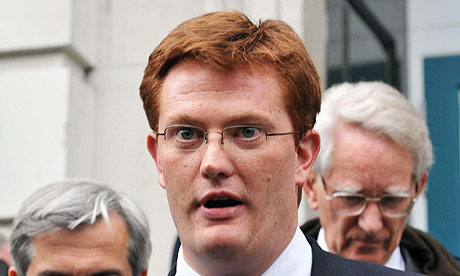
 The ConDem government yesterday followed up previous cuts announcements with further cuts of £2bn and a shelving of planned projects worth £8.5bn, adding a total of £10.5bn to the initial £6bn worth of cuts. The dopy-looking Liberal treasury secretary Danny Alexander was sent before the cameras to cop the heat for this.
There should, you would think, be no discomfort in this for a party that is led by its most unashamedly neoliberal faction, a faction that in some respects has pushed the Tories to the right. And at the moment, the polls suggest that the propaganda campaign is winning. Most voters are willing to blame the last government for the budget cuts, thus suggesting that the narrative of profligate Labour spending causing the deficit has successfully framed the debate for the time being. This is not to say that people favour cuts - the polls also register real worry about how deep the cuts will go, and how rapidly they will be introduced. The aggressive Tory agenda now being imposed was overwhelmingly rejected at the polls. But it's hard to turn on the television or open a newspaper without being advised in alarmist, hysterical tones that there is no money, and it's all the fault of public sector fat cats. However, in the long term, there is a real problem for the Liberals in being seen as part of a government of right-wing millionaires cutting spending for the poor. And some of the previously announced spending reductions hit the working class hard. Cuts in housing expenditure, in free school meals for the poor, and in childcare. The latest cuts hit job creation schemes, infrastructural projects, hospital construction and development. And, of course, it's just the beginning.
The economic logic of the cuts has been distilled for us into a few mantras: we need confidence in the markets; we need a balanced budget; and we need growth led by the private sector. But if anyone's buying this, they won't be in the highly probable event of its resulting in a deflationary spiral. There is no urgent need to pay off the deficit, and doing so at this time and in this way is econocide. As Tim Binding points out, the logical thing to do from a point of view of securing growth would be to redistribute wealth. Well - the cuts do redistribute wealth, but in the wrong direction. The budget cuts are a class project, not a programme for economic revival. Call me a blithe optimist, but I don't think it will be long before this becomes glaringly apparent to the vast majority of people. I give it a few months, though this would not by my first incautious prediction this year. Which raises some questions for the stability of the ruling coalition.
The Liberals, already down 10% in the polls on their pre-election standing, and sometimes as much as 5% below the votes they polled on 6th May, should lose heavily from this. They have benefitted from a surge in support for 'third party' candidates, rising to levels last seen in the 1920s, but their voters have never been a Thatcherite bloc. Ross McKibbin describes the Liberal vote as the least regionally concentrated of the parties, a source of weakness for them in the current electoral system, but this reflects a geography of class, as the Liberals are the only party to have a genuinely cross-class electoral base. They could now lose whatever gains they made in working class, previously Labour heartlands. The C2 vote, usually characterised as the "skilled working class" - really a section of the skilled working class - gravitated away from Labour in various directions, giving both the Liberals and the Tories some of their gains in the last election. But that is not a loyal voting base, and a shift in that vote as the cuts exact their toll is likely to continue to squeeze the Liberals. The Tories may not lose as much, as they could make up whatever they lose in C2 votes with a gain in the AB votes lost to Labour for a decade or so. But their support in the election was only 37%, and it would only take a small shift in votes to give the plurality back to Labour.
This is one reason why business, the banks and the civil service dreaded the prospect of a minority government having to implement cuts and then face re-election in 6-18 months, and why the civil service elite moved to change the rules of the game. Susan Watkins explains:
To the despair of election-night commentators, the May 6 count produced no uniform pattern. ... Britain awoke on May 7 to the likelihood of a weak Tory government and a return to the polls by 2012.
With protests raging in Greece against the PASOK austerity measures, and acrimonious disarray among European governments on how to deal with Eurozone banks’ imbrication in the looming sovereign-debt crises, this was not an outcome Whitehall or the City of London wished to see. ... Austerity measures had been delayed until the May 2010 election was out of the way. The prospect of a minority government, battling to push through closures and redundancies under the shadow of further popular reckoning, was not one that Britain’s rulers could contemplate with equanimity.
Within five days that prospect had been ruled out of court. As a Financial Times report explained: ‘The Cabinet Secretary has positioned the civil service to take maximum advantage of the political uncertainty’. The House of Commons was suspended, on the basis of a draft constitutional handbook which mps had not been permitted to debate, while teams of functionaries helped to coach party leaders towards a mutually beneficial outcome. The next election would be delayed until 2015, with the instant introduction of fixed, five-year parliamentary terms. The majority needed for a no-confidence vote in Parliament would be raised to 55 per cent. Conservative and Liberal Democrat manifestos were elided into a single statement, with a pledge of future referenda to broker the two key areas of difference: electoral reform and further EU treaties. On 12 May, Cameron explained to the waiting press corps that he and Liberal Democrat leader Nick Clegg had come to realize, over the course of the negotiations, that the idea of a minority Tory government was ‘just so uninspired’. The Lib–Con coalition government, announced by the two youthful, telegenic party leaders in the sunshine of the Downing Street garden—‘just like a wedding’—was greeted with almost universal applause. The Financial Times: ‘A seamless transfer of power—a good week for the pragmatism and commonsense of the British constitution.’ The Economist: ‘The best possible outcome, given the ropey electoral numbers—we welcome it.’ The Guardian: ‘The public seem pleased with the coalition . . . This is surely the right response.’
That the "pragmatism and common sense of the British constitution" should come to the rescue of capital, saving it from "ropey electoral numbers" and the unimpressive ambivalence of the British public, should be no surprise to readers of Ralph Miliband. But though the constitutional fix is an important prophylactic, it is no guarantee that the government will not fall. The state, used to decades of stability, has not had to wage a protracted fight with the working class for a generation. The ruling class is far more fractious than it has been for years, lacks the ideological coherence and leadership it possessed when it last had a fight of this magnitude on its hands. It may well be somewhat out of shape.
The struggles that now ensue will inevitably play out to a considerable extent inside the Labour Party. The public sector workers are the bedrock of Labour support. The public sector unions bailed them out to a great extent in the recent election. That wasn't unanimous or wholehearted. The PCS, which has been in battle with the Labour government for a decade, has never been affiliated to the party, and its political fund is not set aside for the Labour Party. The RMT was of course expelled, and the FBU disaffiliated. There has been loud grumbling in other unions like the CWU. But by and large, public sector workers remain Labour, and they are the ones who are going to be in the frontline of the cuts, and the fightback. This has two key implications. The first is that union leaders may, to avoid embarrassing the Labour leadership and keep their powder dry to help 'their' party back into government, try to keep a lid on strikes and protests. They will certainly act as a conservative force. That does not mean that they can be bypassed, or that they should be treated as an 'enemy' on a par with the bosses. But you don't have to be Dave Spart to see a potential problem here.
The second implication is that if rank and file militancy pushes the union leaders to the left, it is likely to pressure the Labour leadership from the left as well. Diane Abbot is the only left-wing candidate for the leadership. She is the only candidate who can be relied on to consistently oppose the cuts, and she has more credibility in doing so than the Milibands, Balls or Burnham. Abbott is unlikely to win, but she has good name recognition, is popular with the public and constituency Labour members, and is getting some decent play in Labour's daily tabloid, The Mirror. She doesn't have the campaigning record of John McDonnell, who has real support in the trade union movement, but she's on the right side of most arguments, and there is some anecdotal evidence that she has shifted the leadership debate to the Left. Given that Abbott is a member of the Campaign Group and is seen by the Blairites as a relic of the hard Left they spent the 1980s and 1990s trying to crush, the fact that they have to adapt to her somewhat is not an insignificant development.
At any rate, whichever one of the disgusting New Labour quad actually wins the leadership, they are all aware of how much they depend on the organised labour movement, and of the need to solidify their standing in working class communities. They will try to resolve this in the most reactionary way possible, say through immigrant-bashing and authoritarian populism on 'anti-social behaviour'. But that relationship of dependency will make it very difficult for them to ignore any struggles that take place. And it does mean that Labour members and supporters will be at the heart of any cuts campaign, and that anyone who thinks they can ignore or bypass the Labour party is deluding themselves. Not that you should join the ranks of lefties flooding back to Labour - it's not an empowering experience. But just don't imagine that the resistance to the cuts will take place without the central involvement of the Labour Party, for all the problems and opportunities that presents. I would infer that this also means that in electoral terms the coming period will see a consolidation of Labour's working class vote, and fewer opportunities for left-of-Labour campaigns.
A first step toward building the anti-cuts campaign will be the budget day protests next week. Large, confident protests will disrupt the inevitable attempt to present the cuts as some sort of consensual process with a democratic mandate, so do attend wherever you can.
Labels: blairites, budget, cuts, david cameron, david miliband, diane abbott, ed balls, lib dems, liberals, neoliberalism, new labour, nick clegg, spending cuts, the meaning of david cameron, tories
10:15:00 am |
Permalink |
Comments thread |
|
Print |
Digg |
del.icio.us |
reddit |
StumbleUpon |
Tweet|
Share|
Monday, May 03, 2010
The leaders' debate posted by Richard Seymour
The group had developed a six-point "manifesto" that it asked each leader to discuss and respond to, and this involved an interesting triangulation. The underpinning ideology was basically Cameronite. The first manifesto point, championing civil society vs the government and markets, is pure 'Big Society'. The demand for a government framework to support community organisers is close to Cameron's idea of government-sponsored 'social entrepreneurs'. The demand for a cap on 'usurious' interest and its replacement with micro-credit is most congruent with Phillip Blond's distributist agenda of capitalising the poor. The introduction to each leader's contribution made it clear that the organisation favoured 'free and competitive markets'. The demand for community land trusts to facilitate cheaper owner-occupied housing was specifically opposed, by one of the speakers, to the alternative of building more council houses. The ambivalence-cum-suspicion toward socialised provision was palpable. Despite this overall ideological thrust, there were some laudable policies, and most of the specific proposals were probably closest to Liberal Democratic policy. These included an amnesty for illegal immigrants, and the end of detention of migrant children. They also included demands for the implementation of a Living Wage (set at £7.60), which every leader evaded in different ways, though all said it was an attractive idea. So, the ideology was Cameronite, and the policies Cleggite. But the leader that was most popular, by far, was Gordon Brown.
Cameron's performance was confident, but ultimately flat and salesy. He made as much as he could of the fact that the ideological presuppositions of the organisers were so close a match for his own 'compassionate conservatism'. "I talk about the Big Society," he enthused, "you are the Big Society." Oh, Jeez - really? I had thought of that line while I was still an epididymal pre-life form. There are extinct species that saw that line coming. He spoke insistently of his 'progressive goals', emoted about the need for greater 'equality of opportunity', made some vague nod in the direction of capping interest rates on debt ("we'll start with store cards, then see from there..."), sounded firmly in favour of a Living Wage, and even took credit on behalf of the Tories for having implemented it in London - I believe it was actually initiated by Livingstone. But though the 'Big Society' stuff was an open goal for him, he had great difficulty connecting his goals with those of his hosts. Clegg, though he had a clear political advantage over the other leaders, was eerily weightless. He was cheered to the rafters when he agreed to an amnesty for illegal immigrants living in the UK, and to an end to child detention. But other than that, my impression of him as a lacklustre candidate who happens to be in the right place at the right time was confirmed. His much vaunted sincerity and directness was belied by the evasiveness of his responses on issues such as the Living Wage - asked about whether his vague murmurs approving the idea of a Living Wage meant that he would legislate it, he said something to the effect that he wasn't sure if it should be compulsory as he didn't know if the money could be found for it.
Brown, who entered to wild applause and hooting of a kind I haven't seen since I was a WWF fan, revealed himself as an effective manipulator and button-pusher. He simulated passion and urgency, laid it on thick with references to the anti-slavery struggle, the civil rights movement, the suffragettes - to whom Citizens UK were compared. When asked about introducing a cap on usurious interest rates, he quipped "well, we all know what the Bible says about the moneylenders! They should be thrown out of the temple." Thrilled applause, as if no one had noticed the last thirteen years go by. Then he gave a very general nod to the idea of capping interest rates on loans. He mentioned a few modestly decent policies such as child tax credits, and said that the Tories inheritance tax plans would hand £200k to the 3,000 richest families (this is true, but it was also true of his own government's earlier inheritance tax cuts). He reminded the audience who had introduced the minimum wage, and spoke of the 'vawlyews' that his father had imbued him with. And he would have completely evaded the issues on which he was at odds with the assembly, such as child detention and immigrants, with the complicity of the organisers, had one contingent of the audience not heckled and demanded an answer. He still didn't really answer, and the organisers didn't press him even though they had, politely but firmly, pressed the other candidates for more specific answers where necessary.
Brown is not the shambling sadsack that he sometimes appears to be on television. He was a smooth, calculating performer, very adept at deflecting potentially problematic issues with off-the-cuff remarks and the invocation of struggle. He said that those struggling for 'fairness' would always find a 'brother' in him, and he finished his speech with this line: "When Cicero made a speech in ancient Rome, they said: 'good speech'. But when Demosthenes spoke in ancient Greece, they said: 'let's march'!" I don't know if it was wise for an incumbent PM whose government has been embroiled in several imperialist wars to compare himself to an insurgent against Alexander the Great.
In the end, what I had thought might be a Cameronite 'Big Society', and then a collective Cleggasm, turned out to be a Labour rally. The organisers, though noisily non-partisan and offensively civil toward their guest speakers, were ultimately facilitators for the Prime Minister's travelling stage show. Their questioning of him was laughably meek, and laudatory. The only moment of real interest in the event was when a protester, whom I have since learned was an anti-nuclear campaigner, disrupted Brown's speech. The protester was pretty roughly man-handled and the audience booed the poor chap as he was being bundled off, before going on to chant "Gordon Brown, Gordon Brown, Gordon Brown..." until it reached a critical mass of embarrassment and everyone shut up. The sympathy for him was unreal. It was like: "first Gillian Duffy, now this...". Brown eventually recovered from the shock and said, "I've had worse". And I watched in bewilderment as thousands of people laughed and cheered as if it was the funniest thing ever. It was like being stuck in a Joe Pasquale gig. It was like being stuck in one of those 'British Comedy's funniest moments' videos, with the scene of Del Boy falling over being played on a continuous loop, and the same galactically disproportionate canned laughter repeating itself ad nauseum. It was gruesome.
So, to return to my original point. There was definitely something of an evangelical atmosphere about this event. If religion is the sigh of the oppressed creature, the heart of a heartless world, and the spirit of spiritless conditions - in a word, the opiate of the masses - then this event could be said to have had the same function. Just as with the previous debates, and doubtless all the hustings going on up and down the country, there was a conspicuous absence from the proceedings of any realism about the devastating social upheavals that are ahead of us - what with unprecedented and corrosive spending cuts, and the consequences that shall have. It was airbrushed out, and instead the party were asked to discuss some basically humane policies in an antiseptic atmosphere. The assembly wasn't designed to discuss urgent policy matters in a direct and challenging way, no more so than the fiascos hosted by Sky, BBC or ITV. It was designed to pump up the assembled viewers, simulate democratic participation (though the only participation from the audience that was welcome was applause - no questions or contributions were accepted from the floor), and finally provide a fairly decisive religious and 'civil society' mandate for one Gordon Brown.
This obvious fix-up, by the way, is being reported as a "triumph" for Gordon Brown.
Labels: david cameron, gordon brown, liberal democrats, neoliberalism, new labour, nick clegg, religion, tories
7:37:00 pm |
Permalink |
Comments thread |
|
Print |
Digg |
del.icio.us |
reddit |
StumbleUpon |
Tweet|
Share|
Sunday, April 18, 2010
Facepalms posted by Richard Seymour
I have not been able to blog for the last few days due to this cloud of volcanic ash emanating from Iceland. This satanic raspberry has apparently inconvenienced quite a few people, and I am glad that our vigilant media - fresh from reporting on February's snowpocalypse - are still very alert to any naturally occurring phenomenon that could hinder travel to and from work, or affect house prices in some way. (The truth is, I have been busy working on my new book, but you're not supposed to know about that yet.) The main reason I wish to post today is to register my embarrassment and disgust over this. It's bad enough that our main two parties are so crap that people actually find Nick Clegg plausible, and his party has now taken the lead - although it is moderately encouraging to note that many of these new Lib Dems are defecting Tories. But this is just to nauseating for words. It's not even a personality cult. It's a dilute derivative of a personality cult. It is a pathetic mock-up, rooted in none of the same social dynamics and aspirations, and attached to a personality with about as much charisma as a loaf of bread. If this were to be the frenzied peak of excitement in British electoral politics, I should just go into hibernation. Thank heavens for TUSC, Respect, Solidarity, etc.Labels: david cameron, elections, gordon brown, lib dems, neoliberalism, new labour, nick clegg, public spending, recession, tories
11:58:00 am |
Permalink |
Comments thread |
|
Print |
Digg |
del.icio.us |
reddit |
StumbleUpon |
Tweet|
Share|