Sunday, January 30, 2011
Aaron Porter is running out of excuses posted by Richard Seymour
Yesterday, having refused to back the main students protest in London, he turned up at the protest in Manchester and was literally chased off the protest by what I hear was about half of those who had thus far gathered. He was escorted by police into the NUS building, where he remained holed up. Later the NUS Vice-President was pelted with oranges and eggs (another variation on the foodstuffs theme). This resulted in a refinement of the usual script. With the help of the Daily Mail, Aaron Porter's supporters have put it about that he was physically intimidated, threatened and subject to antisemitic abuse. Porter himself said: "Just before the march started, I was surrounded by a particularly vicious minority of protesters more intent on shouting threatening and racist abuse at me rather than focusing on the issues. Instead of standing together and fighting the cuts, they instead chose to pursue me along Manchester’s Oxford Road and drive me away from the start of the march. As a result, under the strong advice of the police, I had to withdraw myself from the rally." It is alleged by the newspapers that Porter was called a "Tory Jew", or even "Tory Jew scum".
A few things, then. If this happened, then it's a hate crime, and it would be appropriate for Porter to report it to the police. As members of the public and police officers were present, they can bear witness on his behalf if the allegations are correct. However. The extraordinary thing is that so far there is absolutely no evidence for it. The sole source quoted in any article on this is an unnamed photographer. You will search in vain through the raw footage for any evidence that such a thing was said. This does not mean that it wasn't. There can always be one or two idiots. But I have waited a day since first seeing the first, sometimes contradictory and nebulous allegations, and no evidence has been produced. On the contrary, most of those who were in fact there assert that what was chanted was "Aaron Porter, we know you/We know you're a Tory too". Another extraordinary thing is that the NUS Black Students campaign has apparently felt compelled to issue a statement denouncing something that may not have happened. This is, to my mind, an unwarranted capitulation to what may well be a dirty tricks campaign to spin what was clearly otherwise a very bad headline for a very unpopular Aaron Porter. Labour apparatchiks have a long history of this. Luciana Berger famously resigned from the NUS national executive alleging that the NUS was tolerating antisemitism in its ranks. This was later debunked by an independent inquiry, but she established a reputation on the basis of this and was later parachuted into a safe Labour seat. Similarly, Oona King used accusations of antisemitism against her opponents in Bethnal Green & Bow, though witnesses like Jonathan Freedland disputed her version of events. So, a dirty tricks campaign is hardly out of form.
Alex Andrews recommends that students go to the Press Complaints Commission if this is proven to be a lie, as Climate Camp activists were able to do when they were smeared by the Evening Standard. So, can I just say that this recommendation looks like a safer bet to me than issuing knee-jerk statements denouncing something that may not have taken place?
Labels: antisemitism, austerity, blairites, cuts, dirty tricks, education maintenance allowance, labour, media, nus, protest, students, tuition fees
10:12:00 am |
Permalink |
Comments thread |
|
Print |
Digg |
del.icio.us |
reddit |
StumbleUpon |
 Tweet|
Share|

Tuesday, January 04, 2011
The Blairite mantra posted by Richard Seymour
Class has never been less relevant to how people vote. We are a culturally more cohesive society than we have ever been. From Ikea to Ryanair to X Factor, our way of life is converging...
Thus Tessa Jowell, whose way of life is more akin to those of the spivs who've just destroyed the global economy than that of the 'middle' she is assiduously courting. These people really have no idea how hated they are. Anyway, as this is nothing more than a regurgitation of a piece written by Peter Kellner, a Blairite married to Lady Ashton, here's one I prepared earlier.
Labels: berlusconi, blairites, class, elections, finance capital, middle class, neoliberalism, new labour, psephology, ruling class, spivs, working class
2:48:00 pm |
Permalink |
Comments thread |
|
Print |
Digg |
del.icio.us |
reddit |
StumbleUpon |
Tweet|
Share|
Friday, November 19, 2010
Blairites on civil war footing posted by Richard Seymour
So, that's Dan Hodges. Now he's in the New Statesman, prophesying civil war - ironically, this article is itself a shot in the civil war that the Labour Right launched as soon as the leadership election was decided. And his argument is that the "Brownites" - that's Ed Balls and Yvette Cooper, two cabinet members known for wanting to take a harder line against the cuts - are out for Ed Miliband's head. It will be Ed out, and Yvette in, if they get their way.
Now I know what you're thinking. Why do I care about these petty personality-base debacles? And if that was all that was at issue, I'd agree. I'm not a member of the Labour Party, so I don't have an immediate stake in such matters. But look at what the Blairites have been doing lately. Alan Johnson, whom Miliband installed as Chancellor on the basis of an old saw about tents and pissing, has been publicly going against the leadership on the 50% higher tax rate, saying that he would like to drop it in a few years, and that it's only a tactical response to the deficit. In truth, he is among those who thinks it was a mistake to ever introduce this popular measure.
Now, the Blairites are in The Times, calling for an end to the union link. Alan Johnson is involved again, attacking the legitimacy of Ed Miliband's leadership by attacking the way he was elected. He claims to favour the extension of "one member one vote", neglecting to note that if the principle was applied seriously in the Labour Party, Ed Miliband would have come a clear first in the first round, and Diane Abbott would have come third. Alan Milburn is making the logic explicit, however, in demanding that union affiliates don't get a vote, and that the structural relationship with the unions is abolished. Margaret Hodge, who owes everything to the unions behind the anti-fascist campaigns that worked their fingers to the bone in Barking, is also calling for Labour to cut "the umbilical cord". There's gratitude for you.
If the Blairites were to get their way, Labourism would be dead. That's what they appear to want, and why it doesn't seem to overly perturb them that in going along so slavishly with the cuts agenda they will destroy the constituencies that keep Labourism alive. Ed Miliband, with few radical ideas and a deficit of guts, was nonetheless the candidate for those who wanted to oppose the Blairite mission. He was the candidate who promised to rebuild the Labour base, to defend trade unionism and strengthen the link. That's why his victory left Blairites reeling, fuming, plotting a coup from the off. That's why rich donors like Lord Sainsbury went off in a huff.
Ed Miliband's supporters on both the soft and hard left have called more than once for him to hammer the Blairites. Crack the whip, said Seumas Milne, and make the Right toe the line. Now, there's some faint hope that his decision to 'retire' Ray Collins as general secretary signals a determination to get tough, and purge the ruthless right-wing fixers and allow a real debate in the Labour Party. Collins was known, says Left Futures, for ensuring that any policy proposal discussed at any but the lowest levels of the Labour Party was in tune with what the leadership was thinking. He was certainly part of the disastrous witch hunt that threw Lutfur Rahman out of Labour, causing the party to lose an election for Tower Hamlets mayor that they would otherwise have easily won. And it's hard to believe that the subsequent manoeuvering to get Ken Livingstone booted out for having supported Rahman, and blockade the new East End mayor by refusing to cooperate with him at either a local or London-wide level, would have taken place without Collins' express consent. But while a different general secretary might avoid such obvious embarrassments for Labour, there's little prospect of anything fundamentally changing. The Labour Left is kidding itself if it thinks it's key strengths will flow from any processes inside the Labour Party, where they have been disenfranchised, bullied, witch-hunted and demoralised for a generation now.
John McDonnell is far more realistic. The real social forces that will provide a base for the Left, and thus potentially revitalise Labourism, will not come from the clapped out media-savvy think-tanks of the centre and soft left. They certainly won't come from the small clique of supporters around Ed Miliband. They will come from the very people that Labour's right-wing old guard least understands, and most dislikes - trade unionists, protesters, climate campaigners, and so on. The students whom Ed Balls denounced, and the strikers whom Ed Miliband has preemptively warned will not receive his support. They are the only real power that is capable of taking on the Blairites, whose legitimacy and authority is built on defeat, on acquiescence and conformity, and on deference to the media and public relations flacks.
Labels: austerity, blairites, capitalism, cuts, ed miliband, labour, liberals, neoliberalism, new labour, trade unions, whiggery, working class
8:28:00 am |
Permalink |
Comments thread |
|
Print |
Digg |
del.icio.us |
reddit |
StumbleUpon |
Tweet|
Share|
Wednesday, November 17, 2010
Tories fall back in the polls posted by Richard Seymour
Perhaps this illustrates a point which the late Paul Foot used to insist on: Labour generally does better when 'our side' is stronger. It is not an iron law, but it is a trend that when the working class is more organised, more cohesive, and more combative, it gives even the most degenerate, bland, conformist Labour Party a new lease of life, because its organised base in the organised labour movement is full of fight. I believe he made this point just as the poll tax riots had driven Labour's support above 50% for the first time in decades. You may find this regrettable. Labour's leadership may find it embarrassing, but it is unavoidably the case, and it means that the coming insurgency will do more for Labour's standing than Ed Miliband's doe-eyed moderation.
It is perhaps not a coincidence that Labour's nearly cataclysmic slide in the polls between the credit crunch and the election was matched by a complete knock out for the employers in the class struggle. They shed jobs, they cut wages, and the degraded conditions more or less with impunity. New Labour governance had a lot to do with this, of course. The working class was disoriented and dazed by the recession, not immediately spurred to militancy except in a few enclaves. The labour movement was timid, fatalistic, and conservative. The right set the narrative on the deficit, and Brown and Mandelson, following the logic of their neoliberal commitments, acquiesced. Labour's base was shattered, disoriented, and largely disinclined to vote. Out of sheer urgency, a core vote mobilised that was bigger than anticipated. But Labour's base was still, as the famous Mister Ed has acknowledged, 5 million working class people short of what it could have been.
Gradually, there has been a sense of an urgent need to pull the finger out, a campaign emerging, the first sign in a long time of union assertiveness within the Labour Party itself, the flicker of grassroots dissidence forcing union bosses to retreat on having Cameron at conference and forcing the issue of joint industrial action onto the agenda, the local anti-cuts groups forming, the marches, some small, but some very big, and now the opening shot of a potentially powerful students movement. Even as Miliband goes to extravagant lengths to distance himself from the trade unions, to oppose militancy, to denounce this and condemn that, if an anti-cuts movement really takes off in this country, then he will be the ungrateful beneficiary of the revival and reconstitution of the very social forces that keep Labourism on the life support. However, if such a movement does not take off, or if it goes down to historic defeat, then Labourism may well disappear as a distinctive political formation. Its organised base would be shattered, and the remaining shreds of the party would be easy meat for a further round of Whig 'reform' that would basically turn it into a vulgar, populist adjunct of the Liberals.
So, I'm just saying, this poll result illustrates the perversity of Labourism, its dependence on social forces that it routinely attacks, and its inability to act in the interests of its own perseverance as a political force. That's all, like.
Labels: austerity, blairites, cuts, david cameron, ed miliband, labour, labour left, liberals, new labour, nick clegg, tories, trade unions
8:28:00 pm |
Permalink |
Comments thread |
|
Print |
Digg |
del.icio.us |
reddit |
StumbleUpon |
Tweet|
Share|
Friday, October 22, 2010
Labour loses the East End posted by Richard Seymour
- Lutfur Rahman, Independent - 23,283 (51.76%)
- Helal Uddin Abbas, Labour Party - 11,254
- Neil Anthony King, Conservative Party - 5,348
- John David Macleod Griffiths, Liberal Democrats - 2,800
- Alan Duffell, Green Party - 2,300
This is a wholly deserved defeat for the Labour Right, who have already proven their inability to command support in London with their inept campaign for Oona King. They must have thought that in seeing off Respect in the 2010 elections, they had seen off the leftist insurgency in their own back yard, as it were, and go on a purge. But it doesn't work that way. And it's as well it doesn't because, as I say, this was as much about fiscal priorities and the cuts as it was about anything else. The new mayor will have enormous executive power over budgets, and has said that he will oppose the cuts. Whether or not he intends to put something behind his promises, the vote shows that Tower Hamlets residents are not in a compliant mood.
Labels: blairites, ken livingstone, labour, labour left, new labour, respect, right-wing, tower hamlets
7:48:00 am |
Permalink |
Comments thread |
|
Print |
Digg |
del.icio.us |
reddit |
StumbleUpon |
Tweet|
Share|
Tuesday, October 19, 2010
Labour Right's Kamikaze Act in the East End posted by Richard Seymour
Cllr. Abbas responded to this outcome by accusing his victorious rival of having 'pocket' (fake) members supporting him, and of introducing an atmosphere of intimidation in the council. He claimed that the Islamic Forum of Europe had "brainwashed" Rahman, about which more in a moment. I should stress that these allegations would, even if true, have no bearing on the outcome of the selection, which was run by the regional Labour Party, and where only identifiable members with photo ID were allowed to participate. But Labour, apparently determined to replace Rahman, dealt with the issue at a chaotic NEC meeting, allowing the chosen candidate no opportunity to refute the allgations. They suspended him, deselected him by fiat and chose Abbas instead - the least popular of the main three candidates, and the man whom they had previously imposed as council leader after the local elections gave Labour more councillors in Tower Hamlets.
Now Rahman is standing as an independent candidate, backed both by Respect and, I would gather, much of the London Labour left. Eight local Labour councillors have already been expelled for backing Rahman, along with a number of officers and members. Labour's mayoral candidate Ken Livingstone has expressed support for Rahman. He has said that it was a "moment of madness" for Labour to replace Rahman after having just rebuilt the local party following Oona King's defeat in 2005. He's not wrong. Respect had made it clear that they would back the Labour candidate as Rahman was a popular candidate whose policies were close to their own. Labour could have taken this powerful executive post with no difficulty had it stuck with Rahman. Instead, in a spiteful and petty act, the NEC attempted to establish the Blairites' control over a region that has an established propensity for rebelling against such encroachments.
This is the culmination of a Muslim-baiting war by the managerialist right-wing in local Labour circles, fronted by Jim Fitzpatrick MP, with the connivance of Tory media and Andrew Gilligan. You'll recall that a Dispatches documentary for Channel 4, made by Gilligan, claimed that Rahman had become council leader with the assistance of the Islamic Forum of Europe (IFE), a group close to the Jamaat e-Islami in Bangladesh, and had distributed millions in council funds to organisations supported by the IFE. Specifically, it was claimed, Rahman had helped turn ten million pounds in public funding over to the East London Mosque, which is allied to the IFE. (The mosque refutes these claims). Fitzpatrick alleged that the IFE had 'infiltrated' the local Labour council. The documentary concluded that the IFE was attempting to impose an Islamic social and political order on everyone else. These and subsequent allegations made by Gilligan at his blog on the Daily Telegraph website were cited by senior Labourites in the NEC's decision to suspend Rahman. Indeed, when it was decided that the candidate would be selected by the local members, Andrew Gilligan expostulated in disbelief that the Labour leadership would allow something like this to happen - didn't they know that Labour members were IFE affiliates and would just pick one of their Islamist brothers to lead the revolution?
What of these allegations? Most of the prosecution witnesses, if you like, were either notable Islamophobes or, like Fitzpatrick (then defending an 8000 majority against George Galloway) had a direct interest in representing their opponents as frontmen for an Islamist incursion. The documentary was denounced by a wide array of trade unionists, leftists and liberals for whipping up racist hatred and giving the EDL an excuse to (try to) march on the East End. Discounting for this, for the shrill reactionary politics of the documentary, and for any factual leaps that it may have made, what is left? It is well known that the IFE is influential locally, and that it is socially conservative. It is also well known that the IFE has backed Labour and Respect candidates in the past. There is also a complex and murky history of municipal clientelism, and not only in the East End, wherein Labour politicians make deals with local businessmen and lobby groups to help get elected. Labour Party member Dave Osler describes some of this history here. But I see no evidence that the IFE has taken over the Labour Party, nor is it remotely plausible that the IFE has such weight that it could impose Lutfur Rahman as the leader of the local council. Even if its influence allowed it to extract public funds on a clientelist basis, this is unlikely to be anything more than standard rent-seeking behaviour. And clientelism isn't going to be dealt with and finished off on the basis of racist scaremongering, any more than 19th century 'machine politics' was terminated by scapegoating the Irish. The idea that there's an Islamist plot to impose a theocracy on the East End of London is a paranoid racist fantasy.
Nor, I might add, does it seem plausible that Rahman is the IFE's Manchurian Candidate. Regardless, Fitzpatrick and his supporters continued to push the idea that the East End was on the brink of an Islamist takeover and that Rahman was at the centre of this web of conspiracy. This witch hunt brought to its hysterical culmination in the pages of the tabloids and the Telegraph, the Labour establishment prepared Rahman's auto de fé, deposing him as council leader as soon as the 2010 elections were concluded. Cllr. Abbas' allegations are thus continuous with this witch hunt, inasmuch as Rahman is depicted as an 'Islamofascist' terrorising the community. They are also of a piece with his own previous careerist manoueverings, which at one staged involved him in an alliance with... well, one Lutfur Rahman. No surprise there - the careerist's only permanent friend is himself.
But what is the difference of substance between the two candidates? Judging from their campaigns, there is a straightforward left-right divide. Rahman considers himself a social democrat to the left of Cllr Helal Abbas. Oliur Rahman, the former Respect councillor and recently expelled Labour councillor, says: "Lutfur introduced the London living wage for Tower Hamlets council workers. We bought back council houses and rehoused over 500 overcrowded households. We started building over 1,000 social homes. These are just some of the policies Lutfur implemented. If he’s not mayor, things will go the opposite way. If elected he will fight to save jobs and services." Lutfur Rahman has pledged to oppose the government's cuts. At any rate, the result will make a material difference to the council's decisions. I understand that the council is currently holding back on some of its cuts and job losses until the outcome of the election is known. Abbas' campaign, by contrast, focuses on "social cohesion". You don't need me to tell you what that means. But if you're baffled, I'll point you in the direction of Rushanara Ali MP. Ali, of course, has a personal beef with Rahman for refusing to publicly endorse in the election against her rival, Respect candidate Abjol Miah, and her views were taken into consideration in the decision to suspend Rahman. It's a clear choice, then, between unpleasant bullies who have a patent disregard for democracy and whose message to ethnic minorities is to behave better than everyone else, be above reproach and effectively capitulate to racist hatemongers, and a campaign by the victor in the contest to be the Labour candidate who is foregrounding the material needs of the working class, such as housing and incomes.
The Labour NEC's decision was perhaps predictable, but it is still self-destructive. Dave Hill, no supporter of Rahman, reports 'whispers' from the Abbas campaign that the wind is going Rahman's way. Even if Labour pulls its campaign back from the brink, the fruits of this deranged kulturkampf will mostly be harvested in the form of a depleted and demoralised base, an even more arrogant, tyrannical and disconnected Labour establishment, and a re-fuelled racist hysteria that can only benefit the far right.
Labels: blairites, islamism, islamophobia, labour, new labour, racism, reactionaries, spending cuts, tories, tower hamlets
9:37:00 am |
Permalink |
Comments thread |
|
Print |
Digg |
del.icio.us |
reddit |
StumbleUpon |
Tweet|
Share|
Friday, October 08, 2010
Ed Miliband pandering to the right posted by Richard Seymour
He intervenes to stop the BBC strike, then appoints a Blairite for shadow chancellor and puts Ed Balls in charge of immigration policy. Johnson, the new shadow chancellor, favours Alastair Darling's savage cuts agenda. The unions will have to put up a lot more of a fight before they get more than small change for their votes.Labels: austerity, blairites, cuts, labour, neoliberalism, new labour, tories, unions
8:18:00 pm |
Permalink |
Comments thread |
|
Print |
Digg |
del.icio.us |
reddit |
StumbleUpon |
Tweet|
Share|
Wednesday, September 29, 2010
The wrath of the warmongers posted by Richard Seymour
This is funny:Labels: blairites, david miliband, ed miliband, imperialism, iraq, new labour, warmongers
11:55:00 am |
Permalink |
Comments thread |
|
Print |
Digg |
del.icio.us |
reddit |
StumbleUpon |
Tweet|
Share|
Sunday, September 26, 2010
One person, one vote posted by Richard Seymour
"If you count her votes across Labour’s tripartite electoral college you will see that she actually came third and not last, as some have been extolling. This was not helped by the unfair weighting each MPs vote enjoyed with one MPs vote being equal to 608 party member votes or 12,915 affiliated members. Which brings me to another point that certain rightwing pundits are trying to fertilise and send forth and multiply, the idea that it is undemocratic for the voice of individual trade union members, already heavily outweighed by PLP and CLP votes, to determine who should lead the Labour party. Why shouldn’t the individual voices of ordinary voters decide this? This system that favours the PLP over the individual should be abolished in favour of one person, one vote."Just a quick addendum. If there was one member one vote in the Labour Party, this is what the results would have looked like in the first round:
| First Round | ||||
| PLP | CLP | Unions | Totals | |
| Ed Miliband | 84 | 37980 | 87585 | 125649 |
| David Miliband | 111 | 55905 | 58191 | 114205 |
| Diane Abbott | 7 | 9314 | 25938 | 35259 |
| Ed Balls | 40 | 12831 | 21618 | 34489 |
| Andy Burnham | 24 | 10844 | 17904 | 28772 |
Labels: blairites, capitalism, david miliband, ed miliband, labour, neoliberalism, new labour, socialism, trade unions, working class
9:30:00 pm |
Permalink |
Comments thread |
|
Print |
Digg |
del.icio.us |
reddit |
StumbleUpon |
Tweet|
Share|
Saturday, September 25, 2010
I told you Ed would win. posted by Richard Seymour
It is a defeat for the Blairites inflicted in part by the trade union movement. In that sense, though I have no illusions in Ed Miliband, I take pleasure in this setback for the most right-wing sector of the Labour leadership. I don't see Ed Miliband as a strong or durable leader of social democracy but this result will open up a space for the Left in Labour to get organised and fight the cuts. Good.Labels: blairites, cuts, labour, neoliberalism, new labour, socialism
5:20:00 pm |
Permalink |
Comments thread |
|
Print |
Digg |
del.icio.us |
reddit |
StumbleUpon |
Tweet|
Share|
Sunday, September 12, 2010
Kellner's Blairite intervention in the Labour leadership race posted by Richard Seymour
Firstly, Kellner uses figures relating the division of ABC1 and C2DE voters among the electorate to support his point that the number of 'working class' voters is declining precipitously. If he is right, then the proportion of 'working class' voters dropped from 51% to 43% between 1997 and 2010. That's a rapid rate of employment change, though - given the way New Labour allowed manufacturing industries to collapse and shed employment - not all that incredible. However, the conception of 'class' deployed by Kellner is the old, misleading 'social class' model preferred by market researchers. His 'classes' (ABC1 = middle class vs C2DE = working class) are based on the National Readership Survey classifications derived from official statistics. As he revealingly puts it, according to his conception the middle class are those who work primarily with their brains, the workers primarily with their hands.
This immediately raises the possibility that, far from class being a social reality that is being rapidly outlived, the NRS conceptions of "social class" are increasingly outmoded, inasmuch as their status and culture-based notions of class were ever relevant. The working class was never exclusively manual, though there was certainly a time when more workers were manual, and more of those worked in clerical jobs were middle class. But there was never any reason why that should remain the case. Indeed, accepting for the sake of argument that status and cultural indicators are what matter, then the rise of call centres a new working paradigm shows that non-manual labour can be just as menial, disempowering and poorly paid as manual labour. And for the record, call centre workers are traditionally classified as C1, or 'middle class', as are all junior or intermediate non-manual workers. What Kellner is talking about, without noticing it, is the recomposition of the working class. Another thing he doesn't notice is the absence of the ruling class in his statistics. They're just completely invisible, subsumed into the 'middle class majority'. And the third thing he doesn't notice is that most people don't appear to share his particular conception of class. The 2007 social attitudes survey found that 57% of people thought they belonged to the working class, whereas in 2005 the electorate supposedly comprised only 45% of people who were working class.
Secondly, even sticking with his definitions, there is a gap between his evidence and his assertions. For example, at the zenith of New Labour, the party won with the support of 8 million C2DE voters, and 5.5 million ABC1 voters. In 2010, Labour lost with the support of 4.4m ABC1 voters, and 4.2m C2DE voters. In other words, according to Kellner's definition, the support of the 'middle class' voters declined by some million voters, or about one fifth, while support among 'working class' voters declined by almost a half. If the numbers of votes from C2DE voters had even held at the historically low level of 6 million achieved in 2001, Labour would probably have defeated the Tories by a narrow margin. The collapse of support among 'working class' voters, most of whom did not defect to the Tories but either tried the Liberals, or a centre-left alternative, or (mostly) stopped voting, cost Labour victory in 2010. So, Kellner's conclusion that Labour should behave as if "class is dead" immediately confronts a problem: Labour has attempted to behave in exactly that way for more than a decade, and the result was a drastic contraction of its base, close to its all-time low in 1983 in terms of percentage, and well below 1983 in terms of the total vote.
Even with that in mind, granulating the 2010 results further, using some of Ipsos Mori's analysis (here and here), there is still a powerful 'social class' determinant in voting. Despite losing overall, Labour had the largest share of the vote among DE voters (approx. 40%), while its lowest share was among AB voters (approx. 26%). What happened between 1997 and 2010 was that Labour went from enjoying the support of 60% of DE voters to 40%, mainly because of a lower turnout among those voters, rather than because of shifting political loyalties. That points to another form of political behaviour, then, which is strongly determined by 'social class': non-voting. According to this review of non-voting in recent elections, the more 'middle class' the constituency the higher the turnout. Non-voting was once largely confined to the middle class in the UK, and did not represent political dissent. The same source linked above suggests that in recent elections, a growing number of people - in 2005 a clear majority - who did not vote had explicit political reasons for not voting. Working class Labour voters are increasingly boycotting the polls, and we can assume this is because they do not feel represented by Labour. Labour's relationship to 'working class' voters changed over the last decade or so, which caused it to lose in 2010. Even so, it still commanded a plurality among the poorest of voters.
Kellner says, as if to explain the allegedly declining relevance of 'class' to voting behaviour: "workers by hand (C2DE) and brain (ABC1) tend to visit the same shopping centres, use the same hospitals, grapple with the same mortgage-lenders, get stuck in the same traffic jams, subscribe to the same Sky packages and fret over the same taxes, crimes and insecurities". Thus is class declared "dead" as a political motivation. It is, of course, a fantasy - pseudo-sociology at its most glib. The one thing that is obvious from repeated sociological studies is that the majority at the bottom of the income and property scales have very different lives from those at the top - whether it is in terms of their health, education, experience of crime, consumption choices, need for benefits, access to credit, transport, exposure to taxation, etc.. Richard Wilkinson & Kate Pickett have assembled a mass of evidence on many of these indices, and Danny Dorling's research group has done some important work on the subject. You can watch him discuss social class in Britain today, here:
Social Class in Britain from Worldmapper on Vimeo.
Kellner's rhetorical effects are achieved largely by blithely gliding over huge social divergences in the UK, such that in the end we're all a large unhappy family of voters with "jaundiced" perceptions. Labour's job, then, would to be avoid references to class, win over the expanding 'middle class' and pursue centrist policies. The trouble is that such a strategy, the New Labour strategy, is unpopular with voters. It would only farther advance the contraction of Labour's base that has already taken place over the course of some four general elections. Above all, with the economy in dire straits and the centre vote collapsing, it would miss a unique opportunity to (however briefly) revive the Labour base and potentially overcome the divisions in the left-of-centre voting bloc that have been in evidence since 1983, and which have been devastating for Labour.
Labels: blair, blairites, capitalism, class, inequality, labour, middle class, new labour, ruling class, socialism, working class
10:56:00 am |
Permalink |
Comments thread |
|
Print |
Digg |
del.icio.us |
reddit |
StumbleUpon |
Tweet|
Share|
Friday, June 18, 2010
The real eastenders posted by Richard Seymour
You probably didn't hear about this, but the other day some members of the English Defence League engaged in a sort kamikaze mission in Whitechapel, attacking members of the public and ripping the garments off Muslim women. They were rapidly outnumbered by the arrival of hundreds of locals, and police had to lock the EDL idiots in Whitechapel tube station for a few hours. This suicide attack, as it were, was probably the result of despair after the EDL leadership called off an equally suicidal march into the East End, purportedly against an Islamic conference that was to take place on 20th June (that's this Sunday). Now, even if there had been no political response to this, such a march would likely have provoked enormous opposition in this working class heartland.But there was an immediate response, which was to call a United East End march to oppose the EDL - supported by several trade unions, by UAF, Love Music Hate Racism, by the Muslim Council of Britain, and by the Islamic Forum of Europe. As I've said before, it's important that there is a political response to such attacks, because groups like the EDL and their BNP allies want to polarise the community along racist lines. 17 years ago, the BNP made a small step in this direction by getting their first councillor elected in Tower Hamlets. The council's decision to rehouse Bangladeshi families in Millwall properties that could not be sold was being treated as an act of positive discrimination by the Liberals, who attempted to exploit the issue to win a seat that had come up for bye-election. The BNP, which had been building some pockets of support in the East End in the early 1990s, took the seat and only lost it after an energetic local campaign. They were subsequently shut out of Tower Hamlets for a long time. They stand candidates in places like Millwall and Bow West, but have yet to make a real breakthrough.
Now mark the response of the local Labour leadership. Tower Hamlets council, in the persons of leader Helal Abbas and deputy leader Josh Peck, put tremendous pressure on the organisers of said Islamic conference to call it off, citing allegations of 'views attributed to some of the speakers'. The organisers, the Islamic Society of City University (Isoc), are hardly a threat to anyone, though they are constantly being witch-hunted by the usual dirt from the Centre for Social Cohesion, and subject to repeated baiting by the City Inquirer and the scum over at Harry's Place. The Isoc works in an institution where Muslims are under increasing scrutiny. For example, lecturer Rosie Waterhouse recently called for the banning of the niqab there on the pathetic grounds that she found such dress 'threatening'. Muslims were also attacked in a spate of racist assaults near City University last year, though perversely the university management has used this as an excuse to close the Muslim prayer room. At any rate, the EDL, aware of the allegations against Isoc, attempted to exploit them. And the council seems to have responded by treating Isoc, an entirely peaceful organisation, as an equivalent to the violent bampots of the EDL.
The council also applied pressure to the conference hosts, the Troxy, to cancel the event, saying that they might have to review their working relationship with the company otherwise. That's a pretty big club to bring to any negotiation. The Troxy complied, and the event is looking for another venue. The EDL leadership, admitting that they would have been hammered had they tried to enter Tower Hamlets, called off the demonstration, claiming a victory. The United East End march, intended to underline the refusal of local communities to be divided along racial lines, is still going ahead. It's important, because these racist provocateurs have proven that they are intent on continuing to try and polarise the situation. There are, of course, other activities planned. The EDL are still going to try and march on Wembley, where they are likely to receive just as hostile a reception.
But there is a background of Islamophobic baiting of Tower Hamlets council. This includes Andrew Gilligan's creepy tirade against the Islamic Forum of Europe, through which the media has attempted to attack municipal multiculturalism. The EDL are simply trying to capitalise on that, attempting to position themselves as the cutting edge of the Islamophobic wedge being driven through the East End. The council, as its lobbying of the Troxy shows, is inclined to give in to some of this pressure. The United East End march will be attended by Labour councillors, including Helal Abbas, but it is only fair to note that the East London papers report pressure on the anti-fascists from some local politicians. Predictably, Jim Fitzpatrick, who saw off George Galloway's challenge in the 2010 election by baiting Muslims, has attacked the anti-fascists. You can't expect better from someone like Fitzpatrick. Sadly, Rushanara Ali, who took Galloway's former constituency back for Labour, also called for the march to be called off. It may be of relevance that both local MPs are backing Oona King's bid for mayor against Ken Livingstone. Now Tower Hamlets council, symbolising its commitment to "community cohesion", is flying the England flag from the Town Hall for the duration of the World Cup. Such pointless, trivial gestures neither fulfil their anti-racist mandate nor placate the racist right.
I think this has to be contextualised in terms of the turn being taken by the Labour Party nationally. If the last decade was marked by a revival of neo-Powellite ideology on the Labour right, among the Blairites in particular, that ideological turn is now being aggressively expounded by Labour leadership contenders over, eg, immigration. In a self-serving gesture, they claim that such politics will enable Labour to make amends with "the white working class". This is a cynical move. I suspect that people like Balls believe that by conceding ground to racist hysteria, they can both capitalise on it and contain it. That is reckless, and foolish. Caving in to the racists just gives them more credibility, more armoury, and more space to build in. It benefits the right, in more ways than one. Is it not alarming to Labour members that David Cameron could actually attack Balls from the left over this, characterising the latter as Labour's Alf Garnett? The other context, of course, is the local collapse of Respect. It has one councillor left in Tower Hamlets and no MPs. This doesn't mean its support is negligible, or that it couldn't carry on as a viable local organisation, but its previous clout might have allowed it to resist some of this rightward lurch. I hope it will do well in the upcoming East London mayoral ballot. Because it is the Fitzpatricks of the East End, not the antifascists, who are pursuing genuinely divisive politics, setting working class communities against one another, and attacking the anti-racist consensus that had been established until recently, and giving ammunition to the racists.
Labels: anti-fascism, anti-racism, blairites, east london, islamophobia, multiculturalism, new labour, tower hamlets, uaf, working class
10:55:00 am |
Permalink |
Comments thread |
|
Print |
Digg |
del.icio.us |
reddit |
StumbleUpon |
Tweet|
Share|
The politics of budget cuts posted by Richard Seymour
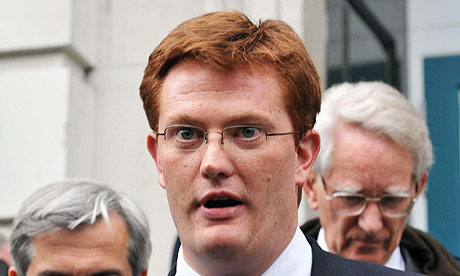
 The ConDem government yesterday followed up previous cuts announcements with further cuts of £2bn and a shelving of planned projects worth £8.5bn, adding a total of £10.5bn to the initial £6bn worth of cuts. The dopy-looking Liberal treasury secretary Danny Alexander was sent before the cameras to cop the heat for this.
There should, you would think, be no discomfort in this for a party that is led by its most unashamedly neoliberal faction, a faction that in some respects has pushed the Tories to the right. And at the moment, the polls suggest that the propaganda campaign is winning. Most voters are willing to blame the last government for the budget cuts, thus suggesting that the narrative of profligate Labour spending causing the deficit has successfully framed the debate for the time being. This is not to say that people favour cuts - the polls also register real worry about how deep the cuts will go, and how rapidly they will be introduced. The aggressive Tory agenda now being imposed was overwhelmingly rejected at the polls. But it's hard to turn on the television or open a newspaper without being advised in alarmist, hysterical tones that there is no money, and it's all the fault of public sector fat cats. However, in the long term, there is a real problem for the Liberals in being seen as part of a government of right-wing millionaires cutting spending for the poor. And some of the previously announced spending reductions hit the working class hard. Cuts in housing expenditure, in free school meals for the poor, and in childcare. The latest cuts hit job creation schemes, infrastructural projects, hospital construction and development. And, of course, it's just the beginning.
The economic logic of the cuts has been distilled for us into a few mantras: we need confidence in the markets; we need a balanced budget; and we need growth led by the private sector. But if anyone's buying this, they won't be in the highly probable event of its resulting in a deflationary spiral. There is no urgent need to pay off the deficit, and doing so at this time and in this way is econocide. As Tim Binding points out, the logical thing to do from a point of view of securing growth would be to redistribute wealth. Well - the cuts do redistribute wealth, but in the wrong direction. The budget cuts are a class project, not a programme for economic revival. Call me a blithe optimist, but I don't think it will be long before this becomes glaringly apparent to the vast majority of people. I give it a few months, though this would not by my first incautious prediction this year. Which raises some questions for the stability of the ruling coalition.
The Liberals, already down 10% in the polls on their pre-election standing, and sometimes as much as 5% below the votes they polled on 6th May, should lose heavily from this. They have benefitted from a surge in support for 'third party' candidates, rising to levels last seen in the 1920s, but their voters have never been a Thatcherite bloc. Ross McKibbin describes the Liberal vote as the least regionally concentrated of the parties, a source of weakness for them in the current electoral system, but this reflects a geography of class, as the Liberals are the only party to have a genuinely cross-class electoral base. They could now lose whatever gains they made in working class, previously Labour heartlands. The C2 vote, usually characterised as the "skilled working class" - really a section of the skilled working class - gravitated away from Labour in various directions, giving both the Liberals and the Tories some of their gains in the last election. But that is not a loyal voting base, and a shift in that vote as the cuts exact their toll is likely to continue to squeeze the Liberals. The Tories may not lose as much, as they could make up whatever they lose in C2 votes with a gain in the AB votes lost to Labour for a decade or so. But their support in the election was only 37%, and it would only take a small shift in votes to give the plurality back to Labour.
This is one reason why business, the banks and the civil service dreaded the prospect of a minority government having to implement cuts and then face re-election in 6-18 months, and why the civil service elite moved to change the rules of the game. Susan Watkins explains:
To the despair of election-night commentators, the May 6 count produced no uniform pattern. ... Britain awoke on May 7 to the likelihood of a weak Tory government and a return to the polls by 2012.
With protests raging in Greece against the PASOK austerity measures, and acrimonious disarray among European governments on how to deal with Eurozone banks’ imbrication in the looming sovereign-debt crises, this was not an outcome Whitehall or the City of London wished to see. ... Austerity measures had been delayed until the May 2010 election was out of the way. The prospect of a minority government, battling to push through closures and redundancies under the shadow of further popular reckoning, was not one that Britain’s rulers could contemplate with equanimity.
Within five days that prospect had been ruled out of court. As a Financial Times report explained: ‘The Cabinet Secretary has positioned the civil service to take maximum advantage of the political uncertainty’. The House of Commons was suspended, on the basis of a draft constitutional handbook which mps had not been permitted to debate, while teams of functionaries helped to coach party leaders towards a mutually beneficial outcome. The next election would be delayed until 2015, with the instant introduction of fixed, five-year parliamentary terms. The majority needed for a no-confidence vote in Parliament would be raised to 55 per cent. Conservative and Liberal Democrat manifestos were elided into a single statement, with a pledge of future referenda to broker the two key areas of difference: electoral reform and further EU treaties. On 12 May, Cameron explained to the waiting press corps that he and Liberal Democrat leader Nick Clegg had come to realize, over the course of the negotiations, that the idea of a minority Tory government was ‘just so uninspired’. The Lib–Con coalition government, announced by the two youthful, telegenic party leaders in the sunshine of the Downing Street garden—‘just like a wedding’—was greeted with almost universal applause. The Financial Times: ‘A seamless transfer of power—a good week for the pragmatism and commonsense of the British constitution.’ The Economist: ‘The best possible outcome, given the ropey electoral numbers—we welcome it.’ The Guardian: ‘The public seem pleased with the coalition . . . This is surely the right response.’
That the "pragmatism and common sense of the British constitution" should come to the rescue of capital, saving it from "ropey electoral numbers" and the unimpressive ambivalence of the British public, should be no surprise to readers of Ralph Miliband. But though the constitutional fix is an important prophylactic, it is no guarantee that the government will not fall. The state, used to decades of stability, has not had to wage a protracted fight with the working class for a generation. The ruling class is far more fractious than it has been for years, lacks the ideological coherence and leadership it possessed when it last had a fight of this magnitude on its hands. It may well be somewhat out of shape.
The struggles that now ensue will inevitably play out to a considerable extent inside the Labour Party. The public sector workers are the bedrock of Labour support. The public sector unions bailed them out to a great extent in the recent election. That wasn't unanimous or wholehearted. The PCS, which has been in battle with the Labour government for a decade, has never been affiliated to the party, and its political fund is not set aside for the Labour Party. The RMT was of course expelled, and the FBU disaffiliated. There has been loud grumbling in other unions like the CWU. But by and large, public sector workers remain Labour, and they are the ones who are going to be in the frontline of the cuts, and the fightback. This has two key implications. The first is that union leaders may, to avoid embarrassing the Labour leadership and keep their powder dry to help 'their' party back into government, try to keep a lid on strikes and protests. They will certainly act as a conservative force. That does not mean that they can be bypassed, or that they should be treated as an 'enemy' on a par with the bosses. But you don't have to be Dave Spart to see a potential problem here.
The second implication is that if rank and file militancy pushes the union leaders to the left, it is likely to pressure the Labour leadership from the left as well. Diane Abbot is the only left-wing candidate for the leadership. She is the only candidate who can be relied on to consistently oppose the cuts, and she has more credibility in doing so than the Milibands, Balls or Burnham. Abbott is unlikely to win, but she has good name recognition, is popular with the public and constituency Labour members, and is getting some decent play in Labour's daily tabloid, The Mirror. She doesn't have the campaigning record of John McDonnell, who has real support in the trade union movement, but she's on the right side of most arguments, and there is some anecdotal evidence that she has shifted the leadership debate to the Left. Given that Abbott is a member of the Campaign Group and is seen by the Blairites as a relic of the hard Left they spent the 1980s and 1990s trying to crush, the fact that they have to adapt to her somewhat is not an insignificant development.
At any rate, whichever one of the disgusting New Labour quad actually wins the leadership, they are all aware of how much they depend on the organised labour movement, and of the need to solidify their standing in working class communities. They will try to resolve this in the most reactionary way possible, say through immigrant-bashing and authoritarian populism on 'anti-social behaviour'. But that relationship of dependency will make it very difficult for them to ignore any struggles that take place. And it does mean that Labour members and supporters will be at the heart of any cuts campaign, and that anyone who thinks they can ignore or bypass the Labour party is deluding themselves. Not that you should join the ranks of lefties flooding back to Labour - it's not an empowering experience. But just don't imagine that the resistance to the cuts will take place without the central involvement of the Labour Party, for all the problems and opportunities that presents. I would infer that this also means that in electoral terms the coming period will see a consolidation of Labour's working class vote, and fewer opportunities for left-of-Labour campaigns.
A first step toward building the anti-cuts campaign will be the budget day protests next week. Large, confident protests will disrupt the inevitable attempt to present the cuts as some sort of consensual process with a democratic mandate, so do attend wherever you can.
Labels: blairites, budget, cuts, david cameron, david miliband, diane abbott, ed balls, lib dems, liberals, neoliberalism, new labour, nick clegg, spending cuts, the meaning of david cameron, tories
10:15:00 am |
Permalink |
Comments thread |
|
Print |
Digg |
del.icio.us |
reddit |
StumbleUpon |
Tweet|
Share|
Thursday, June 04, 2009
Treasons, stratagems and spoils. posted by Richard Seymour
Plotters here, conspirators there, the Guardian calling for his head. But Gordon Brown needn't worry - Peter Mandelson is behind him. (Woo ha ha ha ha ha). All of this unprincipled chicanery seems vaguely familiar...Labels: blairites, gordon brown, new labour, the thick of it
6:16:00 am |
Permalink |
Comments thread |
|
Print |
Digg |
del.icio.us |
reddit |
StumbleUpon |
Tweet|
Share|
Wednesday, June 03, 2009
When the centre cannot hold. posted by Richard Seymour
Left-wing commentators are fond of quoting from verse 1 of Yeats' poem, The Second Coming: "Things fall apart; the centre cannot hold;/Mere anarchy is loosed upon the world...". (Liberals are somewhat more fond of quoting the last two lines from the same verse: "The best lack all conviction, while the worst/Are full of passionate intensity.") We are not yet on the precipice of 'mere anarchy', but there are some pleasurable vistas to be had on the way. So let us just take a moment to enjoy the belated departure of Hazel Blears. Isn't that nice? You had better take some pleasure in it now, because all signs are that she will be back. She has a senior minister lobbying for her already. The claim is that the Brown camp leaked some more details of her expenses claims, and that this constitutes a 'smear' (the poor, fragile thing). This does mean, as people keep saying, that Brown's authority in the cabinet and in the PLP is shot to pieces (he'll be gone by Friday dinner time at this rate). But it also undoubtedly means that Blears is being groomed, either for an independent leadership bid or for a Blairite 'dream team' scenario in which she makes up for Alan Johnson's lack of charisma as deputy leadership candidate. Blears has spent a lot of time shoring up her anti-PC credentials, which could be seen as a broadside against the current deputy leader Harriet Harman and her flagship 'equalities bill'. But whoever is chosen, the range of options available to members for a leadership election will be extremely narrow, with a couple of decent lefties getting no union support, a handful of PLP members and about 5% from the grassroots. Which will once more prove that Labour has neither the desire nor the ability to move in a more radical direction. Any hopes of a revived Labour left during the economic downturn are, in the strictly Freudian sense, an illusion.So, how do we respond to this? New Labour is collapsing, party identity continues to shatter and fragment, the two big parties can no longer expect to dominate the field. What should the left do? Alex Callinicos argues that the left should support the calls for electoral reform, and proportional representation. It turns out, according to Paul Mason, that the rapidly collapsing cabinet is urging Brown to introduce some form of PR to save his Rubinesque hide. Naturally, they will tend to settle on whatever form will most conserve the power of the big parties, but it is clear that 'first past the post' is of no use to Labour in the coming period, since it will amplify the electoral wipeout. The second point that Callinicos makes is that this can only be of use to the left if we can get our act together, since we now have a terrifying impasse from which the left is unable to benefit due to its disunity and lack of organisation. There have been various calls for left unity in response to the credit crunch and ensuing recession, in recognition of the grave threat to working class livelihoods. But little of this has really materialised outside of the stop the war movement. Given that we can't depend on initiatives such as the Prisme or Visteon occupations generalising, there needs to be a mediating factor to agitate, galvanise and channel radicalisation, and this must take an electoral form. We need to learn from the best experience from the continent - from Germany, France and Greece for example - to understand how to do this. But it has to happen.
Labels: blairites, capitalist crisis, gordon brown, left, new labour, socialism, trade unions
7:52:00 pm |
Permalink |
Comments thread |
|
Print |
Digg |
del.icio.us |
reddit |
StumbleUpon |
Tweet|
Share|
Saturday, September 13, 2008
The Ides of September posted by Richard Seymour
The assassins strike their first blow.... Brown won't be PM come 2010.Labels: blairites, gordon brown, new labour, socialism
7:37:00 pm |
Permalink |
Comments thread |
|
Print |
Digg |
del.icio.us |
reddit |
StumbleUpon |
Tweet|
Share|
Tuesday, April 01, 2008
NUS Blairites Defeated posted by Richard Seymour
Victory to the student activists! If you've been following the debacle in the NUS, you'll know that the Blairite wing of the student union leadership has attempted to abolish the national conference and replace it with an annual "celebration" of NUS success, while doing away with the national elected committee and replacing it with a board. It was an unashamed attack on the Left by the Labour Students group (the President, Gemma Tumelty, stood as an Independent, but is a member of the Labour Party and could presumably expect to work her way up the Labour career structure if she was so inclined - just saying is all). After a hectic day, in which the President claimed at one point to have the majority she needed, the proposals were thrown out. This is fantastic news, so well done to all those who put so much energy into mobilising to defeat this policy.Update: Following this victory, Respect has reportedly won two seats so far on the block of twelve, Hind Hassan coming first and Rob Owen coming third.
7:35:00 pm |
Permalink |
Comments thread |
|
Print |
Digg |
del.icio.us |
reddit |
StumbleUpon |
Tweet|
Share|