Friday, August 20, 2010
Labourite repents on immigration posted by Richard Seymour
This is a very interesting piece by Dan Hodges, a friend of Phil Woolas and - if I'm not mistaken - the son of Glenda Jackson MP. Woolas' race-baiting in the 2010 election is currently being investigated, but it produces this reflection from Hodges:The slide into the abyss can be clearly dated. Soon after the election of William Hague as Conservative leader, Philip Gould did a presentation to the cabinet identifying immigration as one of the few issues where the Tories, and Hague, could still outscore Labour. Suitably terrified by the prospect of young William tossing aside his baseball cap, donning a Union Jack t-shirt, and marching his crumbling blue rinse base down Dagenham Heathway, our attempted triangulation of race and immigration began.
How successful did this strategy for managing immigration as a political issue, as opposed to the management of migration itself, prove to be? At the time of the 1997 election, MORI’s Issue Tracker recorded the number of people citing race or immigration as the most important issue facing the nation at 3%. By last May’s election it was 38%. In 1997 the BNP stood 54 candidates and secured 36,000 votes, at an average of 664 votes per candidate. In 2010 they stood 339 candidates and obtained 566,000 votes, an average of 1,663 votes per candidate. A YouGov poll taken in March found that 69% of those questioned believed Labour’s management of immigration had been bad for the country, compared to 21% who thought it had been beneficial.
Set aside principles or morality. Even on its own terms, our political management of immigration has been a disaster. Trying to ape the language of the BNP succeeded only in boosting the BNP. Our use of inflammatory rhetoric to demonstrate our ‘toughness’, served only to draw attention to what the public viewed as one of our greatest policy failures. Take the heat out of the issue? We pumped the entire contents of an oil refinery on to the flames.
A Conservative Shadow Minister I met before the election expressed total incredulity at our strategy; “Does Peter Mandelson really think he can make the Conservative Party look weak on immigration? If you keep talking up the issue, the only winners will be us and the BNP”.
He was right. And we will pay an even heavier electoral price in the future if we don’t radically reassess how we negotiate the complex terrain of migration and race. Because if we don’t invest in a new compass, David Cameron will.
Labels: bnp, ed balls, immigration, islamophobia, labour, multiculturalism, new labour, racism
11:39:00 am |
Permalink |
Comments thread |
|
Print |
Digg |
del.icio.us |
reddit |
StumbleUpon |
 Tweet|
Share|
Tweet|
Share|

Friday, June 18, 2010
The politics of budget cuts posted by Richard Seymour
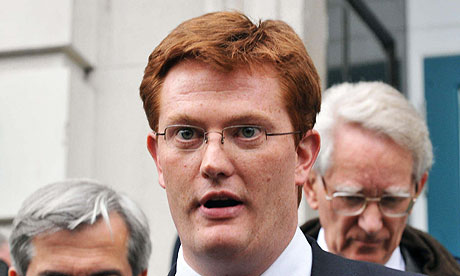
 The ConDem government yesterday followed up previous cuts announcements with further cuts of £2bn and a shelving of planned projects worth £8.5bn, adding a total of £10.5bn to the initial £6bn worth of cuts. The dopy-looking Liberal treasury secretary Danny Alexander was sent before the cameras to cop the heat for this.
There should, you would think, be no discomfort in this for a party that is led by its most unashamedly neoliberal faction, a faction that in some respects has pushed the Tories to the right. And at the moment, the polls suggest that the propaganda campaign is winning. Most voters are willing to blame the last government for the budget cuts, thus suggesting that the narrative of profligate Labour spending causing the deficit has successfully framed the debate for the time being. This is not to say that people favour cuts - the polls also register real worry about how deep the cuts will go, and how rapidly they will be introduced. The aggressive Tory agenda now being imposed was overwhelmingly rejected at the polls. But it's hard to turn on the television or open a newspaper without being advised in alarmist, hysterical tones that there is no money, and it's all the fault of public sector fat cats. However, in the long term, there is a real problem for the Liberals in being seen as part of a government of right-wing millionaires cutting spending for the poor. And some of the previously announced spending reductions hit the working class hard. Cuts in housing expenditure, in free school meals for the poor, and in childcare. The latest cuts hit job creation schemes, infrastructural projects, hospital construction and development. And, of course, it's just the beginning.
The economic logic of the cuts has been distilled for us into a few mantras: we need confidence in the markets; we need a balanced budget; and we need growth led by the private sector. But if anyone's buying this, they won't be in the highly probable event of its resulting in a deflationary spiral. There is no urgent need to pay off the deficit, and doing so at this time and in this way is econocide. As Tim Binding points out, the logical thing to do from a point of view of securing growth would be to redistribute wealth. Well - the cuts do redistribute wealth, but in the wrong direction. The budget cuts are a class project, not a programme for economic revival. Call me a blithe optimist, but I don't think it will be long before this becomes glaringly apparent to the vast majority of people. I give it a few months, though this would not by my first incautious prediction this year. Which raises some questions for the stability of the ruling coalition.
The Liberals, already down 10% in the polls on their pre-election standing, and sometimes as much as 5% below the votes they polled on 6th May, should lose heavily from this. They have benefitted from a surge in support for 'third party' candidates, rising to levels last seen in the 1920s, but their voters have never been a Thatcherite bloc. Ross McKibbin describes the Liberal vote as the least regionally concentrated of the parties, a source of weakness for them in the current electoral system, but this reflects a geography of class, as the Liberals are the only party to have a genuinely cross-class electoral base. They could now lose whatever gains they made in working class, previously Labour heartlands. The C2 vote, usually characterised as the "skilled working class" - really a section of the skilled working class - gravitated away from Labour in various directions, giving both the Liberals and the Tories some of their gains in the last election. But that is not a loyal voting base, and a shift in that vote as the cuts exact their toll is likely to continue to squeeze the Liberals. The Tories may not lose as much, as they could make up whatever they lose in C2 votes with a gain in the AB votes lost to Labour for a decade or so. But their support in the election was only 37%, and it would only take a small shift in votes to give the plurality back to Labour.
This is one reason why business, the banks and the civil service dreaded the prospect of a minority government having to implement cuts and then face re-election in 6-18 months, and why the civil service elite moved to change the rules of the game. Susan Watkins explains:
To the despair of election-night commentators, the May 6 count produced no uniform pattern. ... Britain awoke on May 7 to the likelihood of a weak Tory government and a return to the polls by 2012.
With protests raging in Greece against the PASOK austerity measures, and acrimonious disarray among European governments on how to deal with Eurozone banks’ imbrication in the looming sovereign-debt crises, this was not an outcome Whitehall or the City of London wished to see. ... Austerity measures had been delayed until the May 2010 election was out of the way. The prospect of a minority government, battling to push through closures and redundancies under the shadow of further popular reckoning, was not one that Britain’s rulers could contemplate with equanimity.
Within five days that prospect had been ruled out of court. As a Financial Times report explained: ‘The Cabinet Secretary has positioned the civil service to take maximum advantage of the political uncertainty’. The House of Commons was suspended, on the basis of a draft constitutional handbook which mps had not been permitted to debate, while teams of functionaries helped to coach party leaders towards a mutually beneficial outcome. The next election would be delayed until 2015, with the instant introduction of fixed, five-year parliamentary terms. The majority needed for a no-confidence vote in Parliament would be raised to 55 per cent. Conservative and Liberal Democrat manifestos were elided into a single statement, with a pledge of future referenda to broker the two key areas of difference: electoral reform and further EU treaties. On 12 May, Cameron explained to the waiting press corps that he and Liberal Democrat leader Nick Clegg had come to realize, over the course of the negotiations, that the idea of a minority Tory government was ‘just so uninspired’. The Lib–Con coalition government, announced by the two youthful, telegenic party leaders in the sunshine of the Downing Street garden—‘just like a wedding’—was greeted with almost universal applause. The Financial Times: ‘A seamless transfer of power—a good week for the pragmatism and commonsense of the British constitution.’ The Economist: ‘The best possible outcome, given the ropey electoral numbers—we welcome it.’ The Guardian: ‘The public seem pleased with the coalition . . . This is surely the right response.’
That the "pragmatism and common sense of the British constitution" should come to the rescue of capital, saving it from "ropey electoral numbers" and the unimpressive ambivalence of the British public, should be no surprise to readers of Ralph Miliband. But though the constitutional fix is an important prophylactic, it is no guarantee that the government will not fall. The state, used to decades of stability, has not had to wage a protracted fight with the working class for a generation. The ruling class is far more fractious than it has been for years, lacks the ideological coherence and leadership it possessed when it last had a fight of this magnitude on its hands. It may well be somewhat out of shape.
The struggles that now ensue will inevitably play out to a considerable extent inside the Labour Party. The public sector workers are the bedrock of Labour support. The public sector unions bailed them out to a great extent in the recent election. That wasn't unanimous or wholehearted. The PCS, which has been in battle with the Labour government for a decade, has never been affiliated to the party, and its political fund is not set aside for the Labour Party. The RMT was of course expelled, and the FBU disaffiliated. There has been loud grumbling in other unions like the CWU. But by and large, public sector workers remain Labour, and they are the ones who are going to be in the frontline of the cuts, and the fightback. This has two key implications. The first is that union leaders may, to avoid embarrassing the Labour leadership and keep their powder dry to help 'their' party back into government, try to keep a lid on strikes and protests. They will certainly act as a conservative force. That does not mean that they can be bypassed, or that they should be treated as an 'enemy' on a par with the bosses. But you don't have to be Dave Spart to see a potential problem here.
The second implication is that if rank and file militancy pushes the union leaders to the left, it is likely to pressure the Labour leadership from the left as well. Diane Abbot is the only left-wing candidate for the leadership. She is the only candidate who can be relied on to consistently oppose the cuts, and she has more credibility in doing so than the Milibands, Balls or Burnham. Abbott is unlikely to win, but she has good name recognition, is popular with the public and constituency Labour members, and is getting some decent play in Labour's daily tabloid, The Mirror. She doesn't have the campaigning record of John McDonnell, who has real support in the trade union movement, but she's on the right side of most arguments, and there is some anecdotal evidence that she has shifted the leadership debate to the Left. Given that Abbott is a member of the Campaign Group and is seen by the Blairites as a relic of the hard Left they spent the 1980s and 1990s trying to crush, the fact that they have to adapt to her somewhat is not an insignificant development.
At any rate, whichever one of the disgusting New Labour quad actually wins the leadership, they are all aware of how much they depend on the organised labour movement, and of the need to solidify their standing in working class communities. They will try to resolve this in the most reactionary way possible, say through immigrant-bashing and authoritarian populism on 'anti-social behaviour'. But that relationship of dependency will make it very difficult for them to ignore any struggles that take place. And it does mean that Labour members and supporters will be at the heart of any cuts campaign, and that anyone who thinks they can ignore or bypass the Labour party is deluding themselves. Not that you should join the ranks of lefties flooding back to Labour - it's not an empowering experience. But just don't imagine that the resistance to the cuts will take place without the central involvement of the Labour Party, for all the problems and opportunities that presents. I would infer that this also means that in electoral terms the coming period will see a consolidation of Labour's working class vote, and fewer opportunities for left-of-Labour campaigns.
A first step toward building the anti-cuts campaign will be the budget day protests next week. Large, confident protests will disrupt the inevitable attempt to present the cuts as some sort of consensual process with a democratic mandate, so do attend wherever you can.
Labels: blairites, budget, cuts, david cameron, david miliband, diane abbott, ed balls, lib dems, liberals, neoliberalism, new labour, nick clegg, spending cuts, the meaning of david cameron, tories
10:15:00 am |
Permalink |
Comments thread |
|
Print |
Digg |
del.icio.us |
reddit |
StumbleUpon |
Tweet|
Share|
Wednesday, June 09, 2010
A return to Balls. posted by Richard Seymour
Sunny Hundal, as he promised in successive tweets, has argued in defence of Ed Balls' Observer article on immigration. He concedes some of the criticisms, and stakes his defence on a number of issues, but principally on the ground of what he calls "pragmatism". Namely, he says that the Labour Party has to attend to what its core economically left-wing but socially conservative working class voters are saying. He further argues that since the Left "lost the debate" over immigration, it is time to accept reality and move on. "You can't win a war you've just lost," he implores.The trouble with this narrative is three-fold. First of all, the stereotype of a socially conservative Labour core was always misleading. The core Labour vote was less motivated by the issue of immigration than swing voters were. That isn't to say that there isn't hostility to immigration in the working class today - there is, and Labour bears a great deal of responsibility for this. But is it to say that immigrant-bashing isn't aimed at heartland Labour voters, but more likely at swing voters and Tories. Secondly, why is it that when Labour politicians want to woo the 'core' vote, they always omit the business about being economically left-wing, and accentuate the socially reactionary? Actually, more to the point, is there even a clear dividing line between the social and economic in this case? Is immigration not an economic policy? If the working class is economically left-wing on account of class interests, then a policy that restricts the free movement of labour in Europe (while capital, goods and services freely move across borders) is one that harms working class interests by weakening its bargaining power. If workers cannot move freely to wherever jobs are available, this means artificially forcing them into unemployment, which means strengthening the position of employers with respect to Labour. Why is it impossible to imagine any Labour candidate, barring John McDonnell, articulating an argument along those lines?
Thirdly, as to the 'debate' over immigration. Sunny asserts that the left can't just blame the media for winding people up - quite. New Labour took power while the Tory media was raising a shit-storm about asylum seekers, which Blair et al were moderately dissident on. They won the election, nonetheless. Immigration was way down the list of priorities for most voters. But Labour then proceeded not merely to embrace the Conservative Party's policies and rhetoric but to institiutionalise a whole new system of repression for migrants. Subsequent reports, initiatives and legislation, particularly after the north-east riots of 2001, framed minorities as troublesome, alien substrata at odds with British values. While past anti-immigration legislation was sold as a necessary way of promoting tolerance and multiculturalism, by carefully controlling the 'fears' of the white majority, in the era since 2000 the implicit logic - which treats the presence of 'non-natives' as a problem - has become explicit, as immigration restrictions have been tied to an ideological attack on Britain's domestic minorities. Thus, the 'debate' has been framed for the past decade by a government pushing a neo-Powellite ideology at the level of rhetoric and policy.
Ed Balls, far from breaking with New Labour on this, is continuing the trend at an escalated pitch. That is reflected not merely in his attitude to immigration, but in his decision to wholeheartedly endorse a report supporting racist teachers, and his willingness to participate in moral panic over Muslim faith schools. His latest bit of demagoguery is to cite the prospect of Turkey's accession to the EU, and the prospect of unskilled Turkish workers coming to Britain. Vote Balls to stop the Muslim hordes taking your job. Of course, the trouble is that Turkey isn't going to join the EU in the first place, so the issue is entirely confected. France and Germany, the union's key powers, are implacably opposed to Turkish accession. Even if it did, the evidence is that its workers would only come to Britain if there were jobs for them here. That's what workers do in any economy where they have free movement, whether in a national state, or an economic union. If Balls was merely interested in reconnecting with the working class, why would he invent an issue with clear racist overtones and seek to use that to advance his leadership ambitions? What sort of man does that make him? And isn't there a lesson in New Labour's past conduct with respect to British Asians, and Muslims in particular, that anti-immigrant politics always redounds to the disadvantage of domestic minorities? Isn't that, as experts on immigration policy such as Bikhu Parekh have long argued, the lesson of anti-immigrant politics, period? What sort of friend would Balls be to those core Labour voters?
Another basis of Sunny's defence is that while aggregate studies may show little impact from Eastern European migration, this doesn't exclude the possibility of localised problems that are obscured by national studies. It surely doesn't. But if there is evidence of this, Balls doesn't cite it, and neither does Sunny. And if it does cause problems, surely the answer is not to insist on imposing restrictions on the numbers who can migrate to the UK, but to contrive solutions that specifically address those problems. Because Balls is actually going farther than Cameron here. Cameron wants to impose a cap on non-EU immigration. Balls wants a cap on all immigration, full-stop. Sunny suggests that Balls is just bluffing in this respect, and that we shouldn't pay it any mind. But actually, it is his only concrete policy. He may be bluffing, but what a racist, irresponsible bluff. And it is an odd "defence" that writes off Balls' key proposal in such an off-hand way. Once you've allowed for bluffing and hype to wind up those 'core' Labour voters, discounted the 'Turkish peril', and found no reliable evidence of a negative impact of immigration on British workers' wages or conditions - in short, once you've found no empirical support for the problem Balls claims to identify, and discounted his concrete solution as a bluff - what is there left to defend?
Labels: capitalism, ed balls, european union, immigration, neoliberalism, new labour, racism, working class
10:50:00 am |
Permalink |
Comments thread |
|
Print |
Digg |
del.icio.us |
reddit |
StumbleUpon |
Tweet|
Share|