Wednesday, October 31, 2012
Meme logic posted by Richard Seymour
Memes are an interesting way in which people appropriate mass culture seemingly for their own ends - pictures taken from movie stills, stolen photographs, domestic cat pictures, or crude sketches, fixed to a slogan that is either cute, snarky, ironical, or emetically sentimental. The ways in which these work politically are complex, but particularly where sentiment is involved, a simple Barthesian analysis, with all its limitations, can be sufficient to indicate the dominant tendency. This is a particularly irritating example:
The logic of this image is profoundly ideological (Islamophobic, imperialist, chauvinist, etc), but in what way? It isn't obvious, but nor is it concealed. There is no smoke screen. The ideology works by chains of connotation.
In and of itself, this image depicts a well-known 'ex-Muslim' neoconservative, who has participated in racist reaction in the Netherlands before joining the US right, next to a particularly banal sentiment that one assumes she has uttered at some point. Putting it more kindly, and in the light it is intended to be seen in, it shows a woman who has been raised as a Muslim and described her suffering due to a particular type of religious dogma, articulating a lapidary defence of secular liberal virtues. She has a dignified comportment and dress, a handsome face (yes, it shouldn't matter, but...) and an intelligent expression. That's the literal signification, or denotation.
The connotative signification goes something like this:
"Muslims are violently intolerant, a threat to liberal values of religious toleration going back to Locke. To refuse to acknowledge this and take the appropriate measures (kulturkampf), or to dispute it in any serious way, is to defer to a politically correct consensus that denies reality in the name of polite anti-racism. And what better answer to the politically correct brigade than this black woman who has experienced the worst practices of Muslims, who was raised Muslim and knows the threat that Islam poses in detail? Surely she is the one defending Western values, while their historical champions, liberal intellectuals, capitulate to obscurantism and reaction!"
As I say, nothing is concealed - everything is there in the open. The image works, rather, by establishing a myth, and naturalising the ideology it articulates. That is, if the signification of the image is accepted by its intended myth-consumer, it establishes an apparently natural link between the literal signification and the connotative signification. If read critically, the connotations begin to dissolve: one notices that tolerance is not an obvious, but a contested term; that Hirsi Ali's idea of waging cultural war against Islam (banning Muslim schools, going to war, etc) has at the very least a dubious claim to tolerance; that the Islam she remonstrates and mobilises against is a static, essentialised, literalised, homogeneous bloc which by no means coincides with the complex, contested families of meanings and practices that one actually encounters as Islam; that the political forces she has allied herself with and supported aren't even allies of liberal virtue, or Enlightnment in its real, historical sense; that the 'West' itself is every bit as dubious a concept as 'the white race', onto which it largely maps; and so on.
But the ideal consumer doesn't read critically. S/he absorbes the whole mythological chain of meanings attached to the image, and thus absorbes a racist, belligerent ideology in pseudo-progressive get-up. It is exactly like an advertisement in its logic. One looks at Kate Moss advertising eye mascara; her indifferent, made-up visage, gazing at the consumer against a backdrop of swirling blacks and reds. The image connotes rebelliousness, power, sexuality, self-control and presence, both in terms of the colour scheme and fonts and the well-known back story of the 'troubled' model. There is no concealment of the advertisement's meaning. The literal meaning (here is a beautiful model who is advertising her line of make-up) is as explicit as the mythical meaning (possessing this make-up gives one the presence, social power and independence of Kate Moss!). The connection between the two is naturalised, as are a chain of profoundly ideological, contested ideas - like 'beauty' for example, or like the idea that a woman's worthiness for attention and power are contingent on her identifying at a symbolic level with the male gaze. Memes in this sense, and of this type, are advertisements for a usually dominant ideology, circulated voluntarily through social media, as unpaid labour.
There are a host of other examples I could have picked; one sees dozens daily. Earlier today, I saw a popular one: an image of a 'poppy' represented as a stainless steel lapel pin, with a banner slogan on it - "try burning this". It was obviously a defiant, ironical retort to those Islamist desperadoes who (treason! infamy!) reportedly burned poppies a couple of years ago. And I believe the chain of connotations attached to this image are just as obvious, as is the reactionary ideology that the image reinforces. There are hundreds of thousands, if not millions, of images like this colonizing the internet. One senses that in the rise of memes, the dissident, subversive possibilities are more than compensated for by their potential role as a new technique of governmentality made possible by social media.
Labels: barthes, connotation, cruise missile liberals, islamophobia, liberalism, marxism, memes, racism, structuralism, the liberal defence of murder, war on terror
12:32:00 am |
Permalink |
Comments thread |
|
Print |
Digg |
del.icio.us |
reddit |
StumbleUpon |
 Tweet|
Share|

Monday, July 16, 2012
Liberal Defence of Murder: Relaunch posted by Richard Seymour

Labels: british empire, colonialism, cruise missile liberals, iraq, liberal imperialism, liberalism, libya, middle east, the liberal defence of murder, US imperialism
6:22:00 pm |
Permalink |
Comments thread |
|
Print |
Digg |
del.icio.us |
reddit |
StumbleUpon |
Tweet|
Share|
Tuesday, June 19, 2012
The Liberal Defence of Murder paperback posted by Richard Seymour

Labels: cruise missile liberals, imperial ideology, liberal imperialism, liberalism, the complete and utter works of richard seymour, the liberal defence of murder, the liberal defense of murder
2:14:00 am |
Permalink |
Comments thread |
|
Print |
Digg |
del.icio.us |
reddit |
StumbleUpon |
Tweet|
Share|
Thursday, July 28, 2011
Libya posted by Richard Seymour
"Fresh diplomatic efforts are under way to try to end Libya's bloody civil war, with the UN special envoy flying to Tripoli to hold talks after Britain followed France in accepting that Muammar Gaddafi cannot be bombed into exile."The change of stance by the two most active countries in the international coalition is an acceptance of realities on the ground. Despite more than four months of sustained air strikes by Nato, the rebels have failed to secure any military advantage. Colonel Gaddafi has survived what observers perceive as attempts to eliminate him and, despite the defection of a number of senior commanders, there is no sign that he will be dethroned in a palace coup."The regime controls around 20 per cent more territory than it did in the immediate aftermath of the uprising on 17 February."
Labels: 'humanitarian intervention', cruise missile liberals, liberal imperialism, libya, NATO, obama, US imperialism
2:17:00 pm |
Permalink |
Comments thread |
|
Print |
Digg |
del.icio.us |
reddit |
StumbleUpon |
Tweet|
Share|
Saturday, May 07, 2011
"Unmitigated evil" posted by Richard Seymour
This is amazingly bonkers:
Labels: 'new atheism', 'secularism', christianity, cruise missile liberals, imperialism, islamophobia, liberal imperialism, missionaries, the liberal defence of murder
2:10:00 pm |
Permalink |
Comments thread |
|
Print |
Digg |
del.icio.us |
reddit |
StumbleUpon |
Tweet|
Share|
Friday, March 11, 2011
Against agreeable forgetting posted by Richard Seymour
"It could reasonably be objected that this would rule out support for practically every military intervention Western states have ever carried out; but if so, it is not at all to be lamented, given the catastrophic consequences of the carte blanche that the humanitarian interventionists have frequently allowed to those states, often to their later regret. There is a temptation to say that, given a sufficiently catastrophic situation, these stipulations ought to carry less weight. This is to say that humanitarians ought to be more willing to take risks with the lives of others by urging intervention, whatever the motives of imperial states. Precise calculations of cost and benefit are not necessarily always available, it could be argued. Sometimes, the interests of powerful states might coincide with those of oppressed groups. Let us concede that this is at least a possibility: that the strategy of one military power, even one guilty of the worst crimes, can lead to a reprieve for a threatened population. But, if we are really concerned about the fate of oppressed groups, we also have to concentrate on the other possibility: that even given the best motives, the intervention of powerful states can exacerbate the baleful conditions they were supposed to eliminate – and the burden of history suggests that we are never dealing with the best motives or even very creditable ones."
| — | The Liberal Defence of Murder, Verso, 2008, p. 221 |
Labels: 'humanitarian intervention', cruise missile liberals, dictatorship, liberal imperialism, libya, revolution, the liberal defence of murder
3:14:00 pm |
Permalink |
Comments thread |
|
Print |
Digg |
del.icio.us |
reddit |
StumbleUpon |
Tweet|
Share|
Sunday, February 06, 2011
The liberal defence of mass murder posted by Richard Seymour
Would the liberal commentariat be happy to sacrifice Egyptians for the sake of capitalism?One of the guests, Professor David Cesarani, floated the idea of there being a Tiananmen Square-style massacre in Egypt as a way of quelling potential post-Mubarak anarchy. And there has been no outrage. No Twitterstorm, no blog-based apoplexy, no heated radio phone-ins. Perhaps talking about the massacre of Egyptians is normal these days.
Professor Cesarani was asked by Michael Portillo about the “moral dilemma” of how to deal with what comes after Mubarak. What if it’s worse than Mubarak? Should it be crushed? Professor Cesarani said that if one takes the “wholly pragmatic view”, then “the outcome of a Tiananmen Square-style crackdown is desirable and is predictable”. Because, he said, “if you allow this popular democratic movement to run on unchecked, you cannot predict what’s going to happen. But you can predict probably that after a short, sharp, massive clampdown at huge human cost, there will be a sullen stability.”
Portillo was startled. “Quite a lot of people would be quite shocked to hear what you said – that a Tiananmen-style outcome would be desirable.” Cesarani responded that “the West is no longer weeping that much over Tiananmen Square because we’re doing a lot of business with China. So, many business interests would say, quietly, that, perhaps, well the way in which the Chinese managed their transition was preferable.” Another panellist, Matthew Taylor, former adviser to Tony Blair and now chief executive of the Royal Society of Arts, later described Cesarani’s comments on Tiananmen Square as “incredibly brave” and said: “In a way, I can see his argument.”
Granted, this is Brendan O'Neill's version of events, so you may wish to take this with a pinch of salt.
Labels: cruise missile liberals, dictatorship, egypt, liberal imperialism, massacre, revolution, US imperialism
5:52:00 pm |
Permalink |
Comments thread |
|
Print |
Digg |
del.icio.us |
reddit |
StumbleUpon |
Tweet|
Share|
Friday, August 06, 2010
HP Sauce in racist harassment shocker posted by Richard Seymour
Lately, Harry's Place awarded posting rights to the deranged racist Terry Fitzpatrick, who has established himself at the Socialist Unity blog as an unpleasant and dangerously deluded man with a persecution complex. Apparently, Andy Newman tolerated him because of his glorious past as an anarchist bank robber and anti-racist, sometime back in the 1970s. It transpires that Fitzpatrick has been engaging in a campaign of racist harassment against Lee Jasper for some years now. He accuses Jasper of crack dealing and pimping, and calls him, among other things, a "fucking n*****r ponce". Under Socialist Unity's post on the subject, Fitzpatrick is allowed to repeat his charges.
Lately, Harry's Place launched one of their routine psycho-ceramic campaigns to vilify an opponent as antisemitic - an accusation that Fitzpatrick is handy with too, which is why he was welcome at Harry's Place. Their target was Operation Black Vote, which criticised a heavy-handed police raid on a Nation of Islam mosque in Brixton (the police alleged that they believed it was a "cannabis factory"). The accusation was a variation of the 'Links' game that Justin Horton described on this blog a few years ago. OBV sided with the Nation of Islam, which is antisemitic, so therefore OBV must be antisemitic too. That particular attack was composed by Edmund Standing, whose bilious attacks on Muslims, Muslim organisations, the Quran, political correctness, the left (etc etc) have now spilled over into a libel against a moderately left-of-centre anti-racist organisation.
Lee Jasper, of OBV, wrote a rejoinder to the attack, while also pointing out that Harry's Place hosted an outright racist crank among its writers. He pointed out that Fitzpatrick had been stalking him and subjecting him to the most vile racist abuse. The usual Harry's Place dirt piled on, refusing to take his claims seriously, minimising their import, changing the subject, denouncing the victim of said racism. For such people, the only real victims of racism are Israeli war criminals. As Andy Newman puts it, "Jasper was then not shown solidarity as a victim of racism, but further harassed, and harried over unrelated issues of what his views are on Louis Farrakhan. ... Jasper was accused of being a liar, and being obsessed with race."
Lee Jasper himself writes that "Harry’s Place refused to take my complaint seriously. They trivialised that compliant, they denigrated me as a victim of serious racist abuse and they sought to obscure that compliant by constant counter accusation and showering me with personal abuse." Evidently, some of Fitzpatrick's grotesque racist abuse was allowed to appear on the HP blog itself. Jasper notes that the blog sought to cover for Fitzpatrick, since as soon as Fitzpatrick's racist harassment was reported to the police, and he was charged, "all of his most rabid and racist comments were removed by Harrys Place overnight". Finally, reluctantly, Harry's Place withdrew Fitzpatrick's posting rights, and barred him from the blog. Their final act of arse-covering was to note that Fitzpatrick has long had an association with the anti-fascist Searchlight magazine, for which he has written articles in the past. Searchlight, Jasper notes, has been curiously, sadly silent on this issue. They too migh wish to consider why Fitzpatrick has been allowed to draw on Searchlight's immense bank of credibility long after it had become clear that he was a delusional bigot.
Labels: bnp, cruise missile liberals, hp scum, islamophobia, lee jasper, liberal imperialism, operation black vote, racism, zionism
8:33:00 am |
Permalink |
Comments thread |
|
Print |
Digg |
del.icio.us |
reddit |
StumbleUpon |
Tweet|
Share|
Monday, February 09, 2009
Centrism and bipartisanship can, in extreme cases, lead to social catastrophe and mass murder posted by Richard Seymour
Notwithstanding the chorus of disappointed tuts and boos from Obama's liberal supporters regarding the pared down 'stimulus' package, some - such as the genuinely endearing Michael Tomasky - are in a mood to celebrate. A hammering victory over the Republicans, he cheers, a decisive sea-change in American politics, the return of big government liberalism! And hell, even if we have to make the odd concession, liberals are still getting 80% of what they wanted. Eighty percent! It's time for another street parade, already. Bring out the banners: "Yes, He can".Tomasky, to be fair, has a niche role to fulfil. He apologises to the world for his fellow liberals, and their odd ideas, and then patiently explains to them why they should support the Democratic centre in all its wisdom. Thus, he spent much of the war on terror resisting the twin threats of Cheney and Chomsky, while explaining that liberals needed to be as tough and hawkish in foreign policy as the GOP. Adopting the politics of Richard Perle (with added incoherence and a frontispiece of selective multilateralism) was at the time the Democratic mainstream, and Tomasky was its avid advocate. Today, in a similar role, he explains that liberals are too used to being negative ninnies and, for this reason alone, fail to savour the taste of victory - in the jaws of defeat? (Luckily, Newsweek doesn't fall for any of that liberal nonsense, and has determined the real story: We Are All Socialists Now.)
What if one were to start from different assumptions? Perhaps, following Paul Krugman, one should start by being as radical as reality itself. Rather than tail the Republicans, American liberals should gauge the scale of the challenges they face and measure any putative successes against that. To be sure, if McCain had won, the bill before the House of Representatives and Senate would probably have much more emphasis on upper class tax cuts and fewer concessions to what are invariably called 'middle class' interests. Liberal activists can take their share of credit for the defeat of the Republican electoral machine, and the pressure this momentum brought to bear on Washington - so there is something for them to be cheerful about. However, it has to be said that even this would have been impossible had Obama's supporters all been as timid as Tomasky. And if they now adjust their expectations to accord with Obama's agenda, they will get even less than they presently think they are settling for. First of all, it is important to note that American liberals aren't getting 80% of what they asked for: they are, if the bill passes, getting some reduced version of what Obama proposed, which is not the same. Secondly, Obama's proposals were horribly inadequate. Here is Krugman:
Even if the original Obama plan — around $800 billion in stimulus, with a substantial fraction of that total given over to ineffective tax cuts — had been enacted, it wouldn’t have been enough to fill the looming hole in the U.S. economy, which the Congressional Budget Office estimates will amount to $2.9 trillion over the next three years.
Yet the centrists did their best to make the plan weaker and worse.
One of the best features of the original plan was aid to cash-strapped state governments, which would have provided a quick boost to the economy while preserving essential services. But the centrists insisted on a $40 billion cut in that spending.
The original plan also included badly needed spending on school construction; $16 billion of that spending was cut. It included aid to the unemployed, especially help in maintaining health care — cut. Food stamps — cut. All in all, more than $80 billion was cut from the plan, with the great bulk of those cuts falling on precisely the measures that would do the most to reduce the depth and pain of this slump.
On the other hand, the centrists were apparently just fine with one of the worst provisions in the Senate bill, a tax credit for home buyers. Dean Baker of the Center for Economic Policy Research calls this the “flip your house to your brother” provision: it will cost a lot of money while doing nothing to help the economy.
All in all, the centrists’ insistence on comforting the comfortable while afflicting the afflicted will, if reflected in the final bill, lead to substantially lower employment and substantially more suffering.
This is the trouble with apple pie sentimentality about bipartisanship, and all of the usual "neither Republican nor Democratic, but American" garbage. It is harmful to your jobs, to your healthcare, to your food cupboard. And it can, as in the case of Iraq, lead to mass murder.
Labels: bipartisanship, centrism, cruise missile liberals, iraq, liberalism, us economy
8:48:00 am |
Permalink |
Comments thread |
|
Print |
Digg |
del.icio.us |
reddit |
StumbleUpon |
Tweet|
Share|
Tuesday, January 27, 2009
Obama and the liberal defence of murder posted by Richard Seymour
Yours truly in The Guardian. Amusingly, a lot of the regular Guardianistas seem to be really pissed off about the mean things I said about Obama's foreign policy.Labels: barack obama, cruise missile liberals, the complete and utter works of richard seymour, the liberal defense of murder, US imperialism
6:37:00 am |
Permalink |
Comments thread |
|
Print |
Digg |
del.icio.us |
reddit |
StumbleUpon |
Tweet|
Share|
Sunday, January 25, 2009
Independent on Sunday reviews 'Liberal Defence' posted by Richard Seymour
"Richard Seymour is the blogger Lenin's Tomb. For the past five years, he has been following the war party, noting every suggestion of this group, and connecting their various journalistic musings to the shifts of power on the streets of Fallujah and Baghdad. Through his blog, Seymour has built up an audience of thousands of committed readers. For them and for him there must be a real pleasure at the predicament of the so-called pro-war left now faced with an Obama presidency. Atlanticist to their heart, they find that America has rejected them. At times Seymour perhaps takes too little care to acknowledge those other, precious occasions when liberals and others have refused the appeal of arms. But that quibble aside, this is an excellent antidote to the propagandists of the crisis of our times."Update: This appeared in yesterday's Times:
"The Liberal Defence of Murder by Richard Seymour Verso, Eur16.99 Eur15. 29 In a powerful counter-blast against the monstrous regiment of "useful idiots" who, he says, have contributed in recent decades to the murderous mess of modern times, Seymour indicts not only the obvious suspects - the neocons - but the international cadre of liberal, left-leaning intellectuals and politicians, the "pro-war Left", who supported the War in Iraq for professed "humanitarian" reasons. In anger as much as sorrow, he examines the tropes they defend, such as "civilisation", "progress", "democracy", "freedom", arguing that their attitudes amount merely to an assertion of the status quo, supportive of neo-imperialism, Islamophobia and exploitation."
Labels: cruise missile liberals, the complete and utter works of richard seymour, the liberal defense of murder
12:12:00 am |
Permalink |
Comments thread |
|
Print |
Digg |
del.icio.us |
reddit |
StumbleUpon |
Tweet|
Share|
Sunday, November 16, 2008
Death of the liberal world order posted by Richard Seymour

A set of parallel intuitions developed with the collapse of the USSR and quickly became hegemonic. Even if one didn't accept the more comical variants of the 'end of history' parable, public discussion was governed by three fundamental suppositions: 1) globalisation meant the end of national state economies with extensive regulation and inbuilt welfare safety nets; 2) the end of the USSR meant that state sovereignty was no longer as central to the world system, and new forms of cosmopolitan law were emerging which might override national sovereignty given a failure to respect certain basic norms. Pinochet might be arrested in London, Kissinger might end up on trial in the Netherlands, Milosevic might end his years in jail. UN forces and regional security alliances might mediate in domestic crises, not necessarily with the approval of the state, and always to reinforce a minimal liberalism in the treatment of people. The overthrow of authoritarian regimes in 1989 was seen to propel other, similar revolts in South Africa, Indonesia, South Korea, and eventually Serbia and perhaps the 'colour-coded' revolts of the early 2000s - however different these examples were, they were all seen as part of a democratising process immanent to the new world order; 3) subjacent to both processes was an unprecedented global unipolarity in which America, whose awesome dominion had invaded the previously hostile territory of the Warsaw Pact states, accumulated epithets including Hubert Vedrine's choice phrase: 'hyperpower'. Its resources, its domestic liberalism and rights culture, its pro-capitalism and its freedom to act outside the constraints of a dirty Cold War would - given a globally oriented executive - propel it to take liberal internationalism through its final negation, toward a cosmopolital liberal world order.
Unipolarity has a certain charm as a theory. The US is the world's largest economy, and military power. The second and third largest national economies in the world remain Japan and Germany (the EU is larger than the US, but is hardly a 'national economy'), both of whom developed under US tutelage and both of whom retain American garrisons. The fifth largest economy, the UK, remains committed to a strategic alliance with the US, and subordinates its foreign policy goals to those of Washington. Several regionally important countries around the world are tied to America by defense and economic interests - for example, South Korea on the Pacific side, Poland on the Atlantic side. The apparatus of economic and financial dominance belongs effectively to the United States. These include not just the IMF and WTO, but also organisations like the European Bank for Reconstruction and Development, which is mainly funded by the US and which oversees neoliberal restructuring in 'transitional' countries. The NATO alliance binds 25 European and Asian countries to the US, and comprises 70% of global military spending. Neither of the main emerging competitors, India and China, have the military clout or the economic leverage to match the US. India, the fourth largest economy by purchasing power parity, having embraced Washington-driven neoliberalism in the 1990s, is now party to a nuclear alliance with the US (voted for by both 2008 presidential candidates, incidentally). This deal is supposedly restricted to civilian nuclear fuel, but it is no secret that the Indian state was running out of uranium ore, was anxious to build up its nuclear threat in opposition to Pakistan as quickly as possible, and will use the opportunity to reclassify military sites as civilian ones to refuel, and use its domestic uranium resources for the remaining military sites. This is unmistakeably a military agreement in civilian drag. India's days of non-alignment were, realistically, over long ago, but this arguably sealed the deal: it is now effectively a US sattelite.
One could rattle off factoids and examples in a similar vein for some time, but it would only be more misleading. We can overstate the unity of the Euro-American alliance, only if we forget about South Ossetia. The capacity of American military power to defeat resistance met clear limits in Iraq, despite the obviously disarticulated, fractious nature of the opposition. Latin America, including Brazil - the ninth largest economy by purchasing power parity, and one of the largest emerging markets - is slipping out of the US grasp, partially through popular movements and partially by cutting deals with Russia, China and Iran. The US even embarrassingly lost a key 'lily pad' in Uzbekistan, after it bent over backward to defend its local torturing dictatorship. The trends militating against sustainable American dominance were already becoming visible in the latter half of the 1990s, but it is precisely at this point that a deranged triumphalism was most likely to be vocalised alongside clamorous demands for intervention here and there.
The particularism embedded in universal claims is a distinctive American tradition: an evangelising, universalising Americanism is equally suffused with an American parochialism, a nationalism that embodies a local ruling class interest. In his appearance before the G20 recently, Bush made a last-ditch appeal to respect the terms of free market ideology, placing particular emphasis on free trade. Such an appeal from such a highly protectionist American president would seem rather odd if it wasn't reasonably well understood that the jargon refers particularly to various 'free trade' agreements that are advantageous to the US. It obviously does not refer to an institutionalised framework of free trade in which America and the EU abandon agricultural subsidies in exchange for the concessions extracted from developing countries. Moreover, the president who oversaw a drastic expansion of the state's role in the economy, responsible for the largest nationalisations in history, might have seemed an odd person to be making reassuring noises about the fundamental aptitude of 'free markets', were it not obviously a conventional code for policies that run down the social-democratic content of the state. The evidence is that far from governing a gradual process tending toward the subsumption of national polities into a heavily institutionalised global order, the US continues to pursue the usual hub-and-spoke mechanisms of control, ad hoc bilateral agreements, status of forces agreements, security arrangements etc. Now, this obviously has implications for the seductive vision of a cosmopolitan liberal world order. American interests are often not only at odds with those of its subordinate allies, but so much so that they will actually buck the trend and throw out American-led agreements. Emboldened by anticapitalist movements, this is exactly what many states did at Cancun. Tensions with the EU over tarrifs, subsidies and WTO rulings may seem like small beer, but when substantial strategic differences, compounded by popular movements, lead to major European states (half-heartedly) obstructing an American-led war, it obviously has wider significance. Further, a great deal of US foreign policy can be explained by attempts to outmanoeuvre advanced capitalist rivals - think of the rapid efforts to supplant Germany and France in Yugoslavia, with additional benefits in encircling Russia. The resumption of the nuclear arms race with Russia in the 2000s, the pursuit of the defense shield, the expansion of NATO, and the placement of American bases across Central Asia ultimately led to a conflagration in South Ossetia in which Georgia took its American-trained troops and its American-supplied weaponry and carried out an indiscriminate attack on Tskhinvali which killed Russian peacekeepers. Russia responded with a brutal invasion of Georgia, would-be future NATO member. The US responded with some tough talk and threats, but also watched helplessly as European allies noisily broke ranks. It has been noted, and merits repetition, that if Georgia had been a NATO member at the time of the conflict, then other members of the alliance would have been obliged by its terms to 'defend' Georgia. No road to global peace, this.
So, what if the liberal teleology was wrong? What if the US was not the bearer of the Spirit of History, and what if its various auxiliaries were not governed by an obscure cunning of reason - in which, for example, the ICTY would eventually morph into a judicious and impartial world court? Suppose the US ruling class meant that shit when it told the ICC to go fuck itself and continued to support death squads, dictatorships and anti-democratic movements? Imagine that the presumed symbiosis between 'Western power' and global institutions of political, legal and economic governance did not materialise? What if the liberals' solipsistic conviction that political opposition to neoliberal hegemony was either temporary irrationality or non-existent proved a false consolation? What if the 'Pacific Union' of states bringing Japan, Europe and America together really was just a version of American hegemony, not an 'international community', and certainly not a germinal 'global state'? What if America's habitual disregard for the rules of the institutions that it promulgates, including the WTO and the IMF, proved to be less than accidental? What if the world didn't flatten, the global economy continued to be crisis-prone, and relations between the advanced capitalist states were not so pacific as to rule out inter-imperial rivalry of the pre-1945 variety? And, finally, what if the most likely future vista is one of increasingly autarkic states, more authoritarian government, an escalated arms race, riskier confrontations on the global frontiers, sustained economic turmoil and renewed political polarisation?
Labels: capitalism, cruise missile liberals, Georgia, international relations, liberals, neoliberalism, russia, US imperialism
4:50:00 pm |
Permalink |
Comments thread |
|
Print |
Digg |
del.icio.us |
reddit |
StumbleUpon |
Tweet|
Share|
Thursday, April 24, 2008
Guy Hocquenghem posted by Richard Seymour
 I just wilt over the thought of French revolutionaries. And, looking at the youthful Guy Hocquenghem - as he was during the tumult of '68 - who could blame me? And what I like about Guy Hocquenghem should be obvious enough. A gay liberationist, a founder of the Front Homosexuel d'Action Revolutionnaire, a leader of French cultural revolution, and - what else? - a scathing critic of those who "traded Maoism for the Rotary Club". The weaknesses and downright absurdities of French Maoism need no rehearsing here, although it is a fuck sight better to have illusions in Mao than to be a corrupt stooge of Mitterrand. At any rate, it isn't clear that Hocquenghem himself was ever a Maoist except in the perverse sense.
Hocquenghem had been expelled from the PCF for his homosexuality, and had then been excluded from the Trotskyist Ligue communiste revolutionnaire (the great LCR which, sadly, is soon to liquidate itself into an anticapitalist party of some sort), because of his fondness for 'direct action' which was seen as a Maoist sin. He had been part of a loose confraternity of the radical and revolutionary left, and was inspired by Huey Newton's support for gay liberation. He rejected a certain class of gay rights as constituting a new normativity that was deadly to desire, and even leftist discourse was susceptible to this normalisation. It was necessary to sustain the culture of marginality and deviance, to resist not only legalism and moralism, but normality itself. You can see how this would be compatible with a certain kind of ultra-left politics, and indeed he became convinced that capitalism should be assailed on all fronts at once, rather on its strategically weak points as the orthodox marxist position insisted. And Hocquenghem operated in a Maoist milieu including his work with the journal Tout!. However, when Maoists of the Gauche proletarienne (GP) tendency started to defend Pakistan's suppression of the Bengali liberation struggle, Hocquenghem was a harsh critic. Ironically, he criticised them and the regime they emulated, for being insufficiently Maoist - la pensee maotsetung was the authentic Maoism that was being betrayed by the CCCP and its supporters.
As for the 'nouveau philosophes' and their milieu, it was not their abandonment of Maoism that Hocquenghem attacked so much as the way in which former street-fighters or would-be street-fighters like Andre Glucksmann, Bernard Kouchner and even Daniel Cohn-Bendit had become bourgois, careerist and conformist. The activists who had co-founded the student publication Action at the Sorbonne with Hocquenghem were, by 1981, part of Mitterrand's Restoration. They defended the French state's imperial intervention in Chad, and its nuclear 'shield' at a time when Mitterrand was abandoning the Gaullist posture of restricting the use of nukes to France's self-defense, and suggesting they might become part of the anti-communist arsenal. They hypocritically denounced the youth for their apathy, yet would deprive them of the excitement that would rouse their passions. They warned of the dangers of a spectral 'totalitarianism', clinging to a normality that was only one or two steps away from Travail, Famille and Patrie. Hocquenghem abused and disabused these courtiers in the style of burlesque satire, but it was a humour that originated in disgust. He never apologised for his gauchisme and, unlike the bell-wether 'contrarians' of today, knew that perversity could come in the form of gallant fidelity.
Hocquenghem, despite his obvious importance in French intellectual and political history, has not really been given the profile he deserves. The most recent attempt to undo that injustice, perhaps resulting in part from the hegemony of his foes, is a documentary entitled La Revolution du Desir. This is an extract:
Labels: cruise missile liberals, gay pride, guy hocquenghem, nouveau philosophes, pro-war 'left'
8:46:00 pm |
Permalink |
Comments thread |
|
Print |
Digg |
del.icio.us |
reddit |
StumbleUpon |
Tweet|
Share|
Wednesday, April 23, 2008
A tragicomedy in one paragraph. posted by Richard Seymour
Conveniently early in his essay on "defection literature", David Edgar gives the game away:
"Just as past generations sought to reposition the fault-lines of 20th-century politics (notably, by bracketing communism with fascism as totalitarianism) so, now, influential writers seek to redraw the political map of our time."
Do we get the idea that describing the Soviet model, with its vast network of gulags and millions of state murders and total party control, as "totalitarian" was a historical error? Certainly, that's the suggestion left hanging like a two-pig-owning kulak.
As unlettered as this evidently is, as much as it discloses the hasty prosecutorial zeal of the polemical dilettante, there is an education of sorts lurking here. A sentimental education whose syllabus, originating in Fifties America, has been relentlessly globalised. It is apt that those who disposed of marbles, scruples or both in the post-9/11 reflux should so unreflectively reproduce the precepts of anti-communism, and Andrew Anthony does not make an exception of himself.
There are three points to call attention to here. The first is that of course there is a legitimate controversy over whether 'totalitarianism' is a worthwhile concept, and another for those who accept it as to what it's reach should be. The second is that Andrew Anthony would, on this evidence, have no basis for making such discernments. For him, it is a moral failing not to accept the schema of 'totalitarianism' because for him it is just a word one uses to refer to a state that is not merely very bad, but wicked, egregious, evil. The third is that while Edgar speaks of communism, Anthony speaks of a single regime that purported to embody communism. A whole series of distinctions is being lost here: between different kinds of communist ideology; between different kinds of regime; between different kinds of movement; and between ideology, movement and regime. It is a catechism of anti-communist ideology that such distinctions do not matter, of course. The roots of Stalinist repression are in the organicist conceptions of its ideological forebears, (conceptions they shared with their apparent ideological opposites), and that exhausts all wisdom on the subject. I am not saying that this is what Andrew Anthony thinks, because that would imply that some thought had gone into his excursus, and nowhere is this in evidence. But these are the ideological co-ordinates that structure the sentiment before it is inculcated. (This propaganda film offers a concise account of the ideology, despite its now archaic feel). The political map of the twentieth century can thus be arranged in a simple binary:

Obviously, I left out apartheid and other colonial relics, not to mention indigenous genocide and most of the authoritarian states that might in some views qualify as 'totalitarian lite', 'diet totalitarian' or 'I Can't Believe It's Not Totalitarian'. Totalitarianism versus democracy, the simple all-purpose political struggle. Today, the reinvention of 'anti-totalitarianism' relies on the celebrity of the stateless criminal enterprise of 'Al Qaeda', so 'totalitarianism' is no longer posed primarily as a question of the state versus the individual. Rather, it is refurbished with Victorian cant, its dichotomies revolving around the liberal versus the illiberal, the civilized versus the uncivilized, the progressive versus the barbaric. These work, as they always have, as structures of feeling and intuition rather than as analytical frameworks. In the era of the Cold War, liberals acquiesced in crimes sometimes tantamount to genocide while their idealism and wisdom was being extolled in official propaganda and while they were assured that their ideals were defended by the Pentagon and the CIA. In era of the 'war on terror', some liberals are complicit in grave crimes just as they are encouraged to believe that their always nebulous 'values' are at stake. This is a sentimental education whose output is an unattractive and strident assertiveness about 'Western values', which is as defensive as it is obtuse. This is why its sophisters cannot help but see their critics as in some sense treasonous, for the 'other side'. This is why they cannot help but inculpate, and why they are so drawn to the accusatory style even where all they expose is their own ignorance and lack of thought. It is no laughing matter: Anthony is stuck with his Pavlovian reactions, as are his co-partisans. David Edgar just rang the right bells.
Labels: 'totalitarianism', cruise missile liberals, islamophobia, liberals, pro-war 'left', the liberal defense of murder
6:56:00 pm |
Permalink |
Comments thread |
|
Print |
Digg |
del.icio.us |
reddit |
StumbleUpon |
Tweet|
Share|
Wednesday, April 16, 2008
The quality of their mercy. posted by Richard Seymour
It is not unusual for those recanting from Left-Wing or marxist positions to cite among their reasons for doing so that the Left is too dismissive of rights, insufficiently appreciative of the pacifying effect of liberal institutions, and particularly insensitive to the cruelty that rights-regimes try to curtail. This was Kanan Makiya's argument, and of course Alan Johnson recently repeated it in his list of observations about why he is no longer a marxist. The Eustonites - effectively, though not dearly, departed - made a great deal of their support for 'human rights for all', and again it was part of their belabouring of the Left that it had proven insufficiently appreciative of those rights.So, a very simple question. Does apostasy improve one's commitment to such rights? Does liberalism? We can put this question historically. Were those who rallied round the Wilson administration in 1917-18 more or less concerned with individual liberty than before, especially those who sent up a hue and cry about Bolshevism? Were the Cold War liberals more sensitive to domestic curtailments of individual liberty and rights than their more radical forebears might have been? The ex-Trotskyists among them: were they more or less inclined to oppose McCarthyism, given their understanding of Stalinist repression? Was Camus a better defender of human rights in Algeria than Sartre? Are the 'war on terror' liberals more or less attentive to the issues of cruelty to prisoners, arbitrary detention, torture, evidence-based trials, the rule of law and so on, than their radical opponents? I think the answers to most of the mentioned examples are too obvious to meditate on. And while there is clearly no simple answer to the last one, there are a few relatively simple cases. One of the co-founders of the Euston Manifesto is an apologist for torture and a supporter of internment and/or deportation based on MI5 say-so. Another wants to withdraw from European human rights legislation and set up Diplock courts, after those used in Northern Ireland to try and imprison suspected Republicans. Do we need to rehearse the history of those Diplock courts, or the legacy of internment? Not "human rights for all", then. And this fits into a wider intellectual milieu, with people like Sam Harris defending torture, Michael Ignatieff warning that it may be the 'lesser evil' (retracting his criticism of the Qana massacre too), and Martin Amis flaunting his sinister balls. I can hardly be bothered to reproduce the kind of thing that Christopher Hitchens is likely to come out with these days, and at any rate he seems to have taken too literally Oscar Wilde's aphorism that "the wise contradict themselves."*
Perhaps a more frequent response than outright support for repression is a tactful silence or a drastically curtailed attention span. Yet it is hardly possible for anyone supporting the 'war on terror' and buying its quack ideology not to be an apologist for some atrocities here and some repression there. By contrast, the fiercest critics of the current global torture regime, the secret prisons, the crackdowns on civil liberties, the conscious murder of civilians in Iraq and Palestine and Afghanistan and Haiti and Somalia by our governments, the repression of asylum seekers (particularly of those who are 'detained' in 'decention centres' without having committed any crime), and so on, are indisputably those whose job it is to scorn 'bourgeois rights' and be all, you know, totalitarian. Now why might that be?
* The full epigram is: "The well-bred contradict others. The wise contradict themselves." Hitchens perhaps doesn't realise that by noisily contradicting others and unwittingly contradicting himself, he does not become both well-bred and wise.
Labels: 'war on terror', cruise missile liberals, deportation, detention without trial, eustonites, human rights, humanitarianism, internment, pro-war 'left', torture
8:11:00 am |
Permalink |
Comments thread |
|
Print |
Digg |
del.icio.us |
reddit |
StumbleUpon |
Tweet|
Share|
Wednesday, April 02, 2008
The Liberal Defense of Murder posted by Richard Seymour
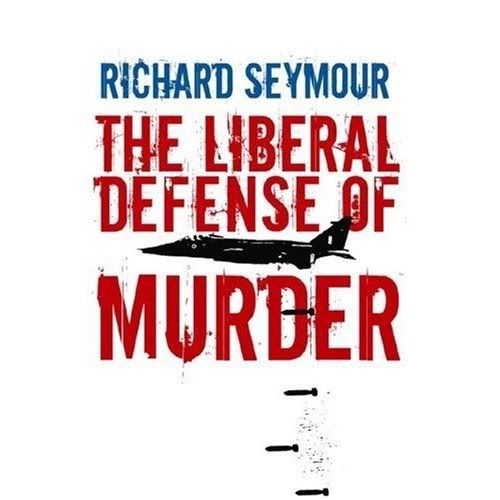
Verso are publishing my first book, The Liberal Defense of Murder, this Summer. As the blurb explains:
Following the collapse of the Soviet Union, a number of prominent thinkers on the Left found themselves increasingly aligned with their ideological opposites. Over the last decade, many of these thinkers have become close to Washington; forceful supporters of the War on Terror, they help frame arguments for policymakers and provide the moral and intellectual justification for Western military intervention across the globe. From Kanan Makiya, one of the chief architects of the US invasion and occupation of Iraq, to Bernard Henri-Levy’s advocacy of “humanitarian” intervention, The Liberal Defense of Murder traces the journey of these figures from left to right and explores their critical role in the creation of the new American empire. With wide-ranging testimony from many key figures on the left, this is a crucial account of the emergence of the “pro-war left,” and its shaping of our post-9/11 world.
The provisional publication date is 1st July. You can, of course, pre-order the book from Verso or Bookmarks. In fact, I order you to do so. This instant.
Labels: cruise missile liberals, imperial ideology, pro-war 'left', the liberal defense of murder
6:13:00 pm |
Permalink |
Comments thread |
|
Print |
Digg |
del.icio.us |
reddit |
StumbleUpon |
Tweet|
Share|
Wednesday, November 14, 2007
Proud supporters of democracy promotion since 1930 posted by Richard Seymour
The Guardian and the Observer have a record of supporting democracy-promotion:The Guardian thought on September 25 1930 that the exclusion of the Nazi party from Reich government, given its electoral success, was not in the best interests of German democracy and that their involvement would "in the long run ... help to perpetuate this democracy".
On the very day that these views were published, Hitler told a court in Leipzig (where three young army officers with Nazi sympathies were on trial for preparing to commit high treason) that his movement would come to power legally, but that it would then shape the state as its members wanted it, and that "heads would roll".
The Guardian maintained its view, however, that Hitler, "while full of the verbiage of revolution", was "no revolutionary leader". It claimed that he lacked courage, and that his baleful threats before the Leipzig court raised unnecessary fears, while his assurances of proceeding legally had hardly been noticed. It dismissed him on September 29 1930 as "the ranting clown who bangs the drum outside the National Socialist circus". Few things, the newspaper had remarked three days earlier, were less likely than that Hitler would gain sole power in Germany.
By 1932, as the crisis of German democracy deepened, British newspapers devoted far more attention to Nazism. Even now, however, underestimation of Hitler was commonplace. The Observer, still on February 21 1932 seeing Hitler as no more than a demagogue propped up by financially powerful nationalists, reversed course following his candidacy for the Reich presidency in March, when it wrote (March 20 1932) that it would be wrong to regard him "as a mere agitator and rank outsider". Here, as in the Guardian (which still implied on March 30 1932 that Hitler was no more than a charlatan), the emerging view was that he was a "moderate", who might possibly develop into a statesman, but could not control his own violent and unruly movement.
This related also to anti-semitism. The Observer, in its article on March 20 1932, hinted that attacks on Hitler's anti-semitism exaggerated the danger, adding: "It must not be forgotten that the major part of the German Republican Press is in Jewish hands."
Labels: colonialism, cruise missile liberals, democracy promotion, fascism, hitler, nazism
1:01:00 pm |
Permalink |
Comments thread |
|
Print |
Digg |
del.icio.us |
reddit |
StumbleUpon |
Tweet|
Share|
Wednesday, October 17, 2007
The neo-imperialist's guide to Islam posted by Richard Seymour
Lesson one: the interpreter:If you ask specifically what is wrong with Islam, it makes the same mistakes as the preceding religions, but it makes another mistake, which is that it’s unalterable. You notice how liberals keep saying, “If only Islam would have a Reformation”—it can’t have one. It says it can’t. It’s extremely dangerous in that way.
Lesson two: the creeping liberal:
That night you revealed, inter alia, that you were Shia; and, as far as I understand it, the Shia minority speaks for the more dreamy and poetic face of Islam, the more lax and capacious (tolerant, for example, of representations of the human form), the more spiritual (in the general sense of that word), as opposed to the Sunnis, whose approach is known to be stricter and more legalistic. Your Shia identity endeared you to me, and made me feel protective, because Islamism, in most of its manifestations, not only wants to kill me – it wants to kill you.
Lesson three: the native informer:
Hirsi Ali: Only if Islam is defeated. Because right now, the political side of Islam, the power-hungry expansionist side of Islam, has become superior to the Sufis and the Ismailis and the peace-seeking Muslims.
Reason: Don’t you mean defeating radical Islam?
Hirsi Ali: No. Islam, period. Once it’s defeated, it can mutate into something peaceful. It’s very difficult to even talk about peace now. They’re not interested in peace.
Reason: We have to crush the world’s 1.5 billion Muslims under our boot? In concrete terms, what does that mean, “defeat Islam”?
Hirsi Ali: I think that we are at war with Islam. And there’s no middle ground in wars. Islam can be defeated in many ways. For starters, you stop the spread of the ideology itself; at present, there are native Westerners converting to Islam, and they’re the most fanatical sometimes. There is infiltration of Islam in the schools and universities of the West. You stop that. You stop the symbol burning and the effigy burning, and you look them in the eye and flex your muscles and you say, “This is a warning. We won’t accept this anymore.” There comes a moment when you crush your enemy.
Reason: Militarily?
Hirsi Ali: In all forms, and if you don’t do that, then you have to live with the consequence of being crushed.
Labels: cruise missile liberals, hirsi ali, hitchens, islam, islamophobia, martin amis, racism, secularism
10:16:00 am |
Permalink |
Comments thread |
|
Print |
Digg |
del.icio.us |
reddit |
StumbleUpon |
Tweet|
Share|
Tuesday, October 09, 2007
Mea Culpa, mea minima culpa posted by Richard Seymour

It is becoming a genre, this tearful backtracking from aggressive imperialism. Hitchens expressing his solipsistic distress about what happened to his democratic revolution, blaming bin Ladenist and Ba'athist 'riff raff' for its failure. Ignatieff taking on the mantle of the messiah, and blaming Iraqis for being incapable of self-government. Peter Beinart blaming Makiya for his military adventurism, and ditching his attempted resuscitation of Cold War liberalism. The neocons blaming Rumsfeld's lack of preparation. No one wants to take responsibility. And now Thomas Friedman 'apologising' for his post-9/11 descent into extremism. Friedman's energetic enthusiasm for sadistic violence long pre-dates 2001, of course, but like every other schmuck who has watched as one murderous fantasy after another was discredited in the grim destruction of Iraq, he needs an excuse - and as excuses go, 'Bin Laden Made Me Do It' is slightly better than 'Makiya Hypnotised Me'. RJ Eskow wants to 'forgive' Friedman. No. If you're worth anything as a human being, you should hate Friedman and all his kind forever. Through the centuries they have pathetically and sycophantically rented themselves to power, and have always sought excuses for their crimes and outrages. If anything, they have said, the Emperor has not gone far enough: he should have committed genocide. He was too enlightened, too moral, too zealous in his defense of goodness. And when at last their charlatanism has taken them to such lengths of absurdity that their earnings are threatened, they have simply cut loose and blamed the devil for their misdeeds. No forgiveness: let them stew in their own squalor.
Labels: belligerati, cruise missile liberals, culture of genocide, iraq, thomas friedman
7:28:00 pm |
Permalink |
Comments thread |
|
Print |
Digg |
del.icio.us |
reddit |
StumbleUpon |
Tweet|
Share|
Wednesday, August 15, 2007
Save Darfur guilty of false advertising posted by Richard Seymour
The Save Darfur coalition has been having a bit of difficulty recently. First, the New York Times (of all publications) criticised them for exaggerating the figures over Darfur, and now the Advertising Standards Authority has had a go at them for the same thing:But Britain's Advertising Standards Authority said in a ruling last week that recent adverts saying that 400,000 people had died in violence that the coalition blames on the Sudanese government went too far.
"There is no dispute that atrocities are going on there," said ASA spokesman Matt Wilson. "One doesn't want to quibble when it comes to mass slaughter but they simply could not substantiate the figure of 400,000."
Labels: cruise missile liberals, darfur
8:16:00 pm |
Permalink |
Comments thread |
|
Print |
Digg |
del.icio.us |
reddit |
StumbleUpon |
Tweet|
Share|