Friday, October 07, 2011
Liberals and reactionaries posted by Richard Seymour
Domenico Losurdo, Liberalism: A Counter-History (Verso, 2011), and Corey Robin, The Reactionary Mind: Conservatism from Edmund Burke to Sarah Palin (Oxford University Press, 2011)I was speaking alongside Domenico Losurdo and Robin Blackburn at a launch event for the former's book at King's College some while ago. Losurdos' latest, Liberalism: A Counter-History, is an investigation into the limits and exclusions of liberalism. A salient point, which marks the beginning of one of his inquiries, is the fact that the three bourgeois revolutions conducted in the name of liberty and equality, were followed by a staggering increase in the global slave trade.
Three interesting problems arose in this discussion. The first is that it is a mainstay of marxist accounts of liberalism, and certainly central to C B Macpherson's analysis, that the core of it is property rights. This is not Losurdo's position, exactly. When a questioner from the floor asked about this question of property rights, he argued that what defined liberalism was not property, but the logic of exclusion. He mentioned the example of Palestinians who were expropriated at every opportunity by Israelis in the name of certain liberal values. And indeed the tension in Losurdo's narrative centres on how far liberalism can be made to expand on its revolutionary promise.
I still think that property is central here. For a start, the expropriation of the Palestinians doesn't disturb the principle of property rights. Property rights have always been structured in such a way as to allow white Europeans to expropriate non-white non-Europeans, from Locke to Vattel onward. After Katrina, the property rights of working class Americans, especially African Americans, were cancelled by fiat - but this didn't disturb the basic politico-legal order of property rights. In fact, I would bet on the idea that the state authorities and companies who carried out this expropriation worked very hard on devising a legal justification for this theft. Moreover, it is the nature of capitalist property relations, to which liberalism is committed, that builds exclusions into liberalism. The second difficulty concerned the distinction that Losurdo wished to draw between radicals and liberals, which is not always a stable boundary - for example, William Lloyd Garrison took liberalism to its most radical conclusions in opposition to racial slavery, the colonization of Indian land, and the oppression of women, but he by no means departed from liberalism (indeed, he refused the term 'wage slavery', supported capitalist 'free labour' and tended to be suspicious of unionism).
The third, related issue arose over the question of what, or who, counts as a liberal. Losurdo argues the case in his opening chapter for seeing the pro-slavery statesman John Calhoun as a liberal. Robin Blackburn disputed this, arguing that it involved far too expansive a definition of liberalism - Calhoun, he said, is a conservative. Blackburn's concern was that Losurdo was risking a sectarian position, failing to acknowledge and that this wasn't resolved by cordoning off some liberals as 'radicals'. Jennifer Pitts' recent review in the TLS takes this criticism much further, and in a much more hostile direction. What I would say is that, taken as a whole, Losurdo's book is more appreciative of liberalism's merits than might appear to be the case from some of the tendentious readings - which, in a counter-history, has some validity. His conclusions are not indiscriminately hostile.
Part of the problem here is that conservatism in its modern sense takes its cue from liberalism. Burke drew from Smith, almost all US conservatives draw from Locke, and modern conservatives are almost all influenced by classical liberalism. So, if Calhoun himself based his arguments on liberal precepts, which he certainly did, does this mean he is a liberal? There is also a deeper theoretical issue when discussing people like Calhoun. Antebellum slavery, some would argue, was a non-capitalist formation. That's a core part of Charles Post's argument in The American Road to Capitalism, written from a 'political marxist' perspective: that the US before the civil war was based on a combination of different modes of production - slavery, petty commodity production, mercantile capital, etc. The interaction between these different productive forms drove the expansionism of both north and south, eventually leading to Civil War. (Some of these arguments were debated on a recent Facebook thread and recorded by Louis Proyect). John Ashworth's classic two-volume marxist history, Slavery, Capitalism, and Politics in the Antebellum Republic, makes the argument that southern political thought was largely pre-capitalist, drawing on classical republican ideologies because they happened to be conducive to the preservation of slave relations. Indeed, he maintains, the Democratic Party when it first emerged was anticapitalist - 'Jacksonian Democracy', based centrally on the valorisation of the white, freeholding farmer, could challenge the power of the banks and commerce in the name of agrarian interests while also being profoundly opposed to strong state intervention in the economy. So, was John Calhoun a liberal, because of his strong individualism and hostility to the over-concentration of central authority, or did liberalism merely provide part of the vocabulary for the defence of conservative interests?
This vexed question, of the relationship between liberalism and conservatism, receives a sustained treatment in Corey Robin's The Reactionary Mind. I have written a review of this for future publication, so I will make no detailed attempt to summarise its arguments here. Suffice to say that, for the purposes of this discussion, there is no doubt for Robin that Calhoun is a conservative. But what does being a conservative entail, then? The image of conservatism as anti-modern, traditionalist, evincing a preference for the familiar and for gradual evolution, is one that he, like Ted Honderich, C B Macpherson and others before him, disputes. The original conservatives - Hobbes, Burke, Maistre - are contemptuous of tradition, largely because of its inability to meet the challenge of revolution. What they are conserving is not a traditional order (as mentioned, Burke was already a free market capitalist), but hierarchy, dominance, unfreedom: they are reactionaries, counter-revolutionaries. To be effective counter-revolutionaries, conservatives must incorporate the ideas and tactics of the enemy. They must speak in the language of the people, "make privilege popular", "transform a tottering old regime into a dynamic, ideologically coherent movement of the masses".
Conservatism is thus not distinguished by its ideas which, with the enormous exception of race, it largely borrows from elsewhere, nor by its tactics, but by its praxis. It would follow that it is not Calhoun's republican, pre-capitalist 'states rights' ideology that makes him a conservative, any more than his defence of private property makes him a liberal. It is his attempt to arouse the South in response to the abolitionist danger, his attempt to conserve hierarchy against mass democracy, that makes him a conservative. Liberals, you may say, have also been known to defend hierarchy and racial supremacy. This is true, but liberalism does not pivot on the defence of hierarchies and domination; that is precisely why it devises 'exclusion clauses'. Indeed, it is because of liberalism's much vaunted commitment to humanitarian and egalitarian values that 'the liberal defence of murder' is a hypocritical ideology, riven with tensions that aren't usually present in the rightist equivalent.
Labels: capitalism, class, conservatism, counter-revolution, liberal imperialism, liberals, racism, reactionaries, reactionary subjectivity, the liberal defence of murder
7:56:00 pm |
Permalink |
Comments thread |
|
Print |
Digg |
del.icio.us |
reddit |
StumbleUpon |
 Tweet|
Share|

Wednesday, December 29, 2010
Capitalist realism vs the memory of the class posted by Richard Seymour
Simon Hewitt alludes to the value of inhabiting a tradition, as part of any anticapitalist project. This shouldn't be controversial. Human beings cannot really exist outside of tradition, though capitalism constantly tries to acculturate them into doing so. In Capitalist Realism, Mark Fisher draws on Frederic Jameson to riff on 'postmodern temporality'. This is a condition where "realities and identities are upgraded like software", such that any "settled sense of self" becomes impossible, such that historical memory and tradition is sacrificed to constant novelty, to "the vertiginous 'continuous present'" characteristic of late capitalism. He quotes from Jameson's 'The Antinomies of Postmodernity', the same essay in which the famous and often misremembered quotation appears: "It seems to be easier for us today to imagine the thoroughgoing deterioration of the earth and of nature than the breakdown of late capitalism; perhaps that is due to some weakness in our imaginations." This 'perhaps' is misleading, as the argument leads directly into Jameson's arguments concerning late capitalist celerity and its effects on the political imaginary. Fisher's sample is worth quoting:
"The paradox from which we must set forth is the equivalence between an unparalleled rate of change on all the levels of social life and an unparalleled standardization of everything - feelings along with consumer goods, language along with built space - that would seem incompatible with such mutability... What then dawns is the realization that no society has ever been as standarized as this one, and that the stream of human, social and historical temporality has never flowed quite so homogenously. ... What we now begin to feel, therefore - and what begins to emerge as some deeper and more fundamental constitution of postmodernity itself, at least in its temporal dimension - is henceforth, where everything now submits to the perpetual change of fashion and media image, that nothing can change any longer."
No wonder that in this situation, it is "easier to grasp the progressive value of conservative or residual modes of resistance to the new thing" than to evaluate "ostensibly left-liberal positions" which "often prove to be indistinguishable from the structural requirements of the system itself". Novelty, 'reform', 'progress', constant newness are bywords for planned obsolescence, for capitalist destruction of the welfare state, education, healthcare, and so on. But Jameson may be succumbing to the cult of novelty himself here, since what he describes as an aspect of late capitalism, of postmodern temporality, is only an aspect of capitalist ideology as such. Capitalism has always venerated its constant reinvention of the wheel, as it were, while celebrating a maudlin fabrication that it calls 'tradition', the purpose of which is to blot out real, living traditions.
The relative strength of the ruling class and its dominant institutions with respect to the working class and its oppositional institutions means that there is all the more pressure brought to bear on the labour movement and the left to adopt vacuous discourses of 'modernity' (and its reliable discursive partner, 'realism'). It constantly seeks to depict the language and institutions of the Left as worse than wrong, but actually uncool, out of fashion, anachronistic. Naturally, this gives rise to the illusion that we can or should seek to jettison those embarrassing encumbrances of old - narrow 19th century notions like classes, parties and ideologies, but obviously not money, markets, credit, capital, interest, etc. But we go along with this at our peril. It is part of our subjection. Part of the means of ensuring that there will be no change.
Labels: capitalism, capitalist realism, fashion, novelty, postmodernity, reactionaries, reactionary subjectivity
8:09:00 pm |
Permalink |
Comments thread |
|
Print |
Digg |
del.icio.us |
reddit |
StumbleUpon |
Tweet|
Share|
Sunday, October 24, 2010
Conservatism and war posted by Richard Seymour
While the contrast between the true conservative and the pseudo-conservative has been drawn in different ways—the first reads Burke, the second doesn't read; the first defends ancient liberties, the second derides them; the first seeks to limit government, the second to strengthen it—the distinction often comes down to the question of violence. Where the pseudo-conservative is captivated by war, Sullivan claims that the true conservative "wants peace and is content only with peace." The true conservative's endorsements of war, such as they are, are the weariest of concessions to reality. He knows that we live and love in the midst of great evil. That evil must be resisted, sometimes by violent means. All things being equal, he would like to see a world without violence. But all things are not equal, and he is not in the business of seeing the world as he'd like it to be.
The historical record suggests otherwise. Far from being saddened, burdened, or vexed by violence, conservatives have been enlivened by it. Not necessarily in a personal sense, though it's true that many a conservative has expressed an unanticipated enthusiasm for violence. "I enjoy wars," said Harold Macmillan, wounded three times in World War I. "Any adventure's better than sitting in an office." The conservative's commitment to violence is more than psychological, however: It's philosophical. Violence, the conservative maintains, is one of the experiences in life that makes us most feel alive, and violence, particularly warfare, is an activity that makes life, well, lively. Such arguments can be made nimbly, as in the case of Santayana, who wrote, "Only the dead have seen the end of war," or laboriously, as in the case of Heinrich von Treitschke:To the historian who lives in the world of will it is immediately clear that the demand for a perpetual peace is thoroughly reactionary; he sees that with war all movement, all growth, must be struck out of history. It has always been the tired, unintelligent, and enervated periods that have played with the dream of perpetual peace.
Pithy or prolix, the case boils down to this: War is life, peace is death.
Labels: conservatism, counter-revolution, edmund burke, gop, imperialism, joseph de maistre, reactionaries, reactionary subjectivity, republicans, tories, war
4:08:00 pm |
Permalink |
Comments thread |
|
Print |
Digg |
del.icio.us |
reddit |
StumbleUpon |
Tweet|
Share|
Tuesday, July 20, 2010
Of baboons and racists posted by Richard Seymour
We are being besieged by baboons again. This happens quite often here on the Constantiaberg mountains (an extension of the Table Mountain range). Baboons are common in the Cape and they are a great deal larger than the vervet monkeys I was used to dealing with in KwaZulu-Natal. They jump onto roofs, overturn dustbins and generally make a nuisance of themselves; since their teeth are very dirty, their bite can be poisonous. They seem to have lots of baby baboons – it’s been a very mild winter and so spring is coming early – and they’re looking for food. The local dogs don’t like them but appear to have learned their lesson from the last baboon visit: then, a large rottweiler attacked the apes, who calmly tore it limb from limb.
Meanwhile in the squatter camps, there is rising tension as the threat mounts of murderous violence against foreign migrants once the World Cup finishes on 11 July. These migrants – Zimbabweans, Malawians, Congolese, Angolans, Somalis and others – are often refugees and they too are here essentially searching for food. The Somalis are the most enterprising and have set up successful little shops in the townships and squatter camps, but several dozen Somali shopkeepers have already been murdered, clearly at the instigation of local black shopkeepers who don’t appreciate the competition. The ANC is embarrassed by it all and has roundly declared that there will be no such violence. The truth is that no one knows. The place worst hit by violence in the last xenophobic riots here was De Doorns and the army moved into that settlement last week, clearly anticipating trouble. The tension is ominous and makes for a rather schizoid atmosphere as the Cup itself mounts towards its climax.
I trust you follow the juxtaposition. African migrants are "baboons", while "local black shopkeepers" are "rottweilers". This is neither subtle nor reticent. For thirteen days, this edit of Johnson's post was allowed to stand, despite complaints from readers. A letter was composed, protesting about the LRB's decision to publish this racist screed, which received the signatures of 73 concerned writers, academics, activists, etc*. In the meantime, the editors received a rather terse e-mail urging them to remove the article. Failure to do so within 48 hours, they were told, would result in a complaint to the EHRC and the PCC. This finally persuaded the editors to act. They removed the post. So, when the letter was sent, a response from the editors stated that "We had already taken this post down before we received your letter. Thank you for your concern."
There was no acknowledgment of the reason why the post had been taken down, or of the fact that it was racist. So, the letter was re-drafted to take note of the decision to remove the post, and sent again in the hope that LRB would publish it and acknowledge that something had gone very badly wrong. The editor, Mary-Kay Wilmers, declined to do so on the grounds that the letter made explicit a series of connections that Johnson had not made explicit. "This isn't a comparison that should be in anyone's mind," she argued, "and we aren't willing to be the cause of its appearing in print." There would of course be no way to address the racist nature of Johnson's article without making the meaning of his racist juxtaposition explicit, but while Wilmers acnowledged that it was "possible" to interpret it in the way that the letter suggested, she nevertheless implied that the comparison between African migrants and baboons, and between black shopkeepers and rottweilers, had not in fact already been made under the impress of the London Review of Books.
Now, it seems to me that the story here is in part one of moral cowardice. The LRB has withdrawn the article, not because it recognised that it was disgusting and offensive, but because it was placed under pressure. They have left no explanation as to why the post was withdrawn, merely citing "complaints". And they decline to have the objections to the article aired in their publication. They are attempting, having only belatedly reacted to the problem, and having then only buried it, and under pressure, to keep it buried.
Quite coincidentally, I've recently been reading a collection of Harold Pinter's writings. In one piece, originally written for the Index on Censorship, he describes the fate of his poem 'American Football', a reflection on the Gulf War composed in 1991. He submitted it firstly to the London Review of Books, which is a magazine I occasionally enjoy reading. Pinter explains: "I received a very odd letter, which said, in sum, that the poem had considerable force, but it was for that very reason that they were not able to publish it. But the letter went on to make the extraordinary assertion that the paper shared my views about the USA's role in the world. So I wrote back. 'The paper shares my views, does it? I'd keep that to myself if I were you, chum,' I said. And I was very pleased with the use of the word 'chum'." I suppose the point of citing this anecdote is to demonstrate that a stroke of the publisher's yellow-streak is nothing new; that, whatever advantages appear to derive from such cowardice generally tend to diminish in time; and that the resultant cop out never looks anything other than absurd, petty and grubby in retrospect. Which perspective I hope the LRB's editors might take on board, and adjust their present stance accordingly.
Update: Gary Younge reports...
Further update: LRB editors apologise.
*This is the letter as it appeared on its second edit, acknowledging the fact that the post was deleted:
20th July 2010
To the Editor,
With its stress on its own 'depth and scholarship and good writing' and its 'unmatched international reputation', the LRB has a responsibility to maintain high standards if it is to retain its enviable position of having the 'largest circulation of any literary magazine in Europe'.
We find it baffling therefore that you continue to publish work by RW Johnson that, in our opinion, is often stacked with the superficial and the racist. In a particularly egregious recent post on the LRB blog, 'After the World Cup', 6 July 2010, Johnson, astonishingly, made a comparison between African migrants and invading baboons. He followed this with another between 'local black shopkeepers' and rottweilers. He concluded with what he presumably thinks is a joke about throwing bananas to the baboons.
In the particular arena of football, some fans do not need to be encouraged to produce racist abuse. Across Europe for many years, black players have been spat at, subjected to racist chants often including references to monkeys or apes, and have been the focus of monkey chanting noises during matches. Neo-Nazi groups have also been known to use football matches as target areas for recruiting new members and promoting their racist practice. (How ironic that when Johnson does decide to write about ‘Football and Fascism’, 11 July 2010, he produces a piece about Italy that reveals the dearth of his knowledge.)
While South Africa has made great strides, overturning the racist politics of the National Party, it still has a long way to go in combating the racism that thrives among certain communities and individuals. Elsewhere, in the UK for example, this is no time for complacency about attitudes to race. Although British National Party leader, Nick Griffin, may have been humiliated at the recent General Elections, his party now has two MEPs. Let’s not forget that young black men in this country are seven times more likely to be stopped and searched than young white men, and they comprise a disproportionate number of the prison population.
Whilst it might be unfair to pick on a man for his inability to be funny, we believe that it would be wholly wrong to stay silent when he resorts to peddling highly offensive, age-old racist stereotypes that the LRB editorial team deems fit to publish. (Indeed, we note from the comments that at some point the post was edited – and yet, in our opinion, it remained an appalling and racist piece of writing.)
We were relieved on Monday 19 July when, finally, the post was taken down. However, we remain appalled that it was published in the first place and appalled that it remained up for 13 days. Several of the comments beneath the post pointed out some time ago that the piece was clearly racist and yet the LRB still chose to leave it online. It is not good enough to remove the post – apart from its URL which, we note, ends ‘coming-of-the-baboons’ – and expect this nasty episode to be forgotten. We would like to know why it was published in the first place and we would like to read a public apology.
It is of deep concern to all of us that the LRB could be so impressed by RW Johnson that his racist and reactionary opinion continues to be published in the magazine and now, in the blog too. And there we all were thinking the LRB was progressive.
Yours sincerely,
Diran Adebayo, writer & academic, Lancaster University
Patience Agbabi, poet
Yasmin Alibhai-Brown, journalist & writer
Candace Allen, writer, journalist & broadcaster
Cristel Amiss, coordinator, Black Women’s Rape Action Project
Baffour Ankomah, editor, New African
Nana Ayebia Clarke, publisher, Ayebia
Pete Ayrton, publisher, Serpent’s Tail
Sharmilla Beezmohun, deputy editor, Wasafiri
Benedict Birnberg
Professor Elleke Boehmer, University of Oxford
Professor Patrick Bond, University of Kwazulu-Natal
Victoria Brittain, writer & journalist
Dr Margaret Busby OBE, publisher & writer
Teju Cole, writer
Eleanor Crook, sculptor & academic, University of the Arts
Fred D’Aguiar, writer
Dr David Dibosa, academic
Kodwo Eshun, The Otolith Group
Gareth Evans, writer, editor, curator
Katy Evans-Bush, poet
Bernardine Evaristo MBE, writer
Nuruddin Farah, writer
Professor Maureen Freely, writer & academic, University of Warwick
Kadija George, publisher, Sable LitMag
Professor Paul Gilroy, London School of Economics
Professor Peter Hallward, Kingston University London
M John Harrison, writer
Stewart Home, writer
Michael Horovitz, poet
Professor Aamer Hussein, writer & academic, University of Southampton
Professor John Hutnyk, Goldsmiths
Dr Sean Jacobs, The New School
Selma James, coordinator, Global Women’s Strike
Gus John, associate professor, Institute of Education, University of London
Anthony Joseph, poet & novelist
Kwame Kwei-Armah, playwright & broadcaster
Candida Lacey, publisher, Myriad Editions
Alexis Lykiard, writer
Firoze Manji, editor in chief, Pambazuka News
Shula Marks, emeritus professor, School of Oriental & African Studies
Professor Achille Mbembe, University of the Witwatersrand & Duke University
Dr China Miéville, writer & academic,
Professor David Morley, University of Warwick
Professor Susheila Nasta, editor, Wasafiri
Courttia Newland, writer
Dr Alastair Niven OBE, principal, Cumberland Lodge
Dr Zoe Norridge, University of Oxford
Dr Deirdre Osborne, Goldsmiths
Lara Pawson, journalist & writer
Pascale Petit, poet
Caryl Phillips, writer
Dr Nina Power, Roehampton University
Jeremy Poynting, managing editor, Peepal Tree Press
Gary Pulsifer, publisher, Arcadia Books
Michael Rosen, poet
Anjalika Sagar, The Otolith Group
Richard Seymour, writer & activist
Dr George Shire, reviews editor, Soundings
Professor David Simon, Royal Holloway
Lemn Sissay MBE, writer
Keith Somerville, Brunel University
Colin Stoneman, editorial coordinator, Journal of Southern African Studies
George Szirtes, poet & translator
Dr Alberto Toscano, Goldsmiths
Professor Megan Vaughan, University of Cambridge
Patrick Vernon, chief executive, The Afiya Trust
Professor Dennis Walder, Open University
Verna Wilkins, writer & publisher, Tamarind Books
Dr Patrick Wilmot, writer & journalist
Adele Winston
Professor Brian Winston, University of Lincoln
Dr Leo Zeilig, University of the Witwatersrand
Labels: london review of books, racism, reactionaries, reactionary subjectivity, south africa, white supremacy
3:59:00 pm |
Permalink |
Comments thread |
|
Print |
Digg |
del.icio.us |
reddit |
StumbleUpon |
Tweet|
Share|
Sunday, June 27, 2010
David Edgar and Lenin's Tomb on apostasy (Marxism 2009) posted by Richard Seymour
 Just seen that this talk is available on Resistance MP3s. It's the panel discussion between myself and playwright David Edgar concerning the topic of "left-right defectors" at Marxism 2009. Edgar's discussion, generously plugging Liberal Defence, covers the subject since WWII - the Cold War liberals, the neocons, the British New Right, and today's Islamophobic terror-warriors. My own contribution focuses on the two examples of Mussolini and Spargo, partly to undercut the tendency to interpret such apostasy in light of the Cold War and Stalinist terror, and highlight the militarist and anti-democratic aspect of such apostasy. Listen, why not, and come to Marxism 2010. My own meeting on racism in Britain today takes place on Friday morning, 10am, at the Royal National Hotel.
Labels: apostasy, events, marxism, marxism 2010, reactionaries, reactionary subjectivity, socialism, the liberal defence of murder
2:45:00 pm |
Permalink |
Comments thread |
|
Print |
Digg |
del.icio.us |
reddit |
StumbleUpon |
Tweet|
Share|
Friday, June 04, 2010
The Meaning of David Cameron, reviewed posted by Richard Seymour
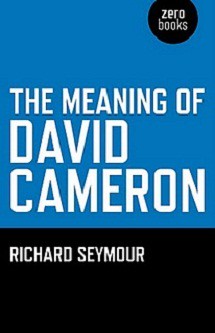
Thanks to Robert for this review of The Meaning of David Cameron:In it's critique of the lurid PR and the accompanying empty venacular of 'change', 'progress' and 'newness' which saturates all party political discussion, Richard Seymour reveals far more and goes far deeper than most critical accounts of politics today. In examining David Cameron, Seymour finds the virus of neo-liberalism. It is as if, David Cameron has already been devoured. He is undead, a neo-liberal Zombie. Seymour's argument is that this isn't unique to Cameron. Whilst certain symptoms may differ from those we saw in Thatcherism and New Labour the same insatiable, dibilitationg virus remains. The book confirms that Nick Clegg, those Orange Book liberals and the ConLib coaltion, are, merely, the viruses new host.
Labels: 'progress', capitalism, conservatism, meritocracy, neoliberalism, new labour, reactionary subjectivity, the complete and utter works of richard seymour, the meaning of david cameron, tories
1:09:00 pm |
Permalink |
Comments thread |
|
Print |
Digg |
del.icio.us |
reddit |
StumbleUpon |
Tweet|
Share|
Wednesday, March 03, 2010
A brief guide to reaction posted by Richard Seymour
1) Affect class resentment of "hopelessly middle class" leftist intellectuals (or if you prefer, "rich college fucks", dixit Daniel Patrick Moynihan). This is a cardinal principle of reaction, particularly if you happen to be hopelessly middle class, or a rich college fuck.
2) Ventriloquise the intimate beliefs and impressions of others. If you're bourgeois, remark that working class people are alienated and confused by the intellectualism of the left. If you're male chauvinist, complain that feminists don't understand how women tick. If you're a racist, talk about how black people love you, agree with much that you say, and find you much preferable to your hopelessly middle class foils.
3) Ground yourself relentlessly in reality. Real people just don't live that way, and don't want to. Real people don't think like that, or talk like that. The real world doesn't work that way.
4) Espouse victimology. Remark that positions exactly like your own are "brave" and "courageous", because they are invariably "shouted down" by the left (cf, "chorus of execration", "political correctness", etc).
5) Talk dirty. Now that you have authenticated yourself as a hard-bitten realist and soul brother (or sister) of the oppressed, feel free to indulge in some old-fashioned baiting and stereotyping. Eg, if your opponent is a woman, you could imply that she is a mad, shrieking harpy. Remember, not only do you speak as a persecuted salt-of-the-earth, dyed-in-the-wool, working class hero, you actually speak on behalf of womankind itself.
Exhibit A. Not one of the more egregious exhibits at that.
Labels: anti-racism, feminism, left, political correctness, racism, reactionaries, reactionary subjectivity, sexism
7:35:00 am |
Permalink |
Comments thread |
|
Print |
Digg |
del.icio.us |
reddit |
StumbleUpon |
Tweet|
Share|
Wednesday, February 25, 2009
Badiou on Le Petit Nicolas posted by Richard Seymour

According to Badiou, the French Left (and by extension, the Left as such) has practised a reactive politics based on fear of the right, which in turn is essentially mobilised by the fear of the leftist challenge. At the same time, the politicians of the reformist left flaunt their impotence, their inability to transform affairs, and cling to it. All they can do is keep the right out of office and limit the reaction. Then Sarkozy wins, and Socialists - many from the generation of the nouveau philosophes - flock to join his administration, or be part of the clique. Sarkozy expresses his 'openness' to the left, the better to coopt its luminaries for the creation of a technocratic single-party state (this is what the language of bipartisanship always boils down to) and form what Badiou calls a Union for Presidential Unanimity (a pun on the name of Sarkozy's party, the Union for a Popular Movement). This is the state that neoliberal capitalism has reduced politics to. As Badiou says, quoting Zizek, those who used to oppose parliamentary democracy to Stalinism missed the point that Stalinism was the future of parliamentary democracy. Indeed, "the technological means for controlling the population are already such that Stalin, with his endless handwritten files, his mass executions, his spies with hats, his gigantic lice-ridden camps and bestial tortures, appears like an amateur from another age".
And how many times have you heard pundits boasting about the big turnout for a particular election? Boast they must, because it is happening with less and less frequency these days. But what does this say about voting, as an act? What matters, apparently is that people participate, and thus give the system a democratic imprimatur. Badiou's conclusion is different. Observing the heralds of Sarkozysme ratify the new administration with its engorged turnout, he retorts: "If numbers alone are a cause for celebration, then this means that democracy is strictly indifferent to any content". If people vote for a mediocre clerk, then "all glory to them! By their stupid number, they brought the triumph of democracy". The bards of parliamentarism are "more 'respectful' than I am of the 'popular will', even when they see it as idiotic and dangerous. Bow down before the numbers!"
Beyond which caustic banter lies the humane purpose of defending migrant workers, upholding the hippocratic principle, supporting creative art, putting emancipatory politics before managerial necessitarianism, and ultimately restoring the 'communist hypothesis' to its proper place. Said hypothesis, which is that the system of classes can be overthrown, is a "real point" to hold onto against the alternative hypothesis of parliamentarist impotence. Those who reject the communist hypothesis are bound to market economics and parliamentary democracy, and therefore to the very logic that leads to the Rat Man. You could wish that Badiou would not say 'democracy' when he means 'parliamentary democracy', or that he would not say 'left' when he means something much more ambiguous (is Ségolène Royal really in any meaningful sense on the Left? Or Bernard Kouchner for that matter?). But the provocative, ludic manner of the collection is part of its charm. It is because Badiou doesn't respect the rules of the 'capitalo-parliamentarist' game that even his ultra-left tendencies - an overhang from his wild Maoist days - become the basis for important insights.
Labels: alain badiou, communism, nicolas sarkozy, reactionary subjectivity, socialism, socialist party
7:38:00 pm |
Permalink |
Comments thread |
|
Print |
Digg |
del.icio.us |
reddit |
StumbleUpon |
Tweet|
Share|
Wednesday, October 31, 2007
The Thermidorian posted by Richard Seymour

One of the weakest arguments about the 'new philosophers' of France, unfortunately repeated in Julian Bourg's otherwise excellent From Revolution to Ethics: May 1968 and Contemporary French Thought, is that they took the logical step from their previous Maoist commitments, and moved straight from a critique of Stalinism to a critique of Marxism as such. A logical - even 'dialectical' - progression. You see this argument elsewhere: look at the neocons, aren't they all ex-Trots, or at least don't they owe their messianic doctrine to Trotsky? Aren't they the logical heirs of his internationalism, his revolutionary zeal etc? I don't think this holds water, for a variety of reasons that I won't go into, but one can see how a critique of Stalinism has been helpful to various styles of public intellectual in clarifying arguments while moving to the right. Yet, the role of anti-Stalinism for a revolutionary socialist, for example, is logically discontinuous with its role in the thought of someone who embraces Robert Conquest and regards Anglosphere social-democracy as the best future for mankind. The assertion of continuity may well reduce itself to the Stalinist stipulation that Trotskyism was already counterrevolutionary. (One of my favourite examples is La Pasionaria arguing, after a full year of Trot-hunting has almost destroyed the revolution and given the fascists the upper hand in the civil war that it was the POUM after all who worked on behalf of the German Gestapo, and who imitated Mussolini, and who assisted Franco).
What I like so much about Badiou's argument about The Thermidorian Subject is that it cuts this argument to shreds. Badiou points out that many of the prosecutors of the French Revolution were once its most fervent advocates, but rather than assenting to Soubol's position that the terrorists of the Directory really brought the logic of Jacobin terror to a head, he pinpoints the structural difference. It is not that the apparent 'opposite' actually embodies the real spirit of the revolution (raised under the banner of equality, it actually introduces capitalist inequality etc), but that each political sequence has its own internal logic which at some point exhausts all its capacities. The revolution proceeds, exhausts its capacities, and now there are those who act as agents of termination: they don't simply accept the limits of the revolution, they actively seek to mystify the revolution, to make it incomprehensible, to decouple its statements from the context, so that it can be seen instead as an expression of some satanic or totalitarian temptation. (Hence, May 1968 is less an expression of deep dissatisfaction with the Gaullist state, an unwillingness to accept the burden of the growing crisis of capitalism, an attempt to urgently re-order the world given the manifest paucity of the models of East and West, than a sort of sustained tribute to the allure of the Soviet Union). Those who were the revolution's agents recognise the crisis, and elect to become the agents of its domestication or liquidation.
Badiou delves into the pertinent background of his selected periods of reaction (he is drawing a sustained parallel between the 'new philosophers' and the Thermidorians), particularly the collusion with empire and capital (one worry was that the Haitian revolt continued - and of course, Napoleon came up with a brilliant idea of killing every resident of Haiti, sometimes by gassing on board ships, and replacing them with 'docile' Africans). But I think what's most telling about it is the understanding of the different roles of terror in a revolutionary and post-revolutionary society. Not only did terror not stop after the sequence of 1792-4; it actually acquired some intriguing new dimensions, so that the state took upon itself the right to regulate adjectives (for example, a club could no longer be "popular", since this was a threat to propertied interests, and at any rate all collectivities tended to be frowned on). For the revolutionary, terror is a substitute for political virtue; for the counter-revolutionary, terror is a means to secure a peaceful accumulation of property. The Thermidorian not only adapts to but ushers in the new situation as perfectly legitimate, what was intended all along even, and much more comprehensible than the utterings of fanatics who may have taken control of the revolution or infected it. Terror is perfectly alright provided it is vended in defense of property, and the political space in which property is accumulated, but demented when used to undermine property or restructure the political space in favour of more liberty (for Haitians) but less property (for French owners) etc. It is comprehensible in light of interests, but not in the pursuit of virtue. The Thermidorian moralises, but only because (s)he expects that this is what the plebians require - (s)he wants no part of virtue, because that is a dangerous autonomous component that threatens the social peace that makes the pursuit of interests possible.
Labels: badiou, obscure subjectivity, reactionary subjectivity, thermidorian
12:26:00 am |
Permalink |
Comments thread |
|
Print |
Digg |
del.icio.us |
reddit |
StumbleUpon |
Tweet|
Share|
Thursday, May 03, 2007
An urgent plea for liquidation. posted by Richard Seymour

Labels: badiou, french elections, institut de reserche conjoncturelle, obscure subjectivity, reactionary subjectivity, sarkozy
5:35:00 pm |
Permalink |
Comments thread |
|
Print |
Digg |
del.icio.us |
reddit |
StumbleUpon |
Tweet|
Share|