Saturday, November 16, 2013
Social Chauvinism as a Political Category in the French Metropolis posted by Richard Seymour
This is the paper presented at Historical Materialism 2013 by Félix Boggio Éwanjé-Épée and Stella Magliani-Belkacem. I am grateful to them for allowing me to republish it here.
We would like to thank Lars Lih, Paul Le Blanc and John Riddel for their precious advices and references. Of course, they cannot be blamed for the potential errors that may follow and they cannot be associated with the political views expressed here.
What did we try, Stella and I? Two years ago, we were in HM London talking about “What the fuck is up with French feminism”. We then tried to answer to a quite understandable amazement over French feminist endorsement of islamophobia and colorblindnes. Now, we would like to tackle another complex phenomenon: the French left attitude towards race and its contemporary implications for political organization. We tried to see the French left attitude towards race and racism as a historical product, as a cumulative process that is not simply “traditional” but contingent on specific historical events and struggles. To do this we proceed as follows: first assessing the relevance of Lenin’s concept of “social-chauvinism” to the French left, and then, proceeding to understand how social-chauvinism can be, in a nutshell, associated with historical materialist theorizing of political categories and with racial formations. Finally, we will delineate the consequences of these concepts in the practice of the Third International in the early twenties-thirties France and in the theoretical failures of the last thirty years’ left to tackle race as a specific phenomenon.
I
Social-chauvinism is a term repeatedly used by Lenin in numerous texts and speeches that accompanied his assessment of the collapse of the Second International. Social-chauvinism meant precisely one of the features of the crisis of social democracy. It referred to the alliance between major social democratic forces with their own imperialist State in the advent of the First World War.
Social-chauvinism was not a political category clearly defined by Lenin. It is a blurry word, even a slur. However, this slur echoes to our present day. Social chauvinism referred in the past to an analysis of the positioning of social-democracy at a geopolitical level. However, the echo, the “todayness” of social-chauvinism is, from our perspective, a domestic political category. Social chauvinism designates a contemporary disdain of the French left for racial relations and even an endorsement of various strands of racism (islamophobia, law and order issues, warmongering against drugs) and an unclear stance against imperialism. Indeed, Mélenchon – and his “Left Party” [Parti de gauche] (among the most important organizations of the Front de gauche, Left Front) – is famously associated with a very harsh attitude towards minority self-organization, public expressions of religious identities, with women wearing the veil in associative nurseries, and an anti-imperialist impulse biased against mostly US imperialism, NATO (Mélenchon’s stance remains very soft on the French military and its imperial take on Africa, Afghanistan, merely calling for feeble reform. Front de gauche MPs have voted and supported the French war in Mali).
Social-chauvinism is therefore the name of an increasingly hegemonic political articulation of radical reformism in French left organizing. As revolutionary Marxists, this evolution is indeed very worrying to us and needs a careful longer-term analysis. Social-chauvinism is not without contradictions and countervailing tendencies. To introduce social-chauvinism, in our perspective, as a political domestic phenomenon more generally, we should emphasize several points, that we would like to relate in our opinion to the main defects of social-democracy that Lenin outlined in his famous texts about the crisis of the Second International:
First of all, a narrow and very domestically focused conception of the worker’s movement. It is a characteristic that can be termed: “internationalism in form, chauvinism in essence”. Today as yesterday, verbal appeals to “workers of the world” are overlapped with a form of cultural and political indebtedness to the French State and its legacies. It is related to an idea of the State as a somehow neutral apparatus that can be manipulated at will, to the interest of a class or another. The French Nation as an imagined community is associated with an imagined “progressive” popular history of France that can be counterpoised to a reactionary France. This is at the very heart of Mélenchon’s and the Front de gauche’s reappraisal of the national anthem and their very effective marches during the presidential campaign that mimicked the taking of Bastille of 1789.
Second, we can outline a general hostility to minoritarian expressions of non-whites, often taken as potentially disruptive to French polity (either in the form of what appears to be “petty delinquency” or in the form of ostentatious display of religious belief). This chauvinistic emphasis on French unity and “vivre-ensemble” (“living together”) is covered by a socialistic call for class against identity. By contrast, in our opinion, it crucially relates to an age-long relationship between the French worker’s movement and parties to the workforce based in the colonies and the colonial movements that emerged against white supremacy and colonialism.
II
Analysis of contemporary social-chauvinism therefore needs to take into account age-long aspects of social democracy and working class consciousness in a French context. To assess the emergence of a social-chauvinist problematic, we have to focus on the First World War as a shifting point in the French social structure: it is a moment when, instead of mainly Italian and Belgian immigrants, subalterns from the French colonial empires are for the first time introduced in the metropolitan workforce on a large scale: notably workers from North-Africa, what we term “Black Africa”, and workers from Indochina (that is Vietnam). This change amounted to a growing relevance of anticolonial agitation in the metropolitan area for left organizations and a growing strata of intellectuals who were subjects of the colonial Empire.
According to Lars Lih “Lenin’s political outlook and strategy from 1914 on stemmed from a definition of the situation that he took lock, stock and barrel from the writings of “Kautsky when he was a Marxist.”
What did Kautsky’s scenario entail before what Lenin saw as a betrayal of his very principles? According to Lars Lih, Kautsky’s analysis in the early years of the twentieth century was premised on a thesis of global revolutionary interaction, that is, interaction between a socialist revolutionary agenda in Europe and political and anticolonial revolutions on the agenda in so-called “backward” or dominated nations. Meanwhile, this global interaction is inscribed within global imperialist rivalries, capital exports in the global South and increasing “world war” tendencies.
Therefore, Lenin’s point, after Kautsky, was to analyze the demise of social-democracy as failures to consider crucial aspects of this global revolutionary scenario, its pitfalls and challenges for the worker’s movement. And Lenin connects that failure to a social analysis of European workers’ movement:
The period of imperialism is the period in which the distribution of the world amongst the ‘great’ and privileged nations, by whom all other nations are oppressed, is completed. Scraps of the booty enjoyed by the privileged as a result of this oppression undoubtedly fall to the lot of certain sections of the petty bourgeoisie and the aristocracy and bureaucracy of the working class.
Well, these quotes are fairly known. There is a great deal of controversy against the labor aristocracy thesis, that is, the idea of a very small portion of the working class being bribed, bought off, with imperialist superprofits. Nonetheless, let me read a comment by a famous opponent of the labour aristocracy thesis, namely, Tony Cliff:
The expansion of capitalism through imperialism made it possible for the trade unions and Labour Parties to wrest concessions for the workers from capitalism without overthrowing it. This gives rise to a large Reformist bureaucracy which in its turn becomes a brake on the revolutionary development of the working class. The major function of this bureaucracy is to serve as a go-between the workers and the bosses, to mediate, negotiate agreements between them, and “keep the peace” between the classes. This bureaucracy aims at prosperous capitalism, not its overthrow. It wants the workers’ organisations to be not a revolutionary force, but Reformist pressure groups. This bureaucracy is a major disciplinary officer of the working class in the interests of capitalism. It is a major conservative force in modern capitalism.
Well, there is a great difficulty in Cliff’s thesis that economic roots of reformism lie in “economic prosperity”. There is a mechanistic bias here that can lead to the dangerous idea of reformism being prone to disappear in the advent of crisis. However, what is interesting here is that economic privilege secured by imperialism can entice a section of the working class movement to support the State, even in its imperial aspects. Again, Cliff says, “If Reformism is rooted in Imperialism, it becomes also an important shield for it, supporting its ‘own’ national Imperialism against its Imperialist competitors and against the rising colonial movements.”
There is thus a clear connection between the crisis of social democracy on the one hand, and imperial rivalries notably around colonial possessions on the other. Actually, you can find in social-chauvinistic literature (in Lenin’s sense), socialistic colonial utopias – not only in Bernstein’s and opportunists’ speeches and writings, but also on the left of European social democracy. Paul Lensch, one of the early opponents of revisionism in the SPD, has later on written a book that was an open endorsement of Germany in the World War. In his plea for German imperialism, Lensch wrote:
After the war, colonial policy will be of the nature of a social policy, for only if the colonial representatives of a government were conscious of their responsibilities as guardians of the interests of the colony, would there be any prospect of making the Colonies what, in the interests of our whole culture and material conduct of life it is essential that they should be: the pillars of that international, or rather intercontinental, division of labour by which the temperate zones are supplied with those indispensable raw materials and fodder stuffs, without which the maintenance of our industrial and agricultural development is impossible. In other words, the revolution which the war has brought about in the capitalistic world means a new epoch also for the colonial world.
Lensch, in his social chauvinistic approval of colonialism, envisions a future development of State Socialism where the colonies would be integrated in a global division of labor. Therefore, social-chauvinism can be told to arise precisely in an endorsement of the very position that imperialist countries and States do have in the international division of labor, that is, social-chauvinism means one form or another of integration into social democratic demands, strategy, analysis of the central tenets of a global division of labor (and, domestically, of metropolitan consequences of it, e.g. in the racialization of the workforce).
What these developments show is that Lenin’s term, his slur, about social chauvinism, cannot be separated from a specific relationship that working class formations develop towards colonies. This relationship lies in the apparent link between capital expansion and accumulation on the one hand, and on employment and better-wage opportunities on the other. That association between accumulation and job creation is an illusory and fetishistic one, obviously. We know from Marx onwards that capital actually produces unemployment and surplus populations, industrial reserve armies, and drives wages down. However, the real appearance of capital, brought about by the separation between the workers and means of productions, produces the illusion that capital is the origin of wealth and jobs. Therefore the specific features of imperialistic accumulation – and one might add, the racial advantage of white workers in the labor market – can lead to a form of attachment of the worker’s movement to a national imaginary community. That form of attachment, linked to the global division of labour, carries with it a whole social and cultural racial formation.
III
We would argue then that the Komintern’s policies addressing the question of the colonial question offer a crucial counterpoint to a longstanding political current in the worker’s movement that can be termed “social-chauvinistic”. Addressing France, it is interesting to see how the implementation of these policies has taken place. In the very early twenties, the French Communist Party established an “Intercolonial Union” that gathered several activists from the colonies. I cannot provide a comprehensive history of the colonial policy of the CP in France. However, one can pinpoint several aspects:
First, colonial policy of the CP was fuzzy and quite unfocused. There were very heroic campaigns for the independence of a region of Morocco that had made session in 1921 and with which France was at war. But that work was being done erratically.
This erratic developments led to autonomist tendencies in the Black communist movement that broke into a separate “negro” organization, the Committee of Defense of the Negro Race
That organization, CDRN has had a very complicated history, the CP gaining hegemony in it at once in the early thirties. What is remarkable is the way in which the CP was involved, often against its own will, in a very tortuous politics of collaborating with nationalistic Black tendencies, with building all-Black unions among Black toilers in Marseille, with tendencies more involved in cultural self-consciousness, with various strand of garveyism.
This is just to take as an example revolutionary Black organizing in France. It is a very complicated example. In this whole story, the CP scrapped many Black activists for being “too autonomist”, and it often sacrificed potential political advances to political lines decided in Moscow. For instance, more sectarian policies towards moderate or nationalistic “negro” organizations or figures were implied by policies of Class against Class in the International Communist Movement. What it amounts to, from our perspective, is that the way in which the Komintern outlined a global “negro question”, an early idea of the Black Atlantic, really contributed to a very rich culture of racial pride alongside with working class identity and solidarity, leading to a more complex tactics of class building. That kind of politics provide a compelling resistance to social-chauvinism in the way in which it ties working class politics with specific issues and oppressions. If the Komintern and the French CP gave credit to Black (or other non-white) autonomism out of pragmatism, that pragmatism teaches an important lesson for practice and theory. In practice, it meant that the racialization of the working class brought about during the First World War and after, meant for communist organizing that an important contradiction was at work in Black autonomist impulses. Indeed, as long as social-chauvinism is a bulwark to revolutionary consciousness, breaking the “white blindspot” (a term taken from Noel Ignatiev and Theodore Allen), breaking the white blindspot, integrating various strands of non-white organizing at the center of the predominantly white working class, can challenge working class focus on the stability and reformability of imperialism.
To elaborate on the disruptive aspects of autonomous organizing and its integration to a left strategy, we can focus on the politics of the revolutionary left during the French Popular Front of 1936. Daniel Guérin and his comrades of the left tendencies of the Socialist Party did uphold during this period the legacy of anti-imperialism and antiracism that the CP was embodying several years ago. Now, from 1937 onwards, the CP abandoned its stance for colonial independence, in order to secure the coalition of the left with the centrists in parliament and government, and also to avoid any interference with democratic France. In other words, the CP had become clearly social-chauvinistic, leading to their approval of the dissolution of the “North-African Star”, a revolutionary nationalist group strong both in Algeria and in the French metropolis among Algerian immigrants.
Guérin and the left revolutionary current of the Socialist Party opposed on many occasions the colonial policies of the Popular Front as part of a general strategy of undermining the counter-revolutionary impulses of that government. Through this, they established an anti-imperialist center, creating links with British panafricans, George Padmore and Jomo Kenyatta. These currents were numerically weak, but no doubt that today’s trotskyst would better reread that story and how the idea of working along with non-white autonomous groupings can be part of a general struggle against social chauvinism, that is, a struggle against reformism.
IV
Now, theoretically, we will try to show that the consequences of the struggle against social-chauvinism are very relevant to our current situation. Through this, we will assess contemporary problems of the left and how its theoretical biases prevent it from tackling these problems. The following questions must be asked:
- how does the social chauvinist current has taken roots in the French situation and become hegemonic electorally and on the ground, even as far as silencing or even erasing a whole far left anti-imperialist commitment? We can clearly connect that hegemonic take of social chauvinists over the whole left as a consequence of an inability of the anti-imperialist far left to have a principled stance on race, theoretically, and we can further relate it to the far-left’s compromises with more mainstream theories of racism and antidiscrimination policies. It therefore lies in the radical left’s inability to grapple theoretically with its own legacy.
- How did social-chauvinism evolve through the years and survive to the ’68 social unrest? The answer must lie in the way in which the left and the unions reacted to capitalist restructuring in the 1970’s onwards. For instance, the main lay offs that occurred in the deskilled sector of the working class during the 1970’s were politically organized to favour French workers in taking the workers from the colonies back to “their countries”. How did the left and unions react to these? They often accompanied the process, while the sections opposing it were not theoretically armed to tackle white privilege as a political construction here, and how autonomous immigrants, or immigrants’ sons and daughters struggles were connected to the racialization of the economic crisis.
- how can we conceptualize here and now race in France and fight social-chauvinism? There has been a unique contribution to a French theoretical approach to race in the practical work of Indigènes de la république and the theoretical work of their founding member Sadri Khiari. Really a historical analysis must begin there. Then, we can learn from their work a very important distinction to do between racial strands of the working class, that is, the idea of separate (while intermingled) Time-Spaces. This notion is connected to the idea of global worker historians of integrating geography, demographics and mobility studies into a framework of class, assessing the different temporalities of class formations. This would permit us to understand how different working class constituencies constitute different identities, different movements and different parties (including racially defined parties) and how to work out a real internationalist articulation of social demands.
V
It means for us to be creative. To imagine the revolutionary subject as a process of self-reformation, of tensions and conflicts between parties, unions, movements, between white and non-whites (and at another level, between different non-white ethnicities). To imagine the “Modern Prince” as a broad subject that would coordinate out of a process of mutual correcting impulses. The revolutionary party of tomorrow may not be one unitary working class party, but several social movements, parties and associations, organic intellectuals, hegemonic apparatuses, that would collectively, and through fierce internal controversy and conflict, challenge reformism and social chauvinism (I do not mention “sexism” because it is not at the center of our focus here, but it is clearly to be integrated to our perspective).
As a matter of conclusion, and to defend this perspective from an orthodox tradition, I would like to mention Trotsky’s late rejection of the One-party system in the Soviet Union, in The Revolution Betrayed:
Every word is a mistake and some of them two! It appears from this that classes are homogeneous; that the boundaries of classes are outlined sharply and once for all; that the consciousness of a class strictly corresponds to its place in society. The Marxist teaching of the class nature of the party is thus turned into a caricature. The dynamic of political consciousness is excluded from the historical process in the interests of administrative order. In reality classes are heterogeneous; they are torn by inner antagonisms, and arrive at the solution of common problems no otherwise than through an inner struggle of tendencies, groups and parties. It is possible, with certain qualifications, to concede that “a party is part of a class.” But since a class has many “parts” – some look forward and some back – one and the same class may create several parties. For the same reason one party may rest upon parts of different classes. An example of only one party corresponding to one class is not to be found in the whole course of political history – provided, of course, you do not take the police appearance for the reality.
Labels: 'race', chauvinism, france, racism
9:43:00 pm |
Permalink |
Comments thread |
|
Print |
Digg |
del.icio.us |
reddit |
StumbleUpon |
 Tweet|
Share|
Tweet|
Share|

Sunday, October 27, 2013
From the EDL to what? On anti-racism strategy. posted by Richard Seymour
This is a document I submitted for the bulletin of the last IS Network conference. It is partially based on a post I wrote a few months ago.
I. The EDL may be finished, its method of street demonstrations having run out of steam according to its former orange eminence, Tommy Robinson. The scattered forces of the far right may be declining - if still resourceful, still too numerous, still dangerous. However sanguine our assumptions on this point may be, though, the wider situation is as toxic as it has ever been, fertile ground for a more effective populist-racist formation. The strong performance of UKIP demonstrates this potential. This new organisation Robinson intends to form with his wooden double act, Kevin Carroll, backed by his comprador allies, the state-sponsored ex-Islamist Qilliam Foundation, will surely seek to plough the same terrain.
II. The EDL was formed in 2009, fusing a number of heterogeneous energies. In one sense, it was a belated expression of a certain type of ‘war on terror’ politics, defending good old British boys against Anjem Choudary’s coffin-botherers. In another, it represented a perverse reanimation of Ulster Loyalism in the English context - the slogan ‘no surrender’ being taken straight from the death squads of the dear six counties. But it also represented the failure of New Labour’s ‘Britishness’ project. Having English, Scottish and Welsh defence leagues was not merely a function of basing the organisation on football casuals and thus deferring to the national division of teams. It underlined just how the axis of xenophobic nationalism had shifted. It also very effectively drew upon and organised the popular mytheme of ‘the white working class’ - supposedly ignored by liberal elites, abused by multicultural politicians, and oppressed by political correctness. This ideology initially began to be articulated under New Labour, and represented a right-ward shift within the Blairite section of the ideological-state apparatuses. But as with so much material that begins life as part of a neoliberal triangulation strategy, it was far more potent in the hands of bovver boys. At the core of it, of course, is the EDL’s contention that Islam is ‘extremist’, that it wages a genocidal war on all Christians, and as such represents an enemy within ‘Christian’ or ‘Western civilisation’. The spread of this style of thinking, conspiracism, is linked to the rise of political paranoia in an increasingly competitive, dog-eat-dog social world. At any rate, this interpellation of ‘culture’ - or a racialised conception of culture - into the political terrain of post-credit crunch Britain achieved one very salient effect. It articulated the concrete experiences of decline - relative national, imperialist decline; economic decline; the declining living standards of workers and a section of the middle class - within a single narrative of resentment structured by Islamophobia. The EDL’s narrative obliquely ‘mentioned’ real social facts, and provided a schema through which supporters could live their relationship to those facts. And of course, it mobilised those supporters to address the ostensible ‘cause’ of those facts in what was at first a highly effective strategy of street mobilisations with football casuals at their core.
III. This immediately posed a unique kind of challenge to traditional anti-fascist strategy in the UK, as the pivot on which a wider anti-racist politics turned. The logic went something like this: fascists are both the most dangerous spearhead of racist reaction and potentially its weakest point. We can and should mobilise the broadest possible unity against the far right; in doing so we have to challenge their racism and we can force our allies in this fight to adopt a more consistently anti-racist position. Of course, even where we do not succeed in this wider objective, a conjunctural defeat for fascism is no small thing. However, the EDL, for all that it knowingly drew in significant strata of the old far right, never became a fascist organisation. This is why the formulations from the SWP and UAF were, some slips notwithstanding, generally very careful: for example, the EDL was “a racist organisation with Nazis at its core”. It resembled a fascist organisation in some respects. For example, its emphasis on control of the streets. Or, its forms of alcohol-greased, macho solidarity, its rabble-paramilitarism. Or, its focus on visual communication and symbolism invoking a cod national mythology (the crusades). Or, finally, the fitful tendencies of the EDL leadership to try to broaden its range of targets (to include students, for example) so that its counter-subversive activities begin to vaguely resemble traditional fascist anticommunism. Yet, it did not become a fascist organisation dedicated to the overthrow of parliamentary democracy and the smashing of workers organisations. In its overall make-up, its strategy, its ideological orientation, it was closer to Geert Wilders, a populist-rightist on the far right of liberal democracy, than to Nick Griffin. And the existence of such an ambiguous, ‘contradictory’, hybrid formation posed, as I say, a challenge to the anti-fascist strategy. The tactical response of antifascists, sensible in its way, was to treat the EDL as a kind of fascism-in-becoming. Since fascism was its telos, it had to be dealt with as would any fascist organisation operating in the same way: broad antifascist coalitions harnessed, where possible, to a strategy of militant confrontation led by the radical wing of the antifascist movement. This usefully limited the EDL’s physical advances, in part by forcing the police to adopt different containment strategies, and among other factors it helped prevent their demonstrations from acquiring a certain critical mass. However, this was only ever useful as a holding response. The underlying problem was that the EDL were building on ideologies that were profoundly mainstream. This is why the media, and certain politicians, can often be found treating the EDL as if they were merely misguided and pursuing counterproductive strategies. And a strategy of harassing the EDL without also doing work on the underlying political and ideological ground could only ever yield short term results.
IV. The fight against racism is a long-term fight that has to be conducted on many different levels. It is not just a question of winning immediate political battles - a glorious victory in Walthamstow or whatever. The tempo of political struggles is extremely rapid, and the half-life of a particular struggle can be very brief indeed. But these struggles are fought on a terrain formed by years of cultural and ideological work, between forces shaped by that same work over a long duration. The tempo of cultural and ideological battles is, compared to political fights, glacial. But just because there are no immediate successes in these fronts doesn't mean they are of no value - they are absolutely central. The intense racist backlash around the English riots, or that following the Woolwich killing, was not inevitable. Such episodes take place on the basis of efforts by diverse forces to elaborate new racist ideologies over a long period.
V. We cannot fight the EDL without also combatting the other major forces of racism in society. The EDL would be nothing without the tabloids, the police, the neoliberal parties in parliament, and so on. The ideologies which legitimise the EDL's actions or at least render them as explicable reactions to extreme provocation, originate in Whitehall, the BBC, the press, parliament and the business funders of reaction. And to defeat those forces we need a different range of tactics. The EDL is primarily based on street violence, so the onus is on counter-mobilisation and self-defence. The same tactics could not be deployed against UKIP, the Murdoch press, or the Home Office. I don't propose a smorgasbord of alternative tactics here; I merely highlight the need for something more than counter-mobilisations.
VI. There is no future in attempting to collapse anti-racism into anti-austerity struggles. Such attempts represent a strain of workerism, and have emerged from some surprising quarters - including Alexis Tsipras. Racism does not simply emerge as a displaced form of despair over deprivation or insecurity. Its development and spread may be accelerated by profound political crisis, the breakdown of authority, crises of overproduction, financial collapses, and so on. As I have suggested, one of the things that EDL racism organises is the experience of certain social classes in the context of crisis and decline. And certainly, as a consequence, the struggles over the capitalist crisis and its resolution have a relationship to the struggle against racism: this means that initiatives such as Left Unity and the People's Assembly should take anti-racism seriously as a semi-autonomous component of their broader strategy. But to understand the relationship between racism, economic crisis and emerging political subjectivities requires an analysis light years ahead of the lingering 'capitalist crisis = hard times = racism' model.
VII. There can likewise be no attempt to collapse anti-racism into the antiwar movement, such as it is. That is no less reductive. For example, the analyses of the Woolwich killing that attempt to ascribe it to the 'war on terror', and therefore to orient analysis primarily toward antiwar activism, strike me as unconvincing. Michael Adebolajo and Michael Adebowale certainly seem to have responded to the context of the 'war on terror', and to have explained their actions in that context. But the processes through which they decided to join the most marginal and militant of Islamist sects in the first place are likely to be rooted in the daily processes of British capitalism. We need to fight and win that argument: that Britain is a profoundly racist and unjust society in which black people are humiliated and deprived in all sorts of highly visible ways. More generally, the forces of racist reaction in our society are not monomaniacally obsessed with the categories of the ‘war on terror’. UKIP, for example, is Islamophopic, but just as importantly it is anti-immigrant and xenophobically anti-European. There is a rich brew of bigotries fusing together in provincial, parochial England, and their specific relationship to the daily workings of capitalism must be grasped as well as their imbrication with imperialist violence.
VIII. It's been obvious for a while, and it is more obvious now. One cannot segment off different types of racism as if they are completely separate; they are mutually reinforcing. The rise in Islamophobia, as we saw during the riots, and as is becoming clear from the intriguing raciologies arising from the Woolwich killing - the EDL speaker in Newcastle urged his audience to "send the black cunts back" - is not exclusive of a long-term regeneration of other types of racism. Indeed, Islamophobia's role as the dominant form of culturalist racism permits the rehabilitation of the discredited elements of racial essentialism, while at the same time articulating them in a new form. What this means is not simply that Islamophobia is simply a cover for 'traditional' types of racism. It used to be argued that it was merely a way of being racist toward Pakistanis. No, current forms of racism do not simply reanimate older forms. As Stuart Hall put it, "Racism is always historically specific. Though it may draw on the cultural traces deposited by previous historical phases, it always takes on specific forms. It arises out of present - not past - conditions, its effects are specific to the present organisation of society, to the present unfolding of its dynamic political and cultural processes - not simply to its repressed past." The current forms of racism refer to and organise current antagonisms, expressed in complex political struggles, from the 2001 riots to the 2012 riots. And there is something very specific about Islamophobia and its content - the obsession with religious identities, with the amateurish hermeneutics of the Quran, and so on - something very current. The point is not that Islamophobia is a cover, but rather that there is a convergence in the techniques of racialisation, the political forces involved, and the ideational content involved in the types of racism in Britain today. I think this means that it would a political mistake to try to identify one type of racism as the 'respectable racism' and simply campaign against that - the tendency is for racism in general to be made 'more respectable', and therefore we need a multi-pronged assault on racism in general.
Richard Seymour
Labels: 'british values', 'extremism, 'race', british state, edl, english defence league, islamophobia, New Category, racism, racists
9:01:00 pm |
Permalink |
Comments thread |
|
Print |
Digg |
del.icio.us |
reddit |
StumbleUpon |
Tweet|
Share|
Wednesday, September 22, 2010
Papists, secularists and capitalists posted by Richard Seymour
 During the Pope's visit, amid some low key hysteria about Muslims plotting to kill his wholly holy holiness, there was some excitement among liberals and a few left-wingers, who took the opportunity to protest himself. The usual oblocutors of faith were there, among them Richard Dawkins and Johann Hari. We heard much of pontiffs and pederasts, papists and paedophiles, nuncios and nonces, as the Church's opponents outlined what they charge is a criminal conspiracy by leading figures up to and including Ratzinger himself to cover up the widespread beating and rape of children by appointed patriarchs in Catholic churches. In doing so, they allege, Ratzinger helped perpetuate the torture, when he ought to have stamped it out with the assistance of the police.
First of all, I must lay out my on-the-one-hand/on-the-other-hand/stating the patently obvious position. From what little I have read and seen on this subject, I suspect that on this issue the 'new atheists' are correct, and that Ratzinger is indeed every bit as indictable as they say he is - just as in general they are correct to charge religion, and not merely its institutions, with promoting patriarchy, oppression and ignorance. On the other hand, that is not all that religion does. I myself have religious friends and comrades who make far better allies of Enlightenment, and of the oppressed and exploited, than a great many of those who claim to be atheists. Religion is not only far from being the major force promoting oppression in this world - for some, it is an inspiration and an alibi in the struggle against it. The diversity of interpretations of religious doctrine, especially on social and political matters, simply does not support any narrow, literalist reading off of prescriptions from texts. I note, with some satisfaction, that for all the theological ignorance of Dawkins et al (an ignorance which, I hasten to add, I share), they are at one with the fundamentalists on the stable meaning of religion and its texts.
Further, I don't accept the explanations of child rape within the Catholic church which attribute it to Catholic practises producing sexual repression - as if were priests allowed to marry, they would not be tempted to abuse boys from the laity. Sexual repression is regrettable in itself, but I doubt that it produces predatory child rapists. The rape of children typically takes place in institutions and situations where adults have too much unaccountable power over children - in children's homes, and in families, for example. The principle of patriarchy does not begin and end in church, and it does not operate in isolation from institutions of the body politic which demean, control, vilify and commodify children, the better to socialise them for a world in which they are commodities, the better to make them governable. If the Catholic church hierarchy is implicated in this scandal, this does not necessarily support the wider arguments of the 'new atheists' on religion, least of all their reductionist account of religion as a sole and sufficient cause of so many more ills than it can plausibly have produced, which we will come back to. Even so, on the face of it, it is quite sensible to protest against a pope with such a record.
That said, some left-wingers looked askance at the weekend's protest, and at the smug bourgeois secularists around 'Ditchkins'. For although the spectacle over the weekend was one of secular protest against theocratic patriarchy, the issue is saturated with meanings that extend well beyond this. This is, after all, a country with an established Anglican church. There is still a dominative Anglo-Saxon culture at work, whose supremacist posture was quite explicit not so very long ago. It is a country which still has an imperial relationship of sorts to Catholics in the north of Ireland, and where there is still a toxic residue of anti-Catholic bigotry - more than a residue in Scotland and Ulster. While I myself was never one of the 'Billy Boys', I was exposed to enough of this bigotry to know it when I see it. I also know imperial condescension when I see it - when I first came to England and found that people here believed that Northern Ireland was torn apart for thirty years or so because of religious sectarianism, because Prods didn't get on with Tims, I was shocked. And I was offended, as I still am when I think of it. When Dawkins et al repeat this ridiculous canard and apply the same logic, mutatis mutandis, to the explanation of the Israel-Palestine conflict (or worse, to the 'civil war' in Iraq), I know all too well that this isn't really about atheism, or secularism. It is about representing those who do not partake of the relative wealth and stability of the Anglophone imperial core as tribal-minded, bloodthirsty, backward idiots. We do not have conflicts based on rational interests, each making a claim to universalism, in which imperialist powers have weighed in on one side. We have petty, parochial struggles over atavistic ideas which are childish premonitions of modern, scientific truth claims, and where imperial power is invisible. Indeed, as Eagleton suggests, part of the whole basis of Dawkinsian befuddlement and outrage over religion is the feeling that things couldn't be so bad as to require a spiritual, much less messianic, solution. Class privilege benights its beneficiaries in this respect.
So, when secularists protest against the Pope, and not against the established church which has far more political clout in the United Kingdom than does the papacy, I can well understand why some Catholics would feel that their faith, their Church, was being singled out. I do not think that most of those protesting against the pope were motivated by bigotry - far from it. Rather, the spectacle was a knowingly vacuous performance, a simulacrum of a political-cum-journalistic campaign whose apparently determinate goals are really empty gestures. There were calls for the pope to be 'arrested', for example. Fair enough. There is prima facie evidence that the man with a crook may be a crook, and it's an amusing idea. But presumably such a campaign should have more immediate, more tangible, more attainable goals. Did it? Not so far as I can see. Did the protest mobilise significant social forces, outwith bourgeois liberals? Did it perhaps tie into the intra-Catholic campaigns for justice for the victims of rape, or indeed any other significant campaign? Did it add anything to the fightback against a resurgent patriarchy? I don't think so. It was pure street theatre, and at that more 'Theatre of the Absurd' than 'Theatre of the Oppressed'. It confirmed that those who had turned out were part of an embattled minority defending science, enlightenment and liberal values. Rather than offering a model of humanism that could transcend the divisions and sectarianism that bourgeois liberals accuse religion of producing, it made a spectacle of difference, in particular of their own alienation from, and condescension toward, the religious.
Significantly, or perhaps predictably depending on your viewpoint, the leading 'new atheists', notably Dawkins and Sam Harris, are purveyors of a reactionary, reductionist biologism that naturalises an extremely savage neoliberal order, featuring the gene as a utility maximiser. That is their 'materialism', which they range against the claims of religion. (Hitchens merely duplicates this reductionism in his own bestselling addition to the God non-debate). The claims of evolutionary psychology have long fuelled reaction over gender, race and class, and have evidently provided a far more compelling narrative of the inevitability of patriarchy, inequality and bigotry than religious texts. The latter may have a peculiar importance in the United States, from 19th Century pro-slavery arguments through Jim Crow and beyond, but the seminal texts justifying and re-coding inequality and oppression today adopt the forms of reductionist evolutionary psychology. Thus, some of those assailing religion have themselves played a key role in naturalising patriarchy and white supremacy, even though they always insisted that this was not their intention. Dawkins would argue that "genetic kinship" and reciprocation offer an explanation of, and evolutionary basis for, solidarity, equality and altruism amid the cruel, harsh and competitive world that his version of Darwinism evokes. But this is neither orthodox Darwinism, nor is it adequate. It does not explain the range of sacrifices that some people are prepared to make for others. The theory of gene kinship entails, as per Haldane's quip, that one will sacrifice oneself for other people who are genetically close to oneself. That would lead us logically to insularity rather than universalism. Indeed, for Dawkins' case to work, he has to suggest that we can subvert our 'selfish', competitive, vicious biological basis through a metaphysically strong 'free will', which is ultimately every bit as idealist as any statement made from the Vatican.
Dawkins' own free will still seems to be constrained by his selfish, competitive genes, however. To the imperial chauvinism mentioned above, we could add his intolerance of cultural difference - he has said, for example, that he experiences a visceral revulsion at the sight of a woman in a burqa, a sensation which is probably similar to that which I feel on witnessing an upper middle class white Oxonian telling Muslim women that what they're wearing disgusts him. In relation to the Pope's visit, he described his Romanness as the head of the second most evil religion in the world. What, I wonder, might come first? Buddhism? Judaism? Hinduism? Jainism? Zoroastrianism? No? Ah, right - so it'll be Islam again. One form of religious intolerance informs another prejudice, one which is bound up with race-making processes across the 'white' world. Such a ranking of religions according to alleged harm is not really to do with atheism. Far from having an emancipatory, enlightened content, it precisely reinforces a hierarchical ordering of human societies and cultures at the apex of which invariably sits largely bourgeois, largely white, and largely male liberals of no faith, other than in the sanctity of the Holy Profit. For these and other reasons, the 'new atheism' is mainly a reactionary current, and I would hesitate to join those leftists and feminists who are tempted to applaud protests in its name.
Labels: 'new atheism', 'race', atheism, capitalism, genetics, humanism, liberalism, racism, secularism, socialism
3:08:00 pm |
Permalink |
Comments thread |
|
Print |
Digg |
del.icio.us |
reddit |
StumbleUpon |
Tweet|
Share|
Friday, April 02, 2010
Class struggle and the invention of race posted by Richard Seymour
"[T]he supply of indentured servants to the Chesapeake had dried up in the years immediately following the disturbance of the 1670s [Bacon's Rebellion]. Even if Virginia farmers and planters had wanted to continue purchasing white servants at that time, the number of indentured migrants was insufficient to meet their needs. The most convincing explanation of the transition from servitude to slavery in the Chesapeake lies in the changing supply and demand situation for servants at this time and the increased availability of African slaves, obtainable in conditions of nearly perfect elasticity of supply ... During the transition from servitude to slavery in the Chesapeake, comparative prices for both forms of labour played their part in determining planters' decisions to purchase unfree workers ... purchasers acted in an economically rational manner."
These arguments usually work in tandem, as even the most economically reductionist account usually emphasises that factors other than the relative costs of the different kinds of labour had to be in operation. They actually emerged in the context of a reaction against more radical accounts of the origins of slavery, pionerred by Oscar and Mary Handlin in the 1950s as part of their contribution to the emerging civil rights movement. The Handlins' thesis was based on the observation that until the 1660s, Africans arriving in the US were not hereditary bondsmen but were indentured labourers much as their European counterparts were. Thus, no pre-existing racial prejudice could account for the differences in treatment that later emerged. Racism was an after-the-fact ruling class strategy to justify segregating and enslaving African American labourers. Thus, there was no 'innate' barrier to African Americans acquiring justice in the United States. Of course, subsequent historical research has done much to render the arguments more complex than they initially presented themselves as being. But, as I think Theodore W Allen's monumental two-volume study The Invention of the White Race demonstrates, the hegemony of the anti-Handlins is not due to their superior marshalling of evidence or theoretical rigour. The institutional power that such accounts have acquired is due to the anathema against work that focuses on such passe notions as 'class struggle' and 'capitalism'.
Here is Barbara Fields' invaluable guide to that labour supply problem, for example:
Ultimately, the only check upon oppression is the strength and effectiveness of resistance to it.
Resistance does not refer only to the fight that individuals, or collections of them, put up at any given time against those trying to impose on them. It refers also to the historical outcome of the struggle that has gone before, perhaps long enough before to have been hallowed by custom or formalized in law—as ‘the rights of an Englishman’, for example. The freedoms of lower-class Englishmen, and the somewhat lesser freedoms of lower-class Englishwomen, were not gifts of the English nobility, tendered out of solicitude for people of their own colour or nationality. Rather, they emerged from centuries of day-today contest, overt and covert, armed and unarmed, peaceable and forcible, over where the limits lay. Moral scruples about what could and what could not be done to the lower classes were nothing but the shoulds and should nots distilled from this collective historical experience, ritualized as rules of behaviour or systematized as common law—but always liable to be put once again on the table for negotiation or into the ring for combat.19 Each new increment of freedom that the lower classes regarded as their due represented the provisional outcome of the last round in a continuing boxing-match and established the fighting weights of the contenders in the next round.
Custom and Law
In the round that took place in early colonial Virginia, servants lost many of the concessions to their dignity, well-being and comfort that their counterparts had won in England. But not all. To have degraded the servants into slaves en masse would have driven the continuing struggle up several notches, a dangerous undertaking considering that servants were well-armed, that they outnumbered their masters, and that the Indians could easily take advantage of the inevitably resulting warfare among the enemy. Moreover, the enslavement of already arrived immigrants, once news of it reached England, would have threatened the sources of future immigration. Even the greediest and most short-sighted profiteer could foresee disaster in any such policy. Given how fast people died in Virginia, the lifetime’s labour of most slaves would probably have amounted to less than a seven-year term of servitude (fifteen thousand immigrants between 1625 and 1640 only increased the population from some thirteen hundred to seven or eight thousand).20 And the prospect of gaining enslaveable children in the future—an uncertain prospect, considering how few women arrived during the boom years21—could not compensate for the certain loss of adult immigrants in the present.
Some of these same considerations argued against employing African descended slaves for life on a large scale; others did not. Needless to say, adverse publicity did not threaten the sources of forced migration as it did those of voluntary migration. Much more important: Africans and Afro-West Indians had not taken part in the long history of negotiation and contest in which the English lower classes had worked out the relationship between themselves and their superiors. Therefore, the custom and law that embodied that history did not apply to them. To put it another way: when English servants entered the ring in Virginia, they did not enter alone. Instead, they entered in company with the generations who had preceded them in the struggle; and the outcome of those earlier struggles established the terms and conditions of the latest one. But Africans and Afro-West Indians did enter the ring alone. Their forebears had struggled in a different arena, which had no bearing on this one. Whatever concessions they might obtain had to be won from scratch, in unequal combat, an ocean away from the people they might have called on for reinforcements. Africans and Afro-West Indians were thus available for perpetual slavery in a way that English servants were not.
The labour supply problem was, therefore, in large measure a story of resistance and ruling class response. It was therefore economically and politically rational that, in the face of the multi-racial Bacon Rebellion (actually, a rebellion that united European and African agrarian workers against Native Americans as much as against their white bosses), Virginia's ruling class backed by the English monarch would start to introduce this cleavage into the labour force. The unity of poor whites and blacks had enabled Bacon's forces to outnumber Governor Berkeley's forces, after all. Though white workers did not necessarily escape forms of slavery, these were never systematised because it was politically unviable to do so. It was far easier for the ruling class to enslave African American workers, to whom the Virginia planters related as part of an imperial ruling elite who had no accumulation of prior struggle with said workers. The dramatic expansion of the African American slave system esp since the 1680s, the introduction of various race laws that poor whites would be deputised to enforce, the transformation of doctrines of the 'Freeborn Englishman' into doctrines of the 'free white man', etc., were all "economically rational" precisely because of the prior accumulation of political - that is to say, class - struggles and their outcomes. The invention of race proved to be a highly durable and effective way of stratifying labour systems in a capitalist mode of production, and the model was subsequently globalised by the most powerful and internationally aggressive capitalist states. The enduring ideological power of those capitalist states is felt in their ability to promote and perpetuate ahistorical narratives that blame some innate human impulse coupled with an almost accidental fluctuation of the labour-supply dynamic for the invention of that system.
Labels: 'race', british capitalism, british empire, capitalism, class struggle, racism, united states, us capitalism
12:31:00 pm |
Permalink |
Comments thread |
|
Print |
Digg |
del.icio.us |
reddit |
StumbleUpon |
Tweet|
Share|
Monday, August 31, 2009
Locked up, locked down, locked out. posted by Richard Seymour
Ruth Wilson Gilmore (Golden Gulag: Prisons, Surplus, Crisis, and Opposition in Globalizing California, University of California Press, 2007; 'Globalisation and US prison growth: from military Keynesianism to post-Keynesian militarism', Race and Class, Vol 40, No 171, 1999) notes that in the 1980s, the US embarked on the largest prison-building programme in the history of the world. They were not built for existing criminals, but for the children of people not even born yet. This was a federal spending project of considerable generosity, for its beneficiaries. (It was not, of course, considered socialistic.) How to justify such a project? If the idea that there was a crime-wave did not withstand scrutiny (crime declined through the 1980s), the need could always be attributed to the violence of a gang-led drug trade. But, as Gilmore also explains, illegal drug use among all population sectors declined from the mid-1970s, and most drug dealers turn out not to be organised in gangs.
Then why did the US government begin, more than a decade after Nixon's "law and order" campaign, to systematically incarcerate millions of its citizens, such that today over 7m Americans are either in prison or on parole? The prison system is not, contrary to some invective, a corporate slave sector of the economy. The overwhelming majority of prisons are in the public sector, as is the labour performed within them. It is racist, but then America has always been racist, without necessarily producing this sadistic system. Nixon's campaign had tapped white America's fears of black rioters in the inner city, (previously, riots had largely taken place in the form of pogroms by white racists), it did not result in a massive escalation in the prison population. Alexander Cockburn has suggested that the American ruling class likes, even requires, sadism - like Nixon's 'madman theory', it works. It frightens people. It makes examples of people by damaging them for life. It makes one irrational. And it reminds one who is boss. But one can strike upon a number of ways to maintain people in a state of panic. Why this solution, and why did it strike when it did?
Gilmore argues that ultimately the prison-building programme provided a spatial solution to a number of surplus problems - surpluses in labour, land, state capacity, and finance capital were all neatly soluble by turning public spaces into cages. Labour would either end up guarding the jail or living in it, the land would be built upon and thus suitably capitalised, the state would invest its resources, and finance capital would be circulated through construction and the outsourcing of services (since traditional infrastructural investment was so weak). For Gilmore, these crises were built up during the period of the Keynesian welfare-warfare state, during which the capitalist class was happy to pay high taxes to ensure "collective investment, labour division and control, comparative regional and sectoral advantage, national consumer market integration and global reach". Given a breakdown of that settlement, brought about in part by the expense of the Vietnam war, US capital sought to reduce its contribution to the "social wage", waging a successful war through the legislature. At the same time, the heightened mobility of capital in an era of 'globalization' enabled it to move faster than labour could follow, leaving substantial numbers of people stuck in spaces with little work and few resources for escape or improvement.
The response of the American state to crisis is one of habit-formed belligerence. In this period, it was preparing to shift gears from an attempt at maintaining labour's allegiance to the imperial state, to wide-ranging efforts to discipline labour by attacking its organisations, undermining its bargaining power, rolling back protective legislation, etc. It was preparing to abandon welfare and stimulus programmes, instead exhorting people to rugged, masculine self-reliance. The only really legitimate sphere of action left for the state was its coercive and racial functions. The very racialised moral panic about crime and disorder, initially inspired by black power, leftist and labour revolts, provided a coercive and masculinist solution to the problems of accumulation. It justified the elaboration of a machinery of domestic surveillance and violence, dwarfing its hardly insignificant scope before. The criminalisation of previously legal activity, and increased sentences for otherwise inconsequential crimes, helped redirect much of the labour surplus, consisting of moderately educated working age people who might in another era have found a waged job and a tolerable existence, into cages. It also provided a post-Keynesian model for economic stimulus, relieving some of the stresses that had developed within the economy over time, without the need for any wet, feminising 'social' programmes. That the solution to the crisis of American capitalism involved locking up and brutalising much of the working class would be shocking, scandalous, were it not for the fact that the effects of this prison-industrial complex are so racially laden. Racism normalises it. It would not have been possible in the first place, I suppose, were it not for the durable hold of a kind of white masculinity among a sector of the population, for whom lethal violence against large numbers of black people is no more than what they deserve.
Labels: 'race', american working class, class, racism, us capitalism, US imperialism
12:01:00 am |
Permalink |
Comments thread |
|
Print |
Digg |
del.icio.us |
reddit |
StumbleUpon |
Tweet|
Share|
Monday, August 24, 2009
Racism and the American class system posted by Richard Seymour
 The US class system has always expressed itself through the fiction of 'race'. Race is a vital means by which labour markets are stratified and managed. Ellen Wood has argued that capitalism's use of racism and other modes of oppression reflects its "systemic opportunism", but I am increasingly inclined to disagree. David Roediger's account suggests that capital accumulation requires means of stratifying labour markets. It is not only efficient, but evidently necessary, to have a labour system in which different functions and rewards are allocated according to some supposedly 'natural' (but actually arbitrary) distinctions. With this conviction in mind, I encountered a piece by Walter Benn Michaels for the London Review of Books, in which he argues that "even if we succeeded completely in eliminating the effects of racism and sexism, we would not thereby have made any progress towards economic equality". Further, "Progress in fighting racism hasn’t done them [the working class] any good; it hasn’t even been designed to do them any good." (Just to point out - Michaels is wrong. A significant component of, say, the Great Society and 'affirmative action' programmes were designed to alleviate white poverty and unemployment.)
Having encountered his writing before, I gather that Michaels is a bit of an intellectual tough guy and provocateur. There's a niche for this kind of writing, and within the confines of a kind of liberal ideology his case makes sense. If it was possible to have a non-racist capitalism, the kind that some Sixties activists and civil rights workers hoped might emerge, then one might cynically conclude that a focus on race is counterproductive for the left. Maybe, as Michaels argues, focusing on racism actually lets the class system off the hook. But if capitalism needs 'race' or some analogue function to operate efficiently, then even that cynical attitude is self-defeating.
One way to look at this argument is consider the case that Michaels does - that of the arrest of a relatively wealthy (Michaels says 'rich', suggesting that despite his focus on class, he doesn't have a particularly rigorous conception of it) African American academic, named Henry Louis Gates. Michaels pretends that Gates' status shows that the elite has been 'diversified'. In furthering his case, which is that only the invisibility of Gates' class status led to his harrassment, he also omits to mention that the officer was perfectly well aware of Gates' position, having viewed his ID, and therefore wasn't cowed by it. He also doesn't mention that the reactions of the officer, the national police bodies, the media and the political class, were not cowed by Gates' being 'rich' either. In fact, what the case showed was that even the expanding black middle class and professional layers are also subject to police violence and harrassment. It also showed that most of the established media, police and political class will defend the officer involved in such instances. It showed that racism remains a crucial part of the way the capitalist system in the US operates. No doubt Gates' class position made it more of an issue for debate, stoking up a little bit of that legendary 'white liberal guilt'. But it didn't stop the system from being racist.
Labels: 'race', america, capitalism, obama, racism, us politics
8:21:00 pm |
Permalink |
Comments thread |
|
Print |
Digg |
del.icio.us |
reddit |
StumbleUpon |
Tweet|
Share|
Wednesday, April 01, 2009
Racism, anticommunism, and American exceptionalism posted by Richard Seymour

The question is this: why should it be that America's decisive turn to overseas empire in 1898 involved a dramatic worsening of the political status of African Americans and the explicit exporting policies of white supremacy to the new colonies, while the far more ambitious imperial grab after 1945 was not only non-colonial, but actually necessitated some concessions to African American struggles? Part of the strategic rationale for pursuing a non-colonial empire was discussed in Neil Smith's work on Isaiah Bowman, 'Roosevelt's Geographer', some of which I outline here. But there is another issue here.
This was Truman's problem. He was a racist from a segregated state who never abandoned his disdain for social equality, notwithstanding the pragmatic concessions he was willing to make in his political career (he supported anti-lynching laws throughout his time as Senator, for example - a stance that later helped win him the Vice Presidency). His close advisor George Kennan distrusted African Americans and Jews, and his anticommunism was bound up with his racism since, as he saw it in his 'Long Telegram', the Russian Revolution had overthrown "the Westernized upper crust" of the Tsarist elite, and revealed a population Orientalised by "a century-long contact with Asiatic hordes". As to the American polity, he had written in 1938 that the US should be turned into a "benevolent despotism" of upper class white males, excluding women, immigrants and blacks from the franchise. Truman chose segregationists and racists for his cabinet: his choices for Secretary of State were all racists in one way or another. James F Byrne was an explicit segregationist. Dean Acheson was, behind his smooth patrician veneer, of the same ilk. He disparaged Africans, Latin Americans and Asians, and was an open supporter of white supremacy in southern Africa. He reflected the attitudes of his class: "If you truly had a democracy and did what the people wanted," he once argued, "you’d go wrong every time". On top of that, the legislature was dominated by southern white politicians. These were not all open advocates of racist violence, as Senator Theodore Bilbo was, but most shared his basic outlook.
Even so, Truman wanted to create a broad, multiracial, anticommunist coalition domestically that excluded only the radical Left (which obviously had a vastly superior position on race), while allowing him to conserve the racial hierarchy with some modifications. To do so he had to somehow neutralise the threat from the radical left represented by Henry Wallace (who was successfully vilified as a communist agent) and also overcome the militantly left-wing and pro-Soviet African American leadership, exemplified by people like the Fabian socialist W E B Du Bois, and the New York City council communist Ben Davis. It turned out that anticommunism was quite useful for conserving segregation and keeping black people in their place. First of all, the attacks on the more racially inclusive and radical CIO unions strengthened the racist unions and helped drive African Americans away from the organised working class. This partially accounts for the later strength of more militant-sounding but sectarian groups such as the Nation of Islam. Secondly, the attacks on communism helped domesticate the extant African American organisations. The NAACP was witch-hunted, Du Bois driven from its leadership, and the organisation essentially reduced its criticisms to the meek claim that America's stance on race relations at home harmed its struggle against communism. Thirdly, the turn to the Cold War was coterminous with a sharp rise in violence against African Americans, and a wave of repression that was justified in part on the grounds that African Americans would have been perfectly happy were it not for the subventions of Stalin's local auxiliaries. The red-scares were of course not completely successful in mitigating such struggles since, in order to neutralise progressive opposition and replace popular front liberalism with vital centre liberalism, it was necessary to accomodate some of the demands of African Americans and indicate that desegregation was an ultimate goal of the US elite.
Globally, Truman also had to find a way to win over newly decolonised societies and particularly the indigenous elites without ceasing his embrace of European colonial powers. His administration did not, any more than Eisenhower or Kennedy administrations, favour 'premature independence' as it was called. The line was that the US supported self-rule for the colonies - eventually. This, of course, was also the line of many colonial powers themselves, including Great Britain. And here, anticommunism was also enormously useful. Firstly, it dramatically reduced the scope for anti-colonial criticism within the United States itself, associating it with communism. As late as 1960, the Reader's Digest pleaded with readers "Don't Decry Colonialism", complaining that "Communist mouthings about colonialism not only have poisoned public opinion in neutral nations but have affected some Americans", and assuring everyone that the system was being gradually and beneficially relinquished before the natives were even ready. Secondly, just as southern politicians justified repression of African American struggles on the grounds that the insurgency was the product of red agitation, so colonial systems and white power structures in southern Africa and elsewhere could justify their existence on the grounds that opposition was Soviet inspired. This was also true of US corporations overseas. In Robert Vitalis' book American Kingdom, we see ARAMCO defending its Jim Crow system in the Dhahran oil camps by describing Arab strikes against the system as simply following the communist party line. Thirdly, of course, America's attempts to frustrate anticolonial movements in Korea and Vietnam were justified as attempts to frustrate Soviet expansionism, with Ho Chi Minh and Kim Il Sung reduced to mere ciphers for the machinery of 'totalitarianism'. Official documents, such as NSC 68, recognised decolonization as a distinctive dilemma for the US, describing it as an increasing "absence of order among nations" that was becoming "less and less tolerable". And where anticolonial rebellions broke out against American allies, the US officials understood well what was at stake. America's representative in Nairobi knew that the Mau Mau struggle was motivated by the violent and exploitative racial hierarchy perpetrated by settlers. But such understanding was repressed in favour of explanations referring to what was and what was not alleged to be in the interests of "International Communism" as opposed to the "Free World" (of colonies and dictatorships).
The interpretation of its global hegemonic struggles as a battle with 'totalitarianism', the antagonistic negative ideograph of American democracy, was ratified by the exceptionalist discourse in which America, uniquely, was possessed by a messianic goal of exporting democracy. Like all exceptionalist discourses, American exceptionalism highlights real discongruities only to overstate them, while sidestepping more significant continuities. As Daniel Rodgers points out, exceptionalism involves more than just difference: it contrasts "one’s own nation’s distinctiveness to every other people’s sameness – to general laws and conditions governing everything but the special case at hand." You can still see this in operation today, even in critical histories. Thomas Borstelmann, one of the better writers on the Cold War and the colour line, spends a great deal of time demonstrating that for the American ruling class there was no tradition of recognising a right of self-government for non-white people - but then finally falls back on the assertion that on those occasions in which American policymakers did seek to undermine European colonialism, as with Truman's sanctions against the Dutch in Indonesia, it was partially the result of a "traditional political principle" arising from 1776 and all that. To service that myth, while also dealing honestly with the facts, Borstelmann simply gainsays himself. Mary L Dudziak similarly bases her assessment of 'Cold War Civil Rights' on the idea that America was intent on ensuring that democracy was appealling to those new nations emerging from decolonization. That doesn't exhaust her analysis, which is frequently insightful, but it does foreground what is supposedly taken to be unique about America. The precedents for African Americans appealing to American democratic traditions to support their political claims are outlined by Dudziak, including the stance of Du Bois and the NAACP during WWI (although I think it notable that such tendencies are most pronounced during authoritarian crackdowns and wars). Dudziak also recites the Myrdalian position that the conflict between racism and democracy is a distinctively American problem, and that America's experiences in WWII traumatically exposed that conflict. Myrdal was, for his part, confident that a distinctive "American creed" could overcome the atavistic cultural throwback that he took racism to be.
This exceptionalist language triumphed after WWII. It had its precedents, but leading American thinkers and statesmen were more apt in previous years to draw on European heritage than to reject it. Woodrow Wilson appealled to Teutonic bloodlines to explain the success of American statebuilding. The early basis of the 'special relationship' between Great Britain and the United States, after decades of wars and tensions, was precisely the doctrine of Anglo-Saxon racial solidarity (in his 'Iron Curtain' speech, Churchill would substitute for Anglo-Saxon, "the English-speaking world"). After WWII, however, it was suddenly extremely useful for the US to be seen as different from those nasty old European powers. And thus, a process of historical forgetting was introduced. A caesura, separating not only America from Old Europe, but also the America of the past from America post-1945, was energetically introduced. The official doctrine of colour-blindness also assured blindness toward America's previous obsession with race, its explicitly imperialist doctrines, its official promotion of eugenics and racial 'science', and so on. Suddenly, slavery and racial genocide was epiphenomenal, or an unfortunate aberration from the sacred canons of constitutional liberty. Just as soon, America's colonial experiment was treated as aberrant. The language of empire was expunged, official discourse decontaminated, and the long-standing association in American thinking of liberty and democracy with 'whiteness' suppressed. That could not have happened were it not for the propagation of militant anticommunism.
Labels: 'race', anticommunism, cold war, colonialism, racism, truman, US imperialism
8:48:00 am |
Permalink |
Comments thread |
|
Print |
Digg |
del.icio.us |
reddit |
StumbleUpon |
Tweet|
Share|
Thursday, April 10, 2008
The malleability of 'race' in wartime posted by Richard Seymour
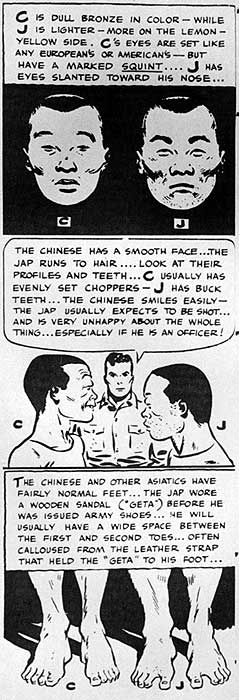
Thomas Nast's infamous depiction of 'The Ignorant Vote' is one particularly pungent example of how the metaphysics of 'race' works. Although the Irishman is labelled 'white', the racial morphology deployed makes him darker and ape-like. The cartoon or caricature just happens to be the ideal means of conveying it, because of the liberties you can take with the physical form. You can see clearly that it is a system of similes and allusions, a disorderly complex of metaphors. In the context of war, the visual metaphors of cartoonists are part of the repertoire in the poetastry of genocide. In this case, the fangs and green tinted skin would not be out of place in Nazi anti-semitic propaganda. Of course, it required a labour of revision to manufacture the correct racial stereotypes in the Pacific theatre of WWII, since - as in the Boxer Rebellion, only with the roles reversed - there were good 'Orientals' and bad ones. Take a look at this comparison: "How To Tell Japs from Chinese". In it, the American racial warrior - not a bit different from the Nazi racial warrior in his build, looks and comportment - explains how to distinguish the good 'Asiatic' from the bad one. The good one smiles easily, has European-American eyes, normal feet, evenly set teeth. The bad one scowls, is slanty-eyed, has bucked teeth and weird feet. Of course this deranged bollocks was never intended to be an actual field guide for the befuddled American soldier - it was intended to make it easier to kill and ultimately exterminate those Japanese weirdos.Racial doctrine therefore proves to be extraordinarily ductile given the exigencies of war. In both subsequent major Asian wars, there were good 'Asiatics' and bad ones. So, during the Korean War, the good pro-American Korean was shown to be under spiritual and racial assault from the quasi-satanic Muscovite-controlled savages from the North. Thus, the old green tint and the claws were out again. The bestiary was put to work again. Suffice to say, the US war was as close to a war of annihilation as anything since Hiroshima and Nagasaki (and the use of nukes was being seriously considered). The Vietnam War, though apparently complicated by the 'good guys' in the south, was increasingly obviously a war against almost the entire Vietnamese population. Hence, the 'dinks' and 'gooks' and 'savages' were relatively straightforward to depict, especially for the children. This war, of course, became increasingly genocidal, as the back room boys devised increasingly intensified anti-civilian warfare. The explicit use of racial caricatures of this kind became a source of embarrassment for the American government following the civil rights struggle, the race riots and the formal abolition of southern segregation, although one remaining respectable form of racism was that directed against Arabs and Muslims, and so it remains. Of course, once again, you can always find some good Arabs, ones who are strangely Americanised, whose skin is lighter, whose eyes are more European, whose values are 'Western'. This is how 'race' works: if you want to 'lighten' or 'darken' someone, you just use your imagination. Hold your breath, make a wish, count to three... There's nothing to it.
One final example. Here is a respected pro-war journalist in a liberal newspaper at the height of the self-congratulatory euphoria over the war in Yugoslavia:
" Do Albanians look like Serbs?
"No. Of course the differences are only approximate but it is often very easy to tell a Serb from an Albanian in Kosovo long before he or she opens his mouth.
"The Serbs often have black or dark brown hair and are generally darker and more heavily built than Albanians. Their appearance is fairly typical of southern Slavs. By contrast, the Kosovars look Celtic to a British eye. They have curly hair, which is often blonde or rust coloured, and their skin tends to be very pale and covered in freckles. Their eyes are often green or blue and their build is much more slender than that of the Serbs. They have longer heads. It is not surprising that they look so different as they belong to different races that have very rarely intermarried." (Marcus Tanner, 'WAR IN THE BALKANS: THE BALKAN QUESTION; KEY ISSUES BEHIND THE WAR EXPLAINED', The Independent, 11 May 1999).
The great war of 1999, then, was a war on behalf of the Milky Bar kid against some squat, Slavic barbarians.
Labels: 'race', imperialism, racism, serbia, war, yugoslavia
7:45:00 am |
Permalink |
Comments thread |
|
Print |
Digg |
del.icio.us |
reddit |
StumbleUpon |
Tweet|
Share|