Friday, April 24, 2009
Allied turf wars posted by Richard Seymour
But now it is different. Barack Obama, who speaks softly but carries a big stick, is the new "leader of the Free World" (astonishing to think that people still use this expression). He is wildly popular in naturally sympathetic European states, and the Euro clerisy are balls deep in his hopeful audacity. As a result, he will have the clout necessary to restore the shattered NATO alliance and solve the problem of overstretch. Obama has spoken of restoring relations with Russia. He has scolded Iran for its nuclear heresies, but also offered to chat, the better to weaken and isolate its fanatical and hate-ridden leadership. As a necessary evil, he has exchanged pleasantries with that poisonous caudillo Hugo Chavez, who will soon fall to a colour-coded 'revolution', you hope. He has taken a sensible approach to Iraq, with a prudent application of the 'Pottery Barn rule' - no precipitous withdrawal, no dissing the surge, and no defunding. He has cautiously sought to roll back the unpleasantness of officially sanctioned torture (Bush scandalously neglected to fully outsource the practise). He has pledged to revive multilateralism and build a strong deterrent force in Afghanistan, and if his preference for 'security' over 'democratisation' saddens you, then you are equally saddened that Afghanistan is not yet ready for the liberal institutions that Bush so hubristically sought to impose. But this only strengthens the case for defeating the enemy. By appointing Clinton era officials, he has offered a reasonable chance of reviving that golden age. And perhaps Obama might better Clinton on Africa. With some intelligent planning, the crackdowns on Somali piracy - an early Obama success, drafting the EU into shouldering more of the imperial burden - can become the basis for a series of actions to stabilise that unfortunate continent, with the pacification of Sudan its crowning achievement. And even France has normalised its relations with the US by electing a neoconservative leadership that has already rejoined NATO. At any rate, you are optimistic for the first time in this young millenium.
Still, you can't help but find something disturbing in all this. If the new president, surely at the height of his appeal, can't get more than 5,000 extra non-combatant troops out of NATO, or reform the alliance to more adequately meet its interests, what has become of his dynamic multilateralism so soon? A boost in NATO commitments was supposed to give Obama room to cut taxes domestically and stimulate the economy. And if the potent POTUS can't get the EU to even agree measures to accept prisoners from the closing Guantanamo, does this point to European moral shortcomings or to US diplomatic shortcomings? Or to something worse? If European states can't see their way to defending the energy frontiers of what Brzezinski called the 'global Balkans', how can they be expected to commit to interventions where their commercial interests are less obvious? Moreover, the Obama administration seems to be remarkably slow at getting the right personnel, with no assistant secretary of state for African affairs appointed five months after his election - is this administration really going to lead an international (ie, Euro-American) coalition to save Darfur? Perhaps it is at this point that you wonder if the whole idea of a renaissance in American foreign affairs is a mirage. The political-economic basis for Clintonite multilateralism is gone, after all. Washington's unipolar dominance is disappearing, its hegemony over potential rivals ending, its mode of dominance through what Peter Gowan calls the 'Dollar-Wall Street-Regime' possibly coming to an end. Now you find Italy and France siding with Russia, while Germany - which, while its banks have suffered terribly from the crisis, is not a heavily leveraged society compared to its Anglo-Saxon competitors - bucks the financial 'bail out' plan. What if Bush was right? What if the neoconservative prospectus as of 2001 was not an extremist, adventurist programme but a realistic engagement with a world in which America's ability to control affairs was undergoing long-term decline? What if, while mobilising antique doctrines of empire, it was in practise an emergency management programme for a society that only survived the 2000-1 recession on the basis of a temporary housing bubble, with poor subsequent growth rates? Suppose the protectionism of the last administration was a sensible response to competition that America could no longer withstand. Even Clinton's handling of WTO disputes was thoroughly protectionist, or does no one remember the "banana wars"? And, after all, Obama isn't exactly abjuring protectionist measures, what with his proposed Patriot Employer Act. What if, moreover, the Bush government could do little else but pursue a 'unilateralist' course given the extreme measures forced upon it by the circumstances of obvious decline? The PNACers would probably have had little influence were it not clear that the US was losing some of its dominance, and was destined to lose its financial 'leadership' (to use one of your favourite euphemisms). What if Obama is obliged to do the same, only more forcefully? What if, unable to draw allies alongside him, he has to expand his Afpak war into other zones of Central Asia? Would Bush's rough-riding henchmen have acted any differently? What if, objectively, your stance for the last eight or so years has been objectively anti-American?
Labels: 'obamamania', afghanistan, barack obama, capitalism, europe, iraq, liberal imperialism, multilateralism, the liberal defense of murder, unilateralism, US imperialism, wall street, yugoslavia
10:37:00 pm |
Permalink |
Comments thread |
|
Print |
Digg |
del.icio.us |
reddit |
StumbleUpon |
 Tweet|
Share|
Tweet|
Share|

Thursday, April 16, 2009
Saving the trophies on the Titanic posted by Richard Seymour
David Clark, former New Labour foreign policy adviser, is unhappy that many on the Left who supported Operation Allied Force in 1999 are revisiting that position and recognising it as a destructive precursor to the attack on Iraq. Given his position, it is reasonable to say that he bore some responsibility for enabling British participation in that war (although I have to say that his boss, Robin Cook, didn't look to enthusiastic at the time, which is probably why the job of selling the aggression was delegated to the defence secretary George Robertson). Has he got anything new to say that might change one's mind? He reproves the Left, but has he listened to what anyone was saying? Unfortunately not. He rehearses a shopworn story, which for the most part has already been answered, and it would be trite to regurgitate it here. He flat out denies that there was any geopolitical motivation in launching the war, which would presumably raise a few smirks among Clinton administration officials who have publicly argued the opposite. He points to ethnic cleansing, but seeks by sheer rhetorical force alone to avoid the fact that the war itself, as well as US tutelage of the KLA, convoked that process, and that the result was entirely avoidable. And just as Clark baldly asserts, without qualification or serious discussion, western innocence with respect to what took place, he takes no account at all of the KLA's co-responsibility for the war, through its targeting of civilians, its seizure of territory, and its smashing of rival groups within Kosovo. He claims that Milosevic's war was waged in the defence of Orthodox Christian supremacy, which is absolute twaddle: it was a vicious counterinsurgency aimed at defeating a violent secessionist movement. One could go on - Clark's polemic is a mindless regurgitation of some long discredited talking points of 'humanitarian interventionists'. But there is just one point that I wish to draw particular attention to. This is the response to (absolutely undeniable) charges that the discussions at Rambouillet were sabotaged:These critics talk as if the destruction of Bosnia was a figment of the imagination. The reality is that by the time of Rambouillet, western leaders had wised up to Milosevic's game of rope-a-dope in which he negotiated peace in bad faith while continuing to unleash ethnic terror on the ground. They had already endured eight years of it.
This is the self-destruct button in the article. Of course, the claim is a direct falsehood. The "western leaders" whom he imagines naively entertaining Mr Milosevic throughout the 1990s were themselves deeply involved in blocking and frustrating peace initiatives, at several key points, including the Lisbon agreement. This isn't a matter of controversy. Moreover, it would appear to be a non-sequitur if it is supposed to refute the claims that the negotiations were sabotaged. But the really interesting point is that Clark - who was presumably involved in the diplomacy at some level - doesn't actually bother to refute the claims that the negotiations were sabotaged and that unrealistic conditions were imposed on FRY in an effort to induce rejection. His retort is as close as one gets to admitting that the negotiations were sabotaged and adding that 'it's a good thing too'. If the story were as Clark says it is, what would be the point of negotiations? Wouldn't they just be an elaborate precursor to war, exactly as the antiwar Left said they were?
Labels: 'humanitarian intervention', kla, kosovo, milosevic, NATO, new labour, yugoslavia
8:47:00 am |
Permalink |
Comments thread |
|
Print |
Digg |
del.icio.us |
reddit |
StumbleUpon |
Tweet|
Share|
Thursday, March 26, 2009
The apex of moronia posted by Richard Seymour
HL Mencken's description of Arkansas might have been revived to describe everything under the NATO canopy in 1999. Then again, his castigating of the "booboisie" would scarcely have gone amiss that year either. The tenth anniversary of the bombing of Serbia, supposedly the summit of that decade's growing humanitarian concern, should be the occasion for some wrist-slashing or hara-kiri on the part of those hideous ghouls who actually cheered the slaughter on. Though it wasn't the bloodiest of American-led wars, it was the occasion for some screaming, shuddering wargasms.The moral ratification for such concupiscence was the contention that, in a corner of Europe not as yet integrated into the civilized integument of the European Union, genocide was (once again) unfolding. It would be redundant to revisit every article cynically rousing Holocaust memory, every quotation from a leading statesperson blithering about 'Europe' or 'Western values' (Ignatieff had surprisingly little to say about such narcissism, presumably because he partook of it), or every barbarity from Thomas Friedman. It is not necessary to catalogue the calls to "cleanse" Serbia, the demands for Serbia to be placed into receivership, the racial essentialism, the cries of "Not yet enough bombs, and they are already too late", Huntington's civilizational crap about Western humanitarianism versus Orthodox Serb barbarism, etc. Nor need we once again rehearse the numbers game, all of which distasteful charade was purely designed to reinforce the idea that there was an ongoing genocide which nothing short of an orchestrated campaign of high-tech violence could stop. The diplomatic record has been amply covered elsewhere, while the CIA's activities in helping lay the ground for war by making the KLA a proxy army of provocateurs awaits further elucidation. And the cover-up over Serbian civilian casualties, concealed within the raiment of 'surgical', 'precision' warfare aimed exclusively at the machinery of 'genocide', need not detain us.
It is enough to note that the ideas which produced this effusive outpouring of support for war were utterly berserk, and contributed to the deranged imperialism that liberals were to espouse during the 'war on terror'. Fresh from having pledged to fight for his country over Kosovo, David Aaronovitch defended Tony Blair's remake-the-world conference speech after 9/11 not so much against charges of "liberal imperialism" which were made in the New Statesman, but against the idea that there was anything wrong with liberal imperialism. Liberals, he averred, should try to run the world. The lesson of the Nineties was clear - do nothing, and you get Kosovo. Michael Ignatieff, having compared Serbian counterinsurgency to the Nazi holocaust, and demanded to know why the war was so late in coming, became a staunch advocate of "humanitarian empire". The age of postcolonial independence was a failure, as "populations find themselves without an imperial arbiter to appeal to" and so have "set upon each other for that final settling of scores so long deferred by the presence of empire". It was only unfortunate that America was so reluctant to fully assume the white man's burden. The liberal-neocon coalition over Yugoslavia, expressed by the Balkan Action Committee and its ads demanding a full invasion of Serbia, was carried forward into the new millenium and may well have continued to thrive had it not been for Iraq. It may yet be revived, over Darfur or a similar issue. The allure of a righteous kill, whether it comes with explicit overtures for empire or not, has hardly disappeared.
One other aspect of the war fever generated in the spring of 1999 was the sheer gratitude that many UK commentators expressed toward Tony Blair. I raise this because in a couple of talks and meetings, I have been asked to say something about why the lib imps so adore Tony Blair. It occurs to me that the love affair really began with Kosovo. Andrew Marr, later to issue a gushing benediction as the BBC's chief political commentator for Blair's war in Iraq, fell over himself praising the "brave, bold, visionary" new PM in the Observer. The liberal press were, as a rule, overjoyed to discover that their ally in Downing Street was no calculating cynic, but a true believer whose ministrations were as impassioned as their own. So unlike the previous, sleazy Major administration and its unprincipled stance toward Bosnia. Why, just look at the images of him, in his short-sleeved shirt, cuddling Kosovan refugees while his wife gently weeps in the background. Moreover, he was even more aggressive in pursuing that war than Clinton had been. There were strong indications that he would have favoured a ground invasion. As Blair became more adept at manipulating the commentariat, the loyalty he generated ensured that many backed him during his worst moments. Just as the antiwar movement was surging in numbers and feeling in early 2003, the neoconservative writer and current Tory MP Michael Gove wrote "I can't fight my feelings any more - I love you Tony". He was not the first or last to express such admiration. American warmongers always much preferred Blair to Bush, and the more the public hated him, the more they treasured for being so contemptuous of public opinion. Ten years on, the best the Atlanticists can do is groom a perpetually puzzled-looking David Miliband to take his place.
Labels: 'humanitarian intervention', air war, kosovo, liberal imperialism, serbia, the liberal defense of murder, tony blair, yugoslavia
7:24:00 am |
Permalink |
Comments thread |
|
Print |
Digg |
del.icio.us |
reddit |
StumbleUpon |
Tweet|
Share|
Sunday, March 22, 2009
In like Flint posted by Richard Seymour
 This is a remarkable article. On the one hand, it contain a shocking revelation - that Slobodan Milosevic's intelligence chief was also a CIA spy. (Actually, the revelation itself is some weeks old, and it is now alleged that he also worked for Russian intelligence, which is not mentioned in the Herald article). This is not the first time that the CIA has been found to have high-level involvement in the former Yugoslavia. Their involvement in training KLA militias in 1998-99, while working as OSCE officers, was revealed in 2000. Still, the implications of this are obviously sweeping. It would suggest that the US government not only had some unseen leverage in the war on the Serbian side, but that it had insight that enabled it to decisively influence negotiations at key points with a reasonable expectation as to the outcome. So, if Zimmerman told Izetbegovic to scuttle the Lisbon agreement, he probably had reason to know that it would lead to years of war. It means that when the Serbian Ministry of Internal Affairs was supporting militias such as Arkan's Tigers or the Red Berets, the US government knew before anyone else did. What did it do with this information? On the other hand, the article is so full of inaccuracies and absurdities that it is hard to take it seriously.
 First of all, Jovica Stanisic is not facing charges at the International Criminal Court, but at the ICTY. There is a huge difference in terms of the standing and legitimacy of each court. Secondly, even the ICTY does not charge that genocide took place in Croatia, or Kosovo, or anywhere outside Srebrenica, and even then it doesn't say that it was driven by Slobodan Milosevic. Yet, the reporter just keeps repeating 'genocide' as if this is supposed to have a hypnotic effect on the reader. What the indictment [pdf] actually alleges is an ethnic cleansing campaign in Krajina, and BiH. And at this point the key word remains 'alleges'. I don't doubt that substantial portions of the indictment are accurate, by the way, or that they would be shown to be such even in a court that wasn't as ridiculously biased as the ICTY. But that is hardly the point. The point of these falsehoods is to convey yet again that the fall of Yugoslavia is essentially a narrative of Greater Serbian expansionism checked only by exiguous 'peacekeeping' constraints, and that the current judicial process has more legitimacy than it actually possesses.
The story also asks us to believe that the CIA's influence was entirely benign, that it sought only to attenuate the causes of war, and that it used Stanisic to do so. This is because the CIA has taken the step of submitting classified documents to the ICTY to, er, 'clear up' their role in this affair. Obviously, we are not going to be told the truth either by the CIA, or by Stanisic in the context of a plea-bargain. But is a sign of the CIA's successful management of the news agenda that the revelation has produced not radical questioning but a further regurgitation of the propaganda memes of the 1990s, in a way that pro-actively whitewashes the CIA. The only question that the reporters asks is whether the US let the world down by being so 'equitable' to the Serbs at Dayton, as if that was the major problem with that lousy settlement. Should the US not have "unmasked" Karadzic and Milosevic and "demanded their surrender"? This would, of course, have entailed an invasion, and potentially quite a bloody one - but implicitly it would only have added to America's righteousness.
Labels: 'genocide', bosnia, cia, racism, US imperialism, war crimes, yugoslavia
2:34:00 pm |
Permalink |
Comments thread |
|
Print |
Digg |
del.icio.us |
reddit |
StumbleUpon |
Tweet|
Share|
Thursday, February 19, 2009
You do it to yourself. posted by Richard Seymour
 My little stalking pony, frontiersman, supporter of Croatian nationalism and extoller of 'Operation Storm', Marko Attila Hoare, is back with what he describes as a "measured" 4,000 word review of pp 190-212 of my book, The Liberal Defence of Murder. As Hoare writes, these pages concern his "own area of special interest" as an historian and polemicist, namely the fate of the former Yugoslavia. In that sense, one would expect Hoare to find his objective, which is to undermine my arguments, relatively simple to accomplish. I will try to be as concise in my reply as he is prolix in his review.
Hoare begins by accusing me of a tautology: "Seymour is unable to provide any evidence that any of his liberal targets did, indeed, support ‘murder’" in the cases of Croatia and Bosnia, there being no notable instances of "bloodcurdling war cries", "unless simply being in favour of Western military intervention automatically makes one a supporter of ‘murder’". In fact, the argument in the book is that in misconstruing the situation in Yugoslavia, and by calling for intervention, pro-war liberals helped to justify political and military interventions that did indeed contribute to ‘murder’, and prepared the ideological ground for supporting future wars. I do not characterise everyone who (to my mind mistakenly) bought the 'humanitarian intervention' argument as a defender of 'murder'. And at no point do I argue that liberal imperialism is simply characterised by "bloodcurdling war-cries". The whole point of liberal imperialism as an ideology is that it doesn’t work that way. The accusation of "tautology" rebounds on the reviewer: it is his tautology, not mine.
I do not argue against military intervention on the grounds that "the Croatians and Bosnians were not worthy of being defended by Western military intervention, because their governments were just as bad as Milosevic’s - possibly worse - and were guilty of the same atrocities." I argue that liberals and leftists misconstrued the facts of the matter, demonised the Serbs and paid little or no attention to comparable crimes by Croatian and Bosnian forces. I do not argue that anyone is "not worthy" of "being defended". The reviewer just assumes that military intervention would, in fact, constitute 'defence'. In outlining the grotesque disinformation in the coverage of the conflict, he further assumes, I mean to imply that Croats and Bosnians were unworthy of a form of 'solidarity' that I might extend to others, suggesting that he has not read/understood the rest of the book. Nor do I say, or imply, that Croatian and Bosnian governments were "possibly worse" than "Milosevic's". This a tautology followed by a non-sequitur, crowned by an invention.
I do not argue that the proper response "to news and images of Serb ethnic-cleansing and atrocities (which Seymour does not deny took place) is not to demand action in defence of the victims, but to ensure that the perpetrators of this ethnic cleansing and these atrocities get a fair coverage and are not condemned in too strong terms". I argue that "action in defence of the victims" of any atrocity is not identical to calling for states to engage in military aggression, and that humanitarian solidarity is not to be confused with hysterical propaganda. It is because Hoare doesn't notice such distinctions that he is able to conclude that "what Seymour has written is a defence of the Milosevic regime and Serb ethnic-cleansing from their liberal critics". (Emphasis in original). If only I were as litigious as the Hoares. It would be far more realistic to say that much of Hoare's output constitutes a defence of the Tudjman regime and Croatian ethnic cleansing.
I would prefer to leave aside the matter of Hoare's taking umbrage on behalf of his mother, but Hoare's misrepresentations make it impossible. Firstly, interviewing former friends of those one wants to evaluate, even if in passing, is not the disreputable technique that he appears to think it is - it is normal practise. Secondly, Hoare claims that Branka Magas only supported Croatian secessionism in the same sense that Socialist Worker did. Magas supported secession, Socialist Worker supported the right to secede - a distinction that made all the difference when Magas denied the ‘systematic persecution’ of the Krajina Serbs, and husband Quentin Hoare defended Tudjman from claims that he was an antisemite and Holocaust-denier.
I reject the evocations of Nazism, World War II and the Holocaust with reference to the Serbian government. This is not because the Serbian government lacked for authoritarianism or because it was not interested in expanding its power – with brute violence when all else failed. It is because that system of allusions was the basis for propaganda that denied the atrocities of other powers and legitimised the highly destructive interventionism of the United States, including its diplomatic sabotage and its subcontracting of reactionary Wahabbi fighters. Serb camps were compared to Belsen, in a sense, so that one didn't have to mention camps run by the HDZ and BiH. In that context, I ironised about Finkielkraut’s deployment of the Nazi-Jew homology in the context of the Croatian war by pointing out that Tudjman was more apt to vocalise pro-Nazi sentiments than Slobodan Milosevic. It is true that I didn’t mention that a number of Bosnian Serb paramilitaries embraced the symbols of the far right, but that was because it not germane to an argument about the Croatian war. I will spare Hoare’s blushes by not meditating too long on the topic of the BNP’s Nazi proclivities, which he denies exist. I will merely say that if it was possible not to see the antisemite in Franjo Tudjman, it is possible to miss the Nazi in Nick Griffin.
Hoare is scandalised that I impute "political motives" to the International Court of Justice: the problem is that I don't. He is referring to page 204, which explicitly references the ICTY, a wholly different (and highly politicised) body. Hoare is also vexed by my claim that "Izetbegovic’s Bosnian regime was the party favoured by ‘Western imperialism’". My claim is actually that US imperialism backed Bosnia. I note that the French government of Mitterrand, for example, was sympathetic to the Serbian side. The reason for this distortion on Hoare's part is that he wants to establish a 'gotcha'. Thus, citing alleged 'false flag' operations by the Bosnian side in Markale, I note that the accusations originate from UN personnel. According to Hoare, this means that the "representatives of Western imperialism" were maligning Bosnians, blaming them for "their own suffering". Even if those UN witnesses were in an uncomplicated way the imperialist delegates that Hoare takes them to be, the point would be one of 'evidence against interest': if those UN witnesses were representatives of US power, they were undermining the narrative industriously promoted by their bosses. Further, the point about 'false flag' operations is precisely that those responsible for them are not the victims. The implication of such an operation would be that the Bosnian government was using the populace as a bargaining tool in its negotiations. Only by assuming that the Bosnian government was the bearer of the volksgeist, in a way that is congruent with his support for Croatian nationalism, could Hoare fail to understand this point.
What seems to annoy Hoare more than anything else is my habit of citing left-wing dissidents, especially those who are either sympathetic to Slobodan Milosevic or sceptical of the claims surrounding the Srebrenica massacre. I make no apology for doing so where they have something interesting to say, and they are more than outnumbered by the usual texbooks, scholarly articles, news reports and so on. But Hoare's undignified indignation leads him to yet another pratfall. Thus, belabouring me for citing Diana Johnstone on Izetbegovic’s deathbed confession, as related by Bernard Kouchner, he complains: "Kouchner’s French government was aiding and abetting Milosevic’s destruction of Bosnia, and maintaining an arms embargo against the Bosnians". And so, he wonders, why should we take his word at face value? Had he read the 22 pages he focuses on properly, he would have been aware that Kouchner was not a supporter of that policy, and worked to get it overturned (see p 199). This would be one more case of 'evidence against interest'.
Those extensive mis-readings and gaffes to one side, there are a number of criticisms where I think Hoare has a point. And it would be grossly unfair, given how much effort he put into his review, to ignore them, so I conclude with those. I cite a quotation from Tudjman that was reproduced in Michael Parenti's To Kill a Nation in which genocide is described as "permitted", and even "recommended". Hoare, who has read the original text from which the quote has been extruded, says that it is taken out of context. I am quite prepared to take his word for it barring better advice, and correct it in the paperback edition. Accusing me of mis-stating casualty figures, Hoare notes my claim that in the run up to the Srebrenica massacre, "a wave of terror, including rape, by Bosnian Muslim forces in surrounding areas had killed thousands of Serbs.’" This was based on a number of neglected news reports from the time, found on LexisNexis. His rejoinder is that statistics from the Research and Documentation Centre, whom I cite elsewhere, put the number of Serb civilians killed in the surrounding area at 879. I did say "Serbs" and not "Serb civilians", and the total number of Serbs killed in that area, according to Hoare's source, is 5573. He might have been more attentive to what he was reading. Still, let us concede that it would have been better to measure those news reports against the RDC’s stats and to make a clear distinction between the killing of military men and civilians in the UN-protected enclave and surrounding areas. There would have been no damage to the substantive point that forces loyal to General Naser Oric were using their numerical strength over the Serbs to harrass, rape, and kill locals, and that little attention was paid to these and other atrocities by Bosniak forces. And I will also give Hoare the point that having opposed the use of inflated figures for civilian casualties, my use of Kate Hudson’s maximal figure for the number of Serbs expelled during Operation Storm (which may well be the total number displaced during the whole of the war from 1991 to 1995) does not sit well – and at any rate wasn’t essential to the point that what Hoare refers to as "the liberation of Krajina" was a bloody and repressive operation.
All the rest, I am afraid, is just futile bluster on Hoare’s part.
Labels: bosnia, croatia, genocide, pro-war 'left', serbia, the liberal defense of murder, yugoslavia
6:37:00 am |
Permalink |
Comments thread |
|
Print |
Digg |
del.icio.us |
reddit |
StumbleUpon |
Tweet|
Share|
Monday, September 08, 2008
No, I didn't. posted by Richard Seymour
"...Seymour argued that Serb shelling of Sarajevo civilians and hospitals during the war in Bosnia was all deliberately provoked by the Muslims in the first place...". No, I didn't. I didn't say anything like that. My sole piece of advice for you, Marko Atilla Hoare, is to get a fucking life, you demented stalker. Either that or sue me.Labels: bomber 'left', the liberal defense of murder, yugoslavia
1:09:00 pm |
Permalink |
Comments thread |
|
Print |
Digg |
del.icio.us |
reddit |
StumbleUpon |
Tweet|
Share|
Friday, September 05, 2008
Guess who's against antisemitism? posted by Richard Seymour

Labels: 'antisemitism', antisemitism, hp scum, jenna delich, tudjman, ucu, yugoslavia
8:37:00 pm |
Permalink |
Comments thread |
|
Print |
Digg |
del.icio.us |
reddit |
StumbleUpon |
Tweet|
Share|
Tuesday, July 29, 2008
Little evil me? posted by Richard Seymour
I really am going to have to insist that Harry's Place stops with its cult of my personality. First they plugged my speech at Marxism, then they, er, 'celebrated' my graduation, and now this. The author, presumably in all seriousness, says that I "supported Serbian territorial expansion" in Croatia. Marko, dearest, I was thirteen when that shit started and wouldn't have known Serbia from a tennis shoe. What he means to say, perhaps, is that I would have supported such a procedure. His 'gotcha' consists of a retort in the comments box to someone brazenly supporting Operation Storm, in which hundreds of thousands of Serbs were ethnically cleansed. This is what I said:So, you just accept the claims of Croatian nationalism, then? No negotiations, no border rectifications, no arrangements for the increasingly oppressed and demonised Serb minority, just take the land and tell the others to fuck off? Some socialist.
...
You’re stuck with your support for Croatian nationalism, then. It doesn’t occur to you for a second that there might be legitimate problems for an oppressed minority following an unnegotiated secession with no dialogue or border rectifications.
Hoare then goes on to offer his interpretation services to HP Sauce readers, who at this point would be snapping their crayons in puzzlement: "he’s saying that the proper solution to the Serb question in Croatia was for part of Croatia’s territory, where Serbs lived, to have been taken from it and annexed to Serbia, thereby creating a ‘Great Serbia’." His over-hasty prosecutorial zeal has led Hoare to neglect to ask the author of the quoted ripostes whether in fact he is indeed "saying" that, but I believe I have the advantage here. After all, I am not the one who [would have] supported the logic of secessionism in the first place, and therefore I would have no problem explaining why the construction of separate states based on ethnic exclusivity would be no solution. It is Hoare who, considering Croatia's secession legitimate and worthy of full-throated support, has to answer why the Krajina Serbs were not entitled to independence from Croatia (and political union with Serbia if they wished). This is particularly the case since the Serbs living in Krajina were, like other Serbs living throughout Croatia, genuinely victims of repression and ethnic hatred by a state whose early gestures included the rescuscitation of fascist symbolism. But if there is going to be secession, ought there not be negotiations as opposed to a unilateral military take-over of the territory? Might there not be a concession of territory by both parties, or are the borders of some states eternal and inviolable, like the Holy Mother's virginity? The logic of supporting ethnic nationalism in Croatia, an ultra-reactionary political project from its inception, is what has produced Hoare's hysterical twaddle. Anything that might appear as remotely sceptical about Croatia's inherent right to dispose of the territory (and the people living there) as it wishes must be taken as an affront.
Hoare also reminds readers that I don't agree with describing the camps run by Bosnian Serbs as 'concentration camps'. He of course redacts my description of said camps, and omits to mention that the main thrust was that there were similar camps with similar atrocities maintained by all the warring parties in Bosnia, with little attention paid by our vigilant press. He also says I am endorsing Living Marxism's claims, which have been 'disproved' in court. In fact, I endorsed the verdict of Phillip Knightley, citing him twice, not that of Thomas Deichmann, cited nowhere. The court did not 'disprove' the points that a) not all those present were emaciated like Fikret Alic, because people could be fed, and therefore the broadcast was wrong to give the impression that people were being forcibly starved; b) many people could come and go, and therefore not all were imprisoned; and c) those who were prisoners were not being held by barbed wire, but by armed guards, which point was obscured because it disrupted the symbolism of the concentration camp. Those were the points I cited. And at at any rate, I am not as content as Hoare evidently is to accept a court's verdict at a libel trial as the final word on a complex, multifaceted historical record. In another bid to establish my evil-doing propinquities, Hoare explains that "Seymour is on record as describing Milosevic’s dictatorship as ‘a state with an elected government, legal opposition parties, independent trade unions, and opposition demonstrations permitted’". It is enough to state the obvious to be indicted in Hoare's petty tribunal. And finally: "He responded to the International Court of Justice’s recognition of the Srebrenica genocide by continuing to deny that genocide had occurred: ‘the massacre of thousands of men of military age is an atrocity, but under no reasonable definition is it genocide’." This point is telling, but not in the way Hoare thinks it is. After all, it would not in itself matter whether such an unspeakable atrocity was genocide or 'merely' a massacre. The condemnation or otherwise of such conduct does not depend on defining it in this way. But for supporters of Croatian and then Bosnian nationalism, it has to be genocide because they know the word functions not in a literal way but in a propagandistic sense. Prophylactically, it isolates the Bosnian Serbs as uniquely malevolent in that conflict, and therefore provides the prior justification for the vicious ethnic nationalism and brutality of the HVO and BiH and their auxiliaries. It affirms a narrative elaborated since 1991, long before Srebrenica became a household name, in which the Serbian government was the Nazi threat refulgent (thus making fascist-loving Tudjman an anti-fascist resistance leader). That is why people like Hoare consider it monstrous to dispute the term - his absurd, whitewashing narrative of heroic Croatian nationalism depends on it.
The entirety of Hoare's infantile imposture is animated by this imperative. The histrionics about me having 'supported' something called 'Great Serbia', based on a couple of flimsily parsed comments box exchanges, truly befit someone who described Operation Storm as "the liberation of Krajina" and who spends much of his time trying to defend the insupportable proposition that the salient characteristics of Croatian nationalism in its militant phase - its reactionary anti-semitic leadership, its revival of fascist regalia, anti-Serb racism, repression, war crimes and ethnic cleansing - were merely incidental to a great liberation struggle.
Labels: bosnia, croatia, serbia, the liberal defense of murder, US imperialism, yugoslavia
6:48:00 am |
Permalink |
Comments thread |
|
Print |
Digg |
del.icio.us |
reddit |
StumbleUpon |
Tweet|
Share|
Sunday, July 27, 2008
Back to Trnopolje posted by Richard Seymour

Ed Vulliamy is not going to tell you anything different. Of course it was a "concentration camp", only slightly less "satanic" than Omarska and other such institutions. Of course the emaciated Fikret Alic, "behind the barbed wire", "embodied the violence unleashed on Bosnia's Muslim civilians at the orders of Radovan Karadzic". And, as we recall, it was necessary to establish the facts of the matter, and what one might say about them, by prosecuting a tiny sectarian publication and driving it out of business. (Never mind what became of said sectarians - the principle established is that it was proper for the state to determine what amounts to truth in the public domain, and what may be censured.) The trouble is that, as Phillip Knightley wrote at the time, the imagery that Ed Vulliamy is citing as evidence in itself for what the newspapers dubbed "Belsen 92", is a deception. Knightley pointed out to The Guardian in 1997 that the key symbols in the image, the ones that Vulliamy evokes here - the barbed wire and the emaciated condition - were inaccurate because a) the other prisoners were clearly not starved, and food could be brought to the prisoners by villagers (Alic's own account of his condition appears to be that he was both poorly nourished and suffering from an untreated illness), and b) while Alic and others clearly were in fact imprisoned (others were not), what was imprisoning Alic was not barbed wire but armed guards. It was, in short, an image settled on to convey what could not be said openly - that these were Nazi-style concentration camps. Former ITN producer Bruce Whitehead wrote, in a trenchant review of ITN's conduct, that "the report that aired gave the clear impression that these men were being forcibly starved behind barbed wire". This was part of a context in which Roy Gutman won a Pulitzer Prize for reporting on Serbian "death camps" with metal cages in which thousands of prisoners were being killed and their bodies cremated for animal feed (evidence for which is scarce). The French organisation Medicins Du Monde, set up by Bernard Kouchner as a split from Medicins Sans Frontieres in 1980, launched a mass campaign advertising death camps, comparing Milosevic with Hitler, inviting audiences to believe that the Nazi holocaust was taking place all over again.
To linger with the obvious for a moment, there was in fact a system of camps intended as prisons for those deemed suspect by forces deputised by the Republika Srpska. They also functioned as deportation camps for those being driven out by those forces, as places where Bosnian men could be drafted to fight on the side of Republika Srpska, and as the basis for 'prisoner transfers' between the hostile forces. Many were closed down in 1992, with thousands of prisoners transferred to UN control. Trnopolje was a transit camp for detainees, although as Phillip Knightley elsewhere wrote (see below), it was also a place where refugees could go. These camps were promulgated in the context of a brutal, ethnicised civil war, which included the deliberate terrorising of civilian victims, and indiscriminate murders by all sides in the conflict. In those camps, murders, beatings and gang rapes took place. It is worth noting that, as Vulliamy points out, he and his journalistic confederates were able to report about these camps because Karadzic had enough bravado to challenge them to find atrocities during a bus-tour of the camps arranged by himself. Bosnian and Croatian forces were not so stupid as to invite journalists to inspect their detention camps, and I bet that most readers couldn't even name one. You know of Omarska, Trnopolje and at a stretch Manjača. The camp at Bugojno run by the Bosnian army is hard to find details about, and while there are extensive wikipedia articles and press discussions of those run by the Republika Srpska, there is nothing on wikipedia about this camp. Try finding out about the Orašac Camp, also run by the Bosnian army. One or two individuals have been brought before the ICTY in connection with acts committed in those camps, but I don't think a single journalist ever thought to try to visit them, much less tell the world that they were death camps. A Lexis Nexis search discloses less than a dozen news stories specifically about the Orašac Camp, all from Croatian news sources. These pertain to investigations into the ritual beheadings, beatings and torture of Serb and Croatian detainees, among other things. Only a few sources outside Croatia can be found mentioning the Bugojno camp, belatedly, even though the area in which the detention camp was sited was frequently reported on during and after hostilities. No one cared, it seems. Journalists had effectively become co-belligerents with the Bosnian army and the their mujahideen auxiliaries, and anything that didn't fit the script contrived by PR companies such as Ruder Finn, which was employed by both Croatian and Bosnian governments, or that of Washington and its allies, was out of the picture.
At any rate, here is a passage from Knightley's evidence intended for the ITN/LM trial:
The most likely explanation is that Trnopolje was both a refugee camp and a detention camp--there were at least two different groups of people there--and that this is what has confused the issue. Refugees had come there of their own free will and could leave at any time. But there were also Bosnian Muslims like Fikret Alic who had been transferred there from other camps, who were awaiting identification and processing, and who were not free to leave.
But even this group was not confined by barbed wire. The out-takes show them in the main camp, outside the agricultural compound, and the main camp was not surrounded with barbed wire, as the War Crimes Tribunal agrees, but by a low chain-mail fence to keep schoolchildren off the road. As well, the barbed wire fence was no deterrent to anyone determined to escape because it was poorly constructed with wide gaps. What confined the Bosnians at Trnopolje, the War Crimes Tribunal says, was the presence of armed Serbian guards. So ITN was right in that the men in the film were detained in Trnopolje, but the image used to illustrate that was misleading because it implied that they were detained by the barbed wire. The barbed wire turns out to be only symbolic.
Were all the inmates starving? No. Fikret Alic was an exception. Even in Marshall's report other men, apparently well-fed, can be seen, and the out-takes reveal at least one man with a paunch hanging over his belt. Phil Davison, a highly-respected correspondent who covered the war from both sides for The Independent says, "Things had gone slightly quiet. Suddenly there were these death camps/concentration camps stories. They were an exaggeration. I'm not excusing the Serbs but don't forget that there was a blockade on Serbia at the time and there not a lot of food around for anyone, Serbs included."
It is a peculiar irony that just when reporters are most integrated into state propaganda (which is usually the case during a war), that is when they become the most arrogantly assured of their absolute, uncompromising integrity and intrepidity. The very fact of their presence at the scene of the crime, their ability to bear witness, even where their attention has been very carefully directed and framed in advance by assumptions elaborated by intelligence and PR agencies, is enough to make them think they are changing the course of history, humanitarian agents enacting la justice de Dieu. (Sometimes the reputation might be warranted. Apparently, the photographer and reporter Janet Schneider, who liked to stare down the "corridor of death" and coolly stated that she had endured rape "more than once" in the course of securing a story, was directly involved in assisting Fikret Alic after his escape from Trnopolje). The sheer irrational fury unleashed when their role is challenged is indicative of the intense narcissism that has been channelled into the enterprise. So, here we are, back to Trnopolje, the barbed wire, the body eaten by hunger and disease, and the spectre of Belsen. And though the montage is a crude specimen of revisionism in itself, it is of course those who do not assent to such vulgar redactions that are labelled revisionists.
Labels: 'death camps', bosnia, itn, lm, serbia, trnopolje, US imperialism, yugoslavia
9:04:00 am |
Permalink |
Comments thread |
|
Print |
Digg |
del.icio.us |
reddit |
StumbleUpon |
Tweet|
Share|
Wednesday, July 23, 2008
What are the odds? posted by Richard Seymour

At last, the truth will emerge. With Radovan Karadzic's capture and imminent trial, by a US-sponsored junket known as the ICTY, we will get to know the full facts about mass rape and genocide. Or will we? Forget for a moment the effrontery of a 'court' that effectively acts on behalf of the occupiers of Iraq dispensing wisdom on war crimes. And let's leave aside the fact that - whether or not Karadzic is guilty, as I think he is, of war crimes - trials of this nature are farcical and tend not to disclose much in the way of official responsibility. The more obvious point is that the verdict was reached, so far as official liberal opinion was concerned, some time ago. And that verdict has it that the Bosnian war was purely the result of a Serb nationalist pact of aggression against the remaining components of Yugoslavia, and that Radovan Karadzic, as a 'mastermind' of the war, strove to exterminate Bosnian Muslims and Croats.
Vulliamy's article puts it like this:
After 13 years on the run, Radovan Karadzic, the former Bosnian Serb leader, is on his way to The Hague to face charges of genocide and masterminding the bloodiest carnage to blight Europe since the Third Reich. ... And that man looking like Santa Claus was him, Karadzic! The man who arranged the mass murder of 100,000 people and the enforced deportation of two million? All those incinerated homes, the mass rape camps, the mass deportations at gunpoint.
This, to be frank, crazed nonsense is unlikely to be met with as much derision as it deserves to be, if any at all. Let me enumerate the falsehoods: Karadzic is certainly likely to be charged with genocide, now that the ICTY has ruled that Srebrenica was a genocide and Karadzic is believed to have ordered that attack, but he is not going to be charged with 'masterminding' the war; Karadzic may be accused of 'arranging' the mass murder of 8,000 Muslim males, but I know of no serious source that holds him responsible for 'arranging' the mass killing of 100,000 people, which is on current estimates close to the total number who died in the war on all sides, civilian and military; at the end of the war, a total of 2.2 million Bosnians of all kinds were displaced, one million of those internally, but it is absolutely not the case that Karadzic 'arranged' the 'enforced deportation' of two million people. These are just matters of fact about which Vulliamy is either deceived, or dissembling. How is it even possible to have a sensible discussion about this if the facts are so obscured by propaganda that - and I bet you this is true - hardly any Guardian reader will notice that the prize-winning senior foreign correspondent Ed Vulliamy is just ranting out of his blowhole? How is it possible that anything that did emerge from a trial would be weighed, if not dispassionately, then at least with an attempt at honesty?
I raise all this not because Karadzic is entitled to any defense from me (I am sure he is more than adequately protected by his amulets). So much is obvious. And I don't raise it because even my reasonably well-grounded suspicions about his culpability are not enough to persuade me that the facts should be settled by a lawless court which refuses to investigate the crimes of its sponsors. I raise it because, well, here we are in the middle of an epic and ongoing war crime with death rates, torture chambers, and mass rapes that are certainly much worse in their totality than anything that happened in Bosnia. All of this is the direct responsibility of the American state, which unarguably launched a war of aggression without any provocation whatsoever. And, somehow, the volume is decidedly muffled. While there are great independent journalists exposing much that is going on, the field is not exactly crowded. The liberal journalists and opinionators who were so vocal in advocating for Izetbegovic, so eager to bear witness, are hardly visible. And where they have not just enthusiastically backed the enterprise, they are at the very least circumspect on the matter of the evident criminality of the war's planners and prosecutors. Even those who are not backers of the war in Iraq constantly apologise for the United States government (usually referred to by the abstraction, 'America'), constantly seek consolation amid its crimes, and assert repeatedly that it still does some good in the world. Well, forgive me, but if that's the trend, shouldn't you be ashamed to talk about Bosnian war criminals? If you find yourself struck by a curious aphasia on the matter of trying to prosecute not only American officials but British ones too, what right have you got to exult about the capture of one lowly thug by the agents of the world's biggest thugs? If you can't match with honest reporting the level of hysteria and propaganda that you generated over Bosnia and then Kosovo, is there no point at which abashment sets in? I ask merely for information.
Labels: 'war on terror', bosnia, genocide, iraq, radovan karadzic, torture, US imperialism, yugoslavia
2:53:00 pm |
Permalink |
Comments thread |
|
Print |
Digg |
del.icio.us |
reddit |
StumbleUpon |
Tweet|
Share|
Tuesday, July 01, 2008
"Intervention" posted by Richard Seymour
Is it still too late to ban this term from serious political discourse? I ask because - well, you know, because of everything, but because of this in particular. It is one of the worst articles I've read in some time, and I read the Telegraph. Everything that is wrong with a particular kind of journalism, the kind that accrues awards and moral approbation, is present. Sentimental kitsch ('...in a country that no longer exists called Yugoslavia, people were begging for help. And we did nothing'), nationalist trivia ('"Someone told us the Americans are coming." Then they turned desperate, grabbing my hands, begging for help, to send a message to a relative, to get them medicine, money, food, a radio, wood to burn, a newspaper, a way to feel that they were not enduring living hell. "Is it true? Is it true? Are they coming to save us?"'), moral imposture (every word), narcissism ('I am often accused of being boring about the war in the Balkans. It's over, move on, people tell me. I'm glad I am a bore'), and casual factual inaccuracy (a quarter of a million people did not die in the Balkans wars of the 1990s, and 'we' did not do 'nothing').This is the story: some cynical foreign policy wonks who outrageously want grants to produce their work do not think it right to 'intervene' to save anyone from murder or rape, but she (Janine Di Giovanni, an American-born writer who styles herself as one of Europe's most respected journalists) has seen the suffering first hand and knows too well the cost of such indifference. Only someone with military experience can understand her outrage. That's it. That's the entire article. Largely to my relief, I am unfamiliar with this particular journalist. But I recognise the genre. Journalism on the Balkans is replete with this kind of horseshit and publishers lap it up because they know that most of those who pick up a journalistic book about Yugoslavia and its break-up have no intention of actually learning anything. In one sense is mood music for the American empire - the world is afflicted, and only yankee supermen (with suitable auxiliaries in tow) can save it. In another, it appropriates suffering for narcissism. In the mere act of encountering another's suffering, meditating on it and irresponsibly calling on an imperial hyperpower to do something about it, one becomes virtuous and loveable. I do need to say that I despise these people, and I could not say how much.
However, to return to what is motivating this tirade, can we not do away with 'intervention', at least in this context, as a gross abuse of the language? Can we not finally force people, at gunpoint, to say what they mean? Calls for 'intervention' typically involve a plea for a major military power to deploy some of its troops and hardware in zones of conflict or humanitarian disaster (notwithstanding any complicity that power might have in that catastrophe or any concurrent one of equal or greater calamity). They usually call upon the American state to invade, or bomb, or overthrow the government of another society. In light of what can reasonably be expected to be among the outcomes of such a venture, the term 'intervention' is even more furtive than 'enhanced interrogation technique', 'collateral damage', and a thesaurus of similar euphemisms. I suggest the following alternatives in future: conquer, subjugate, annexe, vanquish, overthrow, subdue, destroy, crush, bombard and attack. There are probably hundreds of vocables that would pithily express a call for the global projection of violence, and 'intervene' isn't among them.
Labels: 'humanitarian intervention', yugoslavia
3:39:00 pm |
Permalink |
Comments thread |
|
Print |
Digg |
del.icio.us |
reddit |
StumbleUpon |
Tweet|
Share|
Saturday, April 12, 2008
The KLA's death camp. posted by Richard Seymour

It turns out that Carla Del Ponte had credible evidence of the KLA harvesting the organs of Serb prisoners and selling them off. This follows recent reports that the former Kosovan PM, Ramush Haradinaj, ordered the rape, persecution and murder of Serb civilians during the KLA's insurgency in the 1990s (he has, however, been declared 'not guilty' by the ICTY after nine of ten planned witnesses for the prosecution were killed). I must say, the Kosovan Liberation Army become more interesting every time I read about them. One minute they're desperate freedom fighters, next minute they're anti-Serb and anti-Roma racists engaged in pogroms. Then their successors are harrassing Serb minorities and trying to expand into Macedonia. Now they're mutilating prisoners to their death in - what else? - death camps. It seems that "prisoners were aware of the fate that awaited them, and according to the source pleaded, terrified, to be killed immediately". It wasn't just 300 young Serbs who were butchered in this fashion; those killed included Albanians and women trafficked from Russia and Eastern Europe to be pimped. Just so much untermenschen to be processed for the sustenance of the advance army of the NATO protectorate. One question that comes up in the article is why Del Ponte didn't pursue these investigations five years ago. Why should she? After all, she pointedly refused to study NATO crimes. What should compel her to announce to the world that America's local adjunct was engaged in these sorts of crimes? Given the preponderance of themes of fascism and genocide in the justification for war, and given how hysterical the commentariat became on this point, any piece of information that associate America's footsoldiers with death camps had to be delayed for release into a more benign climate. Just as few thought to mention at the time that the guy America paid to help them to victory, Agim Çeku, was a seasoned ethnic cleanser.
We now know, of course, that the KLA was being trained up by the CIA from at least 1998. The KLA had emerged for the first time as a serious force in Kosovan life after the failure of Dayton to address the conflict over Kosovo's status. Launched in Macedonia, they started a series of sabotage campaigns and attacks on Serbian police throughout Kosovo-Metohija in 1996. Within short order they had conquered 30% of Kosovo, declared the goal of a 'Greater Albania', suppressed rival political parties in the areas they controlled (particularly Rugova's DLK) and were en route to making their goal a reality. The Serbian government responded as I suspect most governments would, with a vicious and relentless crackdown. After a series of reprisals that had only intensified support for the KLA, they followed this up in September 1998 by launching a massive counterinsurgency operation, in which villages where the KLA had strength were burned, with about 800 killed and 300,000 forced to flee. By October 1998, just as the war was dying down and OSCE observers sent to help keep the peace, the US had evidently decided on war. This, according to Hashim Thaci, is what the KLA had sought - by provoking attacks on civilians, they believed they stood a greater chance of justifying external intervention. This is a tactic they evidently learned from the Bosnian leadership. NATO had threatened strikes, but unfortunately Milosevic had done the dirtiest deed imaginable - he had launched a negotiations process with Ibrahim Rugova in September that might stand a chance of success. By destroying Rugova's rivals, and empowering his FARK organisation, he could cut a deal that would solve a hitherto intractable problem. For, let's be clear about this: Milosevic may have exploited the problem politically, and he certainly exacerbated it, but he didn't cause it. He did not, for instance, bring about the repression and discrimination against Serbs in Kosovo that he was to tap in his brief for Serbian restoration. He did not cause the failure of the Titoist settlement or the collapse of Yugoslavia, though he milked it. And he did not cause the KLA to choose the means they did, though his means of repression helped them along. Milosevic was a thug, if somewhat less of a thug than Blair or Clinton, but he was essentially an opportunist. So, it was at this point that the CIA started sending its agents to pose as peacekeepers and infiltrated the OSCE. They trained up the KLA in preparation for the war which would inevitably arrive once the US had successfully scuppered the negotiations process by setting "the bar higher than the Serbs could accept", what with the insulting plan for the de facto occupation of the whole FRY and the imposition of 'free market' principles on Kosovo. Having waged war, and conquered, NATO permitted the KLA to edulcorate the territory. Serbs and Roma were expelled en masse, and it seems that it was at this point that they hit upon the happy idea of using Serbs as organ meat. While the US got down to building its own mini-Guantanamo, and UN forces were found to be involved in child prostitution rings, the KLA got down to wiping out its rivals on the grounds that they were "Serb collaborators". They tried expanding into the Serbian region of Preševo and an offshoot started an insurgency in Macedonia. Repeated attacks on the Serb minority, which relies on aid from the Serbian government, has resulted in what are euphemistically described as "ethnic tensions". Even the best tending and care of Dr Bernard Kouchner was unable to alleviate these ailments. And now, free and independent at long last, Kosovo stands tall as the best little lily-pad in the world. The Milky Bar Kid Militia won the day thanks to the yankees. Who says it wasn't worth it?
7:26:00 am |
Permalink |
Comments thread |
|
Print |
Digg |
del.icio.us |
reddit |
StumbleUpon |
Tweet|
Share|
Thursday, April 10, 2008
The malleability of 'race' in wartime posted by Richard Seymour
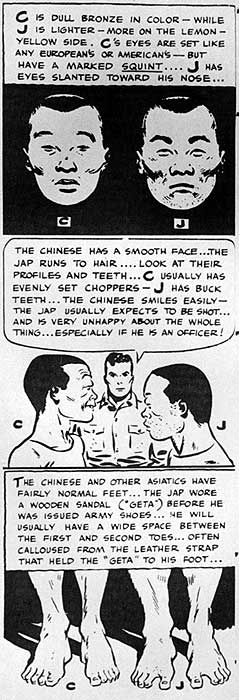
Thomas Nast's infamous depiction of 'The Ignorant Vote' is one particularly pungent example of how the metaphysics of 'race' works. Although the Irishman is labelled 'white', the racial morphology deployed makes him darker and ape-like. The cartoon or caricature just happens to be the ideal means of conveying it, because of the liberties you can take with the physical form. You can see clearly that it is a system of similes and allusions, a disorderly complex of metaphors. In the context of war, the visual metaphors of cartoonists are part of the repertoire in the poetastry of genocide. In this case, the fangs and green tinted skin would not be out of place in Nazi anti-semitic propaganda. Of course, it required a labour of revision to manufacture the correct racial stereotypes in the Pacific theatre of WWII, since - as in the Boxer Rebellion, only with the roles reversed - there were good 'Orientals' and bad ones. Take a look at this comparison: "How To Tell Japs from Chinese". In it, the American racial warrior - not a bit different from the Nazi racial warrior in his build, looks and comportment - explains how to distinguish the good 'Asiatic' from the bad one. The good one smiles easily, has European-American eyes, normal feet, evenly set teeth. The bad one scowls, is slanty-eyed, has bucked teeth and weird feet. Of course this deranged bollocks was never intended to be an actual field guide for the befuddled American soldier - it was intended to make it easier to kill and ultimately exterminate those Japanese weirdos.Racial doctrine therefore proves to be extraordinarily ductile given the exigencies of war. In both subsequent major Asian wars, there were good 'Asiatics' and bad ones. So, during the Korean War, the good pro-American Korean was shown to be under spiritual and racial assault from the quasi-satanic Muscovite-controlled savages from the North. Thus, the old green tint and the claws were out again. The bestiary was put to work again. Suffice to say, the US war was as close to a war of annihilation as anything since Hiroshima and Nagasaki (and the use of nukes was being seriously considered). The Vietnam War, though apparently complicated by the 'good guys' in the south, was increasingly obviously a war against almost the entire Vietnamese population. Hence, the 'dinks' and 'gooks' and 'savages' were relatively straightforward to depict, especially for the children. This war, of course, became increasingly genocidal, as the back room boys devised increasingly intensified anti-civilian warfare. The explicit use of racial caricatures of this kind became a source of embarrassment for the American government following the civil rights struggle, the race riots and the formal abolition of southern segregation, although one remaining respectable form of racism was that directed against Arabs and Muslims, and so it remains. Of course, once again, you can always find some good Arabs, ones who are strangely Americanised, whose skin is lighter, whose eyes are more European, whose values are 'Western'. This is how 'race' works: if you want to 'lighten' or 'darken' someone, you just use your imagination. Hold your breath, make a wish, count to three... There's nothing to it.
One final example. Here is a respected pro-war journalist in a liberal newspaper at the height of the self-congratulatory euphoria over the war in Yugoslavia:
" Do Albanians look like Serbs?
"No. Of course the differences are only approximate but it is often very easy to tell a Serb from an Albanian in Kosovo long before he or she opens his mouth.
"The Serbs often have black or dark brown hair and are generally darker and more heavily built than Albanians. Their appearance is fairly typical of southern Slavs. By contrast, the Kosovars look Celtic to a British eye. They have curly hair, which is often blonde or rust coloured, and their skin tends to be very pale and covered in freckles. Their eyes are often green or blue and their build is much more slender than that of the Serbs. They have longer heads. It is not surprising that they look so different as they belong to different races that have very rarely intermarried." (Marcus Tanner, 'WAR IN THE BALKANS: THE BALKAN QUESTION; KEY ISSUES BEHIND THE WAR EXPLAINED', The Independent, 11 May 1999).
The great war of 1999, then, was a war on behalf of the Milky Bar kid against some squat, Slavic barbarians.
Labels: 'race', imperialism, racism, serbia, war, yugoslavia
7:45:00 am |
Permalink |
Comments thread |
|
Print |
Digg |
del.icio.us |
reddit |
StumbleUpon |
Tweet|
Share|
Wednesday, March 05, 2008
The Spectre of Europe is Haunting Communism posted by Richard Seymour

For a glance at how much the shade of the former Yugoslavia haunts the present geopolitical terrain, you could do worse than looking at this uncannily tasteless article at The New Republic. Entitled 'Balkan Ghosts' (after Robert Kaplan's 1994 book, the precursor to his New Barbarism thesis which argued that the roots of the conflict were in historical cultural antagonisms released from their statist integument), the TNR piece entertains what looks at first sight like a rather trivial and boring parallel between Kosovo and Darfur. But since every sentence in the piece contains a lie - by omission, comission or distortion - it is obviously not intended as an essay in recent history. Rather, it is an intervention within a rather well-policed discursive regime. If we drop the idea that 'Kosovo' and 'Darfur' in this case refer to living places populated with real people struggling over material problems (property, patronage and - in the case of Darfur - land), it becomes much more comprehensible. In terms of the ideology of 'humanitarian intervention', therefore, the piece is a breezily efficient polemic. Kosovo, lorded over by an evil genocidal megalomaniac, had to be rescued at long last and with considerable restraint and reluctance, by an international coalition at whose heart was the American behemoth. Darfur, lorded over by an evil genocidal elite which doesn't even have the decency to be susceptible to intense personalisation, will also have to be liberated in the same fashion. In those terms, the structural isomorphism is exact, and the argument infallible. Who cares if it is an argument over cartoons rather than reality?
But why is the comparison so essential? As much noise was made of the fact that the Yugoslavia wars were happening in Europe rather than another continent, what was really significant for many interventionists was that it was perceived to be on a faultline between the Orient and the Occident. The ancient Balkan culture with its Oriental despotism, its propensity for command economics and its psychological value of repression was depicted as being in a collision with European civilization with its liberal anti-centralist traditions, its free trade, and its psychological value of truth and open inquiry. Those who resisted this quackery with materialist (marxist) analysis were told that they were themselves subject to a Victorian mytheme that was itself part of the root of the problem. By contrast, the Eurocentric and Orientalising habits of 19th Century imperialist thought were treated as if they were the newest and coolest thing, pomo to the max. Doctrines that emphasised universality were outmoded and intolerant forcing all of humanity into a one-size-fits-all mould, while doctrines that relentlessly polarised humanity and dehumanised most of its actual constituents were regarded as inclusive and open-minded.
'Humanitarian interventionism' saw its earliest beginnings in the continent of Africa, in Somalia. The narrative no longer works for Somalia, which is why it is depicted instead as a frontline (or frontier) in the 'war on terror'. But it is appropriate that the doctrine now returns its focus and emphasis to that continent, the topic of Robert Kaplan's eco-fascist musings on overpopulation, scarcity, social breakdown and state failure. In Kaplan's latest book, 'Imperial Grunts', which makes much use of the familiar 'Injun Country' motifs, the whole world has been re-mapped according to the spatial projections of US power (there are actually maps which celebrate the breakdown of the world into distinct zones of US dominance). This is for the better in a war against 'barbarians'. The ordinary business of commerce, arms deals, oil transactions, shipments of Gum Arabic, financial speculation, tilts in geopolitics, bribery, inter-state competition and so on has to be inhabited by the Spirit of Europe and its Oriental or barbarian opposites. Instead of treating Sudanese state personnel is typically cynical operators embedded in a ruling class with clear interests, it has to be inexplicable, inscrutible, instransigent, insusceptible to run of the mill calculations. Instead of treating the problems of land ownership, water shortage, famine, property rights, and so on, as part of a global, universal system of injustice with particularly acute and sometimes genocidal manifestations in zones where postcolonial manipulation and exclusion by external actors interacts with hegemonic strategies by local ruling classes, it is necessary to treat them as simply localised aspects of a genocidal juggernaut.
One is reminded of Stephen Jay Gould and Richard Lewontin's essay on 'the spandrels of San Marco', in which they remark that the spandrels in St Mark's cathedral, the spaces created by the intersection of arcs at right angles, are so beautiful and such lavish use made of them by decorators, that given a sufficient set of intellectual biases one might almost be inclined to treat them as independent of the architecture, or as indeed commanding the architectural structure rather than the other way about. It requires a similarly far-fetched set of intellectual biases to treat a state's mode of repression and rule as independent of the social and economic architecture that actually co-produces it. Yet, this is what the Spectre of Europe is doing in Africa. It is expunging the territory, purging dissident thought, removing the traces of past crimes, concealing the mass graves of colonial and capitalist famines and massacres, committing a kind of ethical cleansing from which the carapace of capital emerges pristine. If Balkan Ghosts are touring Darfur, it is only because the frontiers have shifted. Capital relentlessly reterritorialises, demands a re-spatialisation of the global order, demands new and more intricate morality fables to enable its activities, and creates new frontiers that require taming. It demands the constant disarticulation of global problems as topics for analysis, and even where it permits their rearticulation for the purposes of dramaturgy, one of the functions of any efficient ideologist is to relentlessly particularise and localise. The spectre of Europe permits him to do so with a spurious consistency and even, should he require it, historical resonance.
Labels: barbarians, darfur, europe, kosovo, orientalism, sudan, the spectre of capital, yugoslavia
5:28:00 pm |
Permalink |
Comments thread |
|
Print |
Digg |
del.icio.us |
reddit |
StumbleUpon |
Tweet|
Share|
Friday, February 29, 2008
"Kosovo Madness" posted by Richard Seymour
The Exile revisits a classic piece by Mark Ames:On the south side of the filthy Ibar River, 130,000 Albanians control a near-perfectly ethnically cleansed area; on the North, about 18,000 Serbs, 2,000 Albanians, and another 1,000 gypsies, Turks, Gorani and Bosniaks (the latter two Slavic Muslim people) co-exist uneasily. Only about five or ten Serbs remain on the south Albanian side, half of them priests holed up in a monastery, protected by barbed wire, trip wires, tanks and troops. That's 5-10 Serbs in a population of 130,000 Albanians. That's all they'll tolerate; or rather, that's all that KFOR can manage to protect. South Mitrovica used to have a massive gypsy quarter, at least 7,000 of them. If you walk up to the miners' monument on the high hill on the north Serb side, you can look down and see what happened to Mitrovica's gypsies: an entire section of south Mitrovica, along the south bank of the river, of burned-out white houses, charred white, roofless, blackened beams like burnt ribs. Every last gypsy who wasn't capped or torched had to flee the Albanian pogrom, right under NATO's nose. Some live here in North Mitrovica. Others live in Serb-held Zvecan, most in tents. The remainder are scattered around Serbia.
Labels: albanians, ethnic cleansing, kosovo, roma gypsies, serbia, yugoslavia
8:15:00 am |
Permalink |
Comments thread |
|
Print |
Digg |
del.icio.us |
reddit |
StumbleUpon |
Tweet|
Share|
Monday, February 25, 2008
Watching a humanitarian imperialist squirm posted by Richard Seymour
This debate between Samantha Power and Jeremy Scahill is instructive. Power wriggles and squirms, skewered on her own moralisms and legalisms, utterly incapable of facing well-known facts, and winds up with a rat-a-tat bluster of personal impressions ("I supported ... I didn't see it that way ... I haven't heard") in which she poses as a complete ignoramus. Somehow she just never heard about how rigged the Rambouillet process was. Practically every one of these 'humanitarian' interventionists who remains true to the cause and adores the Democratic Leadership Council is trying to cop some distance from the Iraq catastrophe if at all possible. Power therefore currently poses as an opponent of the war on Iraq, even though she was very much in favour of it when she and Ignatieff and the Harvard human rights circle were debating it in 2002. The trouble is that almost exactly the same reasoning that was deployed to support the prolonged destruction of Yugoslavia applied to Iraq several times over, so there has been some difficulty in explaining exactly why this one was unique. Here she uses the "but for" argument that she offers in one of the interviews appended to 'A Problem from Hell' (an utterly silly book, larded with inaccuracies and omissions). Asked if the war on Iraq was a humanitarian intervention, she says "you know, 'but for' Saddam Hussein's repression of the Iraqi people, would the Bush administration have gone to war? And the answer is yes ... In Kosovo, 'but for' the atrocities against the Albanians, would NATO have bombed? No ... the key ingredient, the 'but for' ingredient, was Milosevic's slaughter and ethnic cleansing." Milosevic certainly repressed the Kosovars harshly and unjustly, although any ethnic cleansing prior to the bombing is entirely fictitious. So, aside from how facile the 'but for' argument is (a cheap soundbite contrived for talk shows, I imagine), it relies on a lie. Actually, her book defends the US government for its claim that Kosovo constituted a 'genocide', although even the ICTY doesn't feel up to defending that ruse any longer. In fact, while Jeremy Scahill rightly points out that the official number of corpses discovered by investigators is 2,700 and ethnicity has not been determined, Power tried to claim in her book that in fact 4,000 bodies had been found, (while on the same page adjusting her claim to 4,000 bodies and body parts) and allows readers to believe that over 11,000 bodies are buried in 529 sites in Kosovo alone. This was the ICTY estimate made during the war, and was repeated by people like Ignatieff. But in fact, Power's book was written in 2003, long after that figure had been dispelled. In short, Power will deploy anything to defend the reputation of the Clinton administration. Her stance is also stunningly hypocritical. For, after all, consider the worst that you can say about Milosevic: he violently repressed the Kosovars and encouraged nationalist resentment toward them; he built up a huge police force especially during the 1990s, to repress the opposition; he censored the media; he invaded Croatia to defend Serbian interests and ended up prosecuting a bloody war; he supported right-wing nationalist scumbags in the Republika Srpska who perpetrated some vile atrocities including the Srebrenica massacre; he was on the take and had ties with an extensive criminal network. On the other hand, hardly a dictator. Elected several times, in a country with independent trade unions, legal opposition parties, demonstrations, and so on, this was not fascism, or even a 'communist dictatorship' as some silly-billies claim. But Saddam's regime. Why, there was certainly an acute mass murder of the Kurds in the late 1980s to punctuate the chronic repression. There was demonstrablly mass torture and rape as policy, no shortage of viciousness, no free trade unions, no independent media at all, no tolerance for opposition demonstrations. Any opposition had to work underground. By Power's logic, she really ought to be one of the most enthusiastic supporters of the occupation of Iraq. After all, you can blame just about everything that happens on the bad guys and feign ignorance when you have to. What's the problem? Essentially, it comes down to this: if the Republicans do it, it is probably for some cheap short-term material benefit, whereas if the Democrats do it, it is for long-sighted compassionate reasons. So, as a great man once asked, what's a "but for"? The answer: for pooping, silly.Labels: bosnia, genocide, iraq, kosovo, milosevic, samantha power, serbia, yugoslavia
7:07:00 am |
Permalink |
Comments thread |
|
Print |
Digg |
del.icio.us |
reddit |
StumbleUpon |
Tweet|
Share|
Friday, February 22, 2008
Resisting the demonological temptation posted by Richard Seymour

Serbian protesters, angry at the secession of Kosovo, certainly picked the right target. There's hardly anywhere in the world where people don't delight in seeing a US embassy go up in flames. Unfortunately, they also managed to burn some poor functionary to death. Inevitably, the old cliches will be drawn upon. The reaction will be put down to simple-minded nationalism, ethnic hatreds, ancient prejudices etc, augmented by an obstinate Serbian administration stirring things up. There's no manipulative demagogue around to help the fantasy this time, since he's kicked the bucket. Further, the pro-Western candidate, Boris Tadic, won the recent elections. Nevertheless, there are ominous murmurings about the Serb regime trying to make it difficult. These myths are entirely unhelpful to understanding what's happening, but they have been cultivated for almost two decades now.
The break-up of Yugoslavia, for all that it involved the instrumentalisation of nationalism, was not fundamentally about that. It was about changes in property forms, a neoliberalisation enforced by the IMF with predictably catastrophic results. Producing waves of strikes and protests, it also led to intense competition among the players in the federation about the political forms in which the changes would take place, who would benefit, and how. The two northernmost republics, Croatia and Slovenia, were also the wealthiest and had reason to resent paying taxes toward the federation, while their political elites were straining at the leash. They took up democratic demands in order to win popular support, but also encouraged reactionary brands of nationalism, especially in Croatia, where Tudjman gave vent to pro-Nazi and anti-semitic politics, not to mention virulent anti-Serb sentiment which would be formalised in state repression and exclusion. Though one cause of resentment was the redistribution of their wealth to the poorest autonomous region, Kosovo, they nonetheless opportunistically backed Kosovan protesters if it would weaken the Serbian republic. It had nothing to do with the legitimate grievances of Kosovan Albanians. Milosevic had successfully used the resentment about Kosovo's autonomy under the 1974 constitution, to put himself in a virtually impregnable position in the Serbian communist party. Many of the accounts melodramatically describe a cold manipulator and demagogue, and he was adept at diverting discontent and protest into nationalist sentiment, outplaying far more doctrinaire rivals such as Vuk Draskovitch. However, trying to get the broadest layer of support on his side and also hoping to rely on the JNA whose elite was concerned about its privileges, took a formally pan-Yugoslav position and kept to it throughout.
While none of the secessionist parties won a majority in the December 1990 elections, and while the IMF and EU initially preferred a federation-wide solution, European states eventually came to the aid of Slovenian and Croatian secessionists, with Germany under Chancellor Kohl taking the lead in recognition. Kohl's quite immovable hostility to the claims of pan-Yugoslav unity and his willingness to break agreements and EC rules, is often put down to domestic pressures from Germany's Catholic constituency and from Croatian emigres. Yet, for a recently reunified German state, the prospect of two wealthy allies in the Balkans was surely very tempting. And while the other EC states blamed Kohl's intransigence and bullying, they were quite happy to go along with secession as long as certain concessions were made. The UK delegation, for example, was mostly concerned about conserving the interests of British capital, by allowing the UK to opt out of the social contract in the Maastricht Treaty. But they all agreed in principle to the partition of Yugoslavia. And the US got in decisively on the action by backing Alija Izetbegovic, arming him with the assistance of Iran, helicoptering mujahideen into the republic and encouraging Izetbegovic to resist compromise settlements. The EC broke its own rules to recognise Bosnia, and so contributed to the centrifugal forces tending to civil war. The JNA's abortive interventions in Slovenia and Croatia were pitched in terms of defending the constitution and, in Croatia's case, an oppressed minority. Certainly, this is how Milosevic presented his case, although he proved a false friend to the Krajina Serbs. As for the Bosnian Serbs, with no guarantee as to their rights or status, they largely rallied to nationalist parties and paramilitaries. A plebiscite held by the nationalists found that most Bosnian Serbs would rather secede from Bosnia in the event of a secession on its part.
The wars of the 1990s resulted from an interaction between class restructuring within Yugoslavia and the intervention of external powers. As Radha Kumar has written, the break of Yugoslavia very closely resembles the classic colonial partition. Such partitions have a lousy record, of course, and the brutality of the ensuing wars show that Yugoslavia was no exception. But as soon as the Western powers opted for partition, the demonology became crucial. Thus, it was all about rabid Serbs being whipped up by a malicious demagogue bent on genocide. As a result, the deaths during the Bosnian war were inflated and the blame placed almost exclusively on the Bosnian Serbs, with the subsidiary insistence that Milosevic was behind it all. Thus, Bosnia became a UN protectorate, a colonial dominion with a light democratic facade overseen by an appointed High Commissioner. Then, as the Kosovan Albanian secessionist movement turned to armed struggle, in light of repression and the lack of any resolution on their behalf in international agreements, Milosevic adopted a classical counterinsurgency strategy. This involved quite severe atrocities, although it bears repetition that in 1998, the year preceding NATO occupation, the KLA were responsible for more deaths than the Serb military. Spying an opportunity, the US led a negotiations process which was intended to fail. When Milosevic didn't agree to the neo-colonial terms set at Rambouillet, once again he was a genocidal maniac. The war was launched with the promise that anythying between ten thousand and a hundred thousand bodies would be recovered in mass graves. Kosovo became another colonial outpost governed by the UN, and hundreds of thousands of Serbs were ethnically cleansed from the province. Today, Serbs in Kosovo are a beleaguered and reviled minority. And while the Serbian working class was strong enough to overthrow Milosevic, it was not strong enough to impose a government that would defend its interests, so we have had a succession of timid, neoliberal administrations. They have all made use of the Kosovo issue, which has been a running sore on account of gangsterism in the Kosovan Albanian political elite, ethnic violence and endless provocations. But they're pretty impotent. Kosovo has now attained 'independence' with colonial oversight - what kind of independence is that? I note that Serbian socialists have argued (scroll down) that they support Kosovo's right to secession on the grounds that only solidarity of this kind can undermine the imperialist stalemate. They also point out that there is a radical element in the independence movement that also calls for an end to colonial rule. Quite. Nationalism in Yugoslavia has been a constant alibi for imperialism, and it can't be otherwise. However, for those Western liberals and even lefties raised on a diet of Serb 'evil', it's rather important to resist the demonological temptation here. The facile dichotomies of ruthless expansionism and genocidal aggression versus multicultural unity and patriotic defense have to be abandoned at long last. Milosevic was thuggish, corrupt and autocratic, but he was not a fascist demagogue as has been claimed, and his farcical trial actually made that rather plain. Izetbegovic was responding to a set of circumstances that he didn't decisively shape, but he was not a democrat fighting the good anti-fascist fight a la the Spanish civil war. The demonisation of Serbia and the overestimation of opposing forces has gone on for long enough. The protesters who have trashed the American embassy have plenty of reason to be angry at Washington. We do too.
Labels: bosnia, demonology, kosovo, serbs, yugoslavia
7:07:00 am |
Permalink |
Comments thread |
|
Print |
Digg |
del.icio.us |
reddit |
StumbleUpon |
Tweet|
Share|
Sunday, December 02, 2007
Another round of ethnic cleansing on the way, courtesy of NATO. posted by Richard Seymour
Every state that seceded from Yugoslavia ended up enforcing ethnic cleansing of some kind. Either the logic of one secession produced another smaller secession (with the hope of unification with the federal republic) or the new state simply proceeded to attack and eventually remove or kill legitimate residents, or both. Kosovo is expected to unilaterally declare independence in about a week's time. The current policy of NATO, which is to oversee Kosovan secession, is expected to produce a new wave of terror, and an attempt by the perpetually harrassed and abused Serbs to secede from the new 'free' Kosovo. The last wave of ethnic cleansing in mid-to-late 1999 drove 200,000 Serbs out of the province, and this one may get rid of the remaining 120,000. Now, the Kosovan leadership argues that the Serbian government will order Serbs to leave (I'm sure I've heard this line before?). It also argues that the result of the secession will be violent, crisis-ridden, punctuated by blockades and humanitarian disasters - but that Kosovo will win through the support of the "international community". To put it another way, you could be sure they wouldn't take a risk like this if the policy wasn't so clearly mandated, as it is, by Bush, Brown, Sarkozy, and the rest of that ilk. UNMIK, in case you have forgotten, still asserts sovereignty over the country. British troops are among those likely to be sent to back up those forces. So, what you may be about to see is a bloody conflagration with NATO troops effectively deployed to ensure the secession contain the violence a little, and effectively look on as ethnic cleansing takes place. It is the final step in the dismemberment of Yugoslavia, and it promises to be as swell as every preceding step. And they're going to call this 'freedom', which - as we all know - is 'messy'.Labels: kosovo, NATO, serbs, yugoslavia
6:07:00 pm |
Permalink |
Comments thread |
|
Print |
Digg |
del.icio.us |
reddit |
StumbleUpon |
Tweet|
Share|