Friday, March 09, 2012
Threshold of the Bolivarian revolution posted by Richard Seymour
Guest post by Callum McCormick:There is a consensus that the Venezuelan Presidential elections set for October this year will pose the most serious electoral challenge yet to Hugo Chavez and his Bolivarian Revolution. The Venezuelan opposition, which for much of the Chavez era has busied itself with reactionary intrigue, self-defeating abstentions, various forms of economic sabotage and fratricidal conflict, has selected itself a plausible candidate, Henrique Caprilles, the ‘youthful’ governor of Miranda state and signalled its intention to mount a genuine campaign. While the odds are still in Chavez’s favour, the polls suggest a tight election is in the offing and a defeat for Chavez is not beyond the realms of possibility. The price of Venezuelan bonds and those of the state owned oil company (PDVSA) rallied recently, with the suggestion being that international financiers are gearing up for Chavez’s downfall and the economic ‘reform’ that might follow.
The upcoming race comes after some setbacks for the regime, including the loss of the PDVSA’s ‘supermajority’ in the Venezuelan legislature in the 2010 elections, itself preceded by reversals in the 2008 local elections that included the loss of the important and symbolic mayoralty of Caracas, and, of course, the President’s battle with cancer. (There is currently a rather bizarre debate going on in the Venezuelan media about when and where it is appropriate to use the word ‘metastasize’). While Caprilles is sticking to the line that he hopes the President recovers, the opposition press is filled daily with various unsubstantiated rumours about the true state of Chavez’s health. For its part, the government does not seem to have helped matters by pursuing a somewhat defensive and secretive attitude to the matter. Along with doubts about whether Chavez will be able to complete another 6-year term should he win, the issues that look set to form the bulk of the opposition’s campaign include inflation (which is high but falling, and is positively mild compared with examples from Latin American history), shortages in food and , above all, law and order.
Crime in Venezuela, by any measure, is a problem. The murder rate in the country is something like ten times the global average and Caracas in particular is a violent place. The murder rate in the capital city of 163 per 100,000 compares with 2 per 100,000 in London, or to give a more reasonable comparison, around 5 per 100,000 in Buenos Aires. Of course the figures, like everything in Venezuela, are highly contested and subject to immediate politicization by Chavez’s opponents. The travel advice issued to American tourists by the State Department makes Caracas sound like Mogadishu. Federico Welsch, a professor of political science at a Caracas university blamed the ‘government discourse’ for the violence because it teaches the young that ‘if you are lacking something, it is because of injustice. Then look for it, take it away from those who have it. You can obtain justice in your own hands’. The relationship between socialism and armed robbery, sadly broken since the halcyon days of 1970’s urban guerrillas, has perhaps been re-established.
Of course, the crime levels in Caracas and the country generally do not exactly present an impenetrable mystery. The cities layout functions as a metaphor for inequality in Latin America as a whole, as well as an object lesson in urban planning gone awry. The poor, working mostly in the growing ‘informal sector’, are crowded into hillside barrios that surround and stalk the affluent neighbourhoods below. Abject poverty exists alongside well-guarded shopping malls that stock all the latest consumer goods and house plush fine-dining restaurants. Income inequality over the period of Chavez’s rule has fallen and the poorest have seen their income rise quickest, but the sources of real structural inequality have remained largely unchallenged. One of the programs the government has recently introduced is a new house-building program designed to provide good housing to replace the desperate slums described, for instance, in Mike Davis’ Planet of Slums.
In any case, the fear of ‘lawlessness’ that is growing particularly among the middle and upper classes (the bulk of the violence is actually poor on poor and occurs within the barrios) is being stoked by the media and feeds into a more general sense of social ‘unease’ that Chavez has provoked among those at the top of Venezuelan society.
This line of attack is itself somewhat novel, since most previous opposition campaigns have amounted to hysterical denunciations of the ‘tyranny’ of Chavismo, thinly veiled racist vilification of Chavez and his supporters and paranoid fantasies about the role of Cuba in the country. The latter was re-animated this week when the opposition accused Chavez of ‘violating the constitution’ by ‘issuing decrees’ from Havana, where he was receiving treatment for his tumour.
On the whole though, the opposition has been pursuing a new track over the last few years in particular. Apparently finally disabused of the notion that they, and those they represent, have a divine right to govern the country and that Chavismo amounts to a savage anomaly, they are pursuing a new ‘inclusive’ strategy. This strategy, based on the assumption that a third of Venezuelans will always vote for Chavez and another third against, is intended to ‘depolarize’ the debate and convince ‘independents’ that the opposition are once again fit to rule. Caprilles has made much of his admiration for the social liberal model pursued over the last decade by Brazil in an attempt to neutralize the accusation that the opposition simply wants a return to the old neo-liberal order.
For those who support Chavez and the project of ‘21st century socialism’, the election is something of a crossroads. The long time activist and former member of the Chavez government, Roland Denis, recently said that the project for building an alternative to capitalism had ‘collapsed’. The problem for Chavez is the same one confronting all the governments of the ‘pink tide’ in Latin America. Their elections expressed and promoted a desire for radical social change among the despised masses of Latin America. Their actions in government have often given concrete form to these desires and just as often thwarted them.
The story is an old one. Propelled into government across the continent as part of a deep and general revolt against the IMF imposed ‘structural adjustment’ programs of the 80’s and 90’s, the ‘new left’ is faced with the dilemma of knowing that an alternative is needed but not quite being sure what it is. Socialism is, not the first time, proclaimed everywhere and created nowhere.
In many senses, the crisis of the Morales regime in Bolivia is even more acute. His approval ratings are hitting the floor amidst a series of social revolts whose participants would have been seen as his natural allies. Jeffrey Webber has written elsewhere about the struggle over TIPNIS and the planned road through indigenous land that was recently ‘delayed’. The regime was recently embroiled in an even uglier dispute when the police attacked a protest of ‘las personas con discapacidades’ (the disabled) who were threatening self-immolation and hunger strike in their campaign to win an annual grant from the government.
While a defeat would for Chavez would be a setback for the left and perhaps ignite a ‘carnival of reaction’ across the continent, the more fundamental questions would be perhaps be posed by a Chavez victory. If he were to win and serve a full term, he would have spent 20 years as Venezuelan President, much of that time with big legislative majorities and with the benefit of historically high oil prices (something like 80% of Venezuelan export revenue comes from oil). There is little doubt that Venezuelan society will have made progress in that period, but enough progress to justify the uncritical praise heaped on Chavez by sections of the Left?
Some were perhaps given a moment’s pause by Chavez’s fairly disgraceful attitude to events in Libya, where he parroted various infamies against the Libyan rebels and defended Gaddafi to the hilt. He seems intent on pursuing the same course in the Syrian case, recently providing the regime with a shipment of oil. While consistent anti-imperialism is to be applauded, Chavez seems incapable of reconciling this commitment with recognition of the legitimate desire for an end to authoritarianism that is causing the convulsions in the Middle East and North Africa.
Hugo Chavez has been and remains a figurehead and an inspiration for anti-imperialists and anti-capitalists across Latin America and the world. Should he head off the latest challenge to his government from a Venezuelan opposition for which no one on the Left should feel the slightest sympathy, then it is incumbent upon those who favour socialist change in Venezuela and beyond to build up the pressure for a fundamental and irreversible transformation of Venezuelan society. While Chavez and his government have the opportunity to play a role in that transformation, its ultimate success lies in forces beyond him and his regime, in the poor and working class of Venezuela. Only their self-activity and self-emancipation can provide the change Venezuela needs.
Labels: 21st century socialism, chavez, left, socialism, venezuela, working class
11:03:00 pm |
Permalink |
Comments thread |
|
Print |
Digg |
del.icio.us |
reddit |
StumbleUpon |
 Tweet|
Share|
Tweet|
Share|

Thursday, September 24, 2009
"Inside the Revolution" posted by Richard Seymour

The new documentary Inside The Revolution (trailer here) deals with precisely this question. This sort of film could so easily just re-tread old ground. It could just as easily lapse into uncritical adulation. Or it could just be very cliched, with various pleasing sentiments structured around a 'story so far' narrative. Already, films about Venezuela are characterised by some very familiar vistas: the red t-shirts, the smiling Chavez supporters, the scandalously abusive corporate media footage, and the slums, all overlaid with cheery joropo music. And if these were to be the fixtures of a genre that ossified the exciting and conflict-ridden social processes of Venezuela into low budget entertainment for leftists, then the Bolivarian revolution would have been done a disservice. But Inside The Revolution takes the argument deeper than previous films, making an effort to gauge what kind of example Venezuela provides for the left. It has less glamour and polemical bite than Pilger's The War on Democracy, for example, but is intellectually more challenging.
The argument is more distinctive than the material, most of which can be found in useful texts such as Bart Jones' biography of Hugo Chavez - cryptically entitled ¡Hugo! - and Gregory Wilpert's Changing Venezuela By Taking Power (an excellent counterblast to the Holloway thesis). Thus, you get a very brief account of the history of Venezuelan politics, from the Jimenez dictatorship to the highly controlled liberal democracy during the oil boom of the post-war era, to the social collapse and soaring poverty from 1978 onward. You get a discussion of the radicalisation in 1989, a counterpoint to the general demoralisation on the Left as the Berlin Wall fell. There is footage of Chavez's attempted coup in 1992, and his 72 second speech to the nation upon surrendering in which he famously said that his goals could not be achieved "por ahora" (for now). This statement became a catchphrase for millions, as Chavez became a hero to the poor and, upon his release, he began to build up support for a presidential campaign. He wins, brings about constitutional changes, faces down the hysteria of the ruling class, defeats a coup, braves a referendum defeat, suffers electoral setbacks, but continues to make progress. So far, so familiar - and accurate too.
The issue, then, is does Venezuela stand on the precipice of lasting socialist transformation? Does it defy what might be seen as the linear, stageist conceptions of social change that have dominated some quarters on the left for a century? The main editorial voice of the documentary appears to be Michael Lebowitz, author of Build It Now, and a critical supporter of Chavez. He has long maintained that Chavez's reforms, such as the breaking up of the latifundia, the creation of communal councils and particularly the institutions of co-management in which workers are represented at the managerial level of firms, place Venezuela in a transitional state. It is not socialism, he acknowledges, but it is potentially a pathway to socialism. As it is, the argument is underdeveloped in the documentary because of the constraints of time and narration, but it does leave you with a clear sense of the unfinished character of the Venezuelan experiment, the left-right divisions within the PSUV, the arguments over how to relate to the legacy of Stalinism and the dangers of confusing socialism with statism, the persistence of corruption and conservatism within the Bolivarian state, the existence of a rump within Chavez's government who continue to obstruct real change, and so on. It is nonetheless optimistic that with the enabling reforms carried out by Chavez and continued pressure from below, something like socialism could be constructed.
There are, though, a few things missing from this picture. The first is that, had this process began in 1980, the Bolivarian revolution would most likely have been crushed by death squads and torturers trained by the CIA. Today's Venezuelan ruling class must feel terribly betrayed by the United States for its insufficient attention to its own back yard. So, a vital condition for the successes of Chavez has been that the most concentrated centres of capitalist power in the world did not make it a priority to destroy the revolution. How long would such a state of affairs persist, one wonders, if the reforms went too far? So far, capital has been regulated, nationalised and curbed by Chavez, all in a very improvised fashion and with considerable restraint bearing in mind the powers that he is up against. For example, take land reform. As a rule, the institutions created by the government to redistribute land to the peasants have taken a very softly-softly approach, and have had to be goaded by popular radicalism to take more controversial stances. Thus, when peasants occupied the El Charcote estate, challenging the claim to ownership of the land by the British cattle-ranching company of Lord Vestey, the land institute ruled that though the company couldn't prove ownership of the territory, they could keep the two-thirds of it as it was being made use of. The other third was distributed to peasants. Examples of this kind of very qualified expropriation, being carried out on a pragmatic basis and in a very negotiated fashion, are typical. Were peasants and rural workers to start occupying and socialising estates on a mass basis, though, this would place the Chavez government in a very difficult situation. They would either have to confront the established centres of power whom Chavez has said he prefers to negotiate with, or send the police or army in to shut down the militancy. So, there is in that sense a self-limiting quality to the Bolivarian revolution.
Another problem with the documentary is that its focus can be a little parochial. It discusses Chavez's efforts to carve out a space independent of imperialism through such initiatives as ALBA, and this is indeed an extremely important development. It is not exactly a pilot for 'socialism in one continent', but it frees a space for further democratic breakthroughs and is thus worthy of applause in its own right. But there are some less savoury global imperatives that Chavez has to pursue. For example, he has to do business with the Chinese dictatorship in order to keep selling the oil that produces the revenues that fund his reforms. I don't think this is so terrible, but there is a problem when Chavez openly praises the leaders of countries where Venezuela does business - China, Iran, Syria, North Korea, Zimbabwe, Russia, Belorussia, etc. You may say he has no choice in this respect, which is debatable. But what is indisputable is that Chavez is making it harder for those struggling for the same kind of social justice and human rights that he defends, in those countries. This limits any claim to internationalism by the Bolivarian state, and it does point to the limited, cautious nature of its objectives. That is not to say it deserves any special opprobrium, but I think it does enjoin a more restrained attitude than is evident in this documentary.
All of that said, it helps to see how the experience of change in Venezula - change you can believe in, though Obama may not - is driving a process of ideological radicalisation and intellectual enquiry within Venezuela. There is a very real sense from the footage of the communal councils of just how much the workers and poor believe the revolution to be theirs, not the property of Hugo Chavez or anyone else. And it is that very old-fashioned idea, of socialism from below, that gives the documentary its most hopeful and critical edge.
ps: more info here.
Labels: bolivarian revolution, chavez, inside the revolution, socialism, US imperialism, venezuela
11:45:00 am |
Permalink |
Comments thread |
|
Print |
Digg |
del.icio.us |
reddit |
StumbleUpon |
Tweet|
Share|
Sunday, June 28, 2009
Coup d'etat in Honduras posted by Richard Seymour
So, is the six month old Obama administration taking ickle baby-steps towards its first coup? Eva Golinger thinks so. The background:Ah yes, the Reagan years, during which time Honduras was the base for CIA training of Nicaraguan death squads. This was also the era during which John Negroponte was helping flood the country with military aid so that Battalion 316 could murder and torture dissidents. Proceeding:
Supposedly at the center of the controversary is today's scheduled referendum, which is not a binding vote but merely an opinion poll to determine whether or not a majority of Hondurans desire to eventually enter into a process to modify their constitution.Such an initiative has never taken place in the Central American nation, which has a very limited constitution that allows minimal participation by the people of Honduras in their political processes. The current constitution, written in 1982 during the height of the Reagan Administration's dirty war in Central America, was designed to ensure those in power, both economic and political, would retain it with little interference from the people.
Zelaya, elected in November 2005 on the platform of Honduras' Liberal Party, had proposed the opinion poll be conducted to determine if a majority of citizens agreed that constitutional reform was necessary. He was backed by a majority of labor unions and social movements in the country. If the poll had occured, depending on the results, a referendum would have been conducted during the upcoming elections in November to vote on convening a constitutional assembly. Nevertheless, today's scheduled poll was not binding by law. In fact, several days before the poll was to occur, Honduras' Supreme Court ruled it illegal, upon request by the Congress, both of which are led by anti-Zelaya majorities and members of the ultra-conservative party, National Party of Honduras (PNH).
Zelaya has been irritating the country's ruling class for some time with his support for Chavez and the 'Bolivarian Alternative for the Americas', and his calls for drug legalisation, but the attempt to maybe, pending a possible future referendum, democratise the system a little was a step too far. The Miami Herald, naturally enough, vocalised the propaganda of the would-be putschists a couple of days ago, namely their speculation that the aim might secretly be to try to remove the cap on presidential re-elections and thus have some sort of elected dictatorship just like that Chavez monster. So, to forestall the possibility, the military has installed an unelected dictatorship. The White House is denying any involvement in the coup. Is it a plausible denial? Back to Eve Gollinger:
Another major source of funding in Honduras is USAID, providing over US$ 50 millon annually for "democracy promotion" programs, which generally supports NGOs and political parties favorable to U.S. interests, as has been the case in Venezuela, Bolivia and other nations in the region. The Pentagon also maintains a military base in Honduras in Soto Cano, equipped with approximately 500 troops and numerous air force combat planes and helicopters. Foreign Minister Rodas has stated that she has repeatedly tried to make contact with the U.S. Ambassador in Honduras, Hugo Llorens, who has not responded to any of her calls thus far. The modus operandi of the coup makes clear that Washington is involved. Neither the Honduran military, which is majority trained by U.S. forces, nor the political and economic elite, would act to oust a democratically elected president without the backing and support of the U.S. government.
Well. I would say that if the behemoth just to the north has a military base in your country, and funds your military and major pro-US parties, then you probably do have to get their permission before overthrowing the government. The Honduran army will presumably now have a brief to deal with the protesters, the social movements, the labour organisations, and everyone else who has been inconvenient in backing Zelaya and might now try to resist the coup. They're calling it a 'bloodless' coup... for now.
Update: well, well.
Labels: chavez, coup, democracy, dictatorship, honduras, referendum, US imperialism, venezuela
3:27:00 pm |
Permalink |
Comments thread |
|
Print |
Digg |
del.icio.us |
reddit |
StumbleUpon |
Tweet|
Share|
Thursday, September 11, 2008
Bolivia - a different kind of rising. posted by Richard Seymour

The recent victory of Evo Morales in the national referendum, with a much stronger mandate (67%) than he had achieved in 2005 (53.7%), was a tribute to the depth and breadth of ongoing social struggles in Bolivia. That referendum also put eight of nine governmental regions (departments) to a recall vote, and a particularly delicious result saw the shady right-wing local governor (prefect) of Cochabamba, Manfred Reyes Villa, ejected by the local population. That scumbag actually tried to insist that he would stay on and refuse to recognise the result, but he was forced to resign in a matter of days. The referendum was perhaps the inevitable result of conservative ruling class blocs seeking to frustrate government reforms by first blocking reforms within the national assembly, and then carrying out sabotage from without. Morales had to find a way to shore up his authority. But the victory was not inevitable, and it is really due to sustained grassroots mobilisation, labour militancy, and mass democracy with popular assemblies regularly filling the streets.
Anyway, after a recent US threat to interfere in Bolivia's affairs in support of right-wing 'autonomists' (rich fucks who don't want to be governed by socialists), there has been a bit of old-fashioned rightist putschism in Santa Cruz, supported by the right-wing Podemos party, which is itself part of a larger opposition coalition including provincial governors and business interests. A conservative ruling class descended from European colonists might well put up with a very adulterated version of the indigeous rights project of the Morales government, but not the attempt to assert national sovereignty over the country's energy and land resources. As this paper by Mark Weisbrot and Luis Sandoval shows, it is the secessionist areas that have the highest concentrations of land ownership and receive a disproportionate share of energy revenues. Any attempt at social justice in terms of resources and land has to involve extensive expropriations from rpecisely those areas, either by the elected government operating effectively and legitimately, or by the Bolivian workers themselves.
Since the conservative opposition stormed out of the assembly in 2006, they've been trying to push for a version of 'autonomy' that would give the Santa Cruz elite control of the main resources, such as oil, gas, soya, and precious woods. Having staged an illegal referendum, the Santa Cruz elite says it has a mandate to assert control over the resources that it has so successfully plundered. This Tuesday, it seems, neo-fascist youths were unleashed by local elites determined to accelerate their attempts to effectively secede from La Paz, and attacked government departments, human rights organisations, and media outlets that aren't aligned to the ruling class. They've done this before, but it reached such a level this week that the government called it a coup. Morales has quite rightly instructed the US ambassador to leave the country.
US subventions are being successfully resisted in other ways too. Recently, USAID has been kicked out of Chapare by the coca growers, because it was aggressively trying to drive the coca growers out of business as part of the "Dignity Plan" (reminding one of Noriega's old Dignity Battalions) which the US worked out with the neoliberal Bolivian leadership in 1998. The growers noted that Venezuela was prepared to supply no-strings aid, so they didn't have to rely on an American agency which they accused of trying to undermine the Morales government. Still, if the US is reduced to sponsoring only regional rightist coups, there may be some cause for hope in that.
Labels: bolivia, coup, evo morales, right-wing, socialism, venezuela
9:12:00 am |
Permalink |
Comments thread |
|
Print |
Digg |
del.icio.us |
reddit |
StumbleUpon |
Tweet|
Share|
Friday, March 07, 2008
The Israel of Latin America. posted by Richard Seymour

Chavez describes Colombia as "the Israel of Latin America" for good reason. It was recently revealed revealed that Israelis have been fighting against FARC guerillas in Colombia, supplying counterinsurgency expertise from their many decades of hunting Palestinians in order to help accomplish this sort of thing. This is part of a long-standing relationship that Israel has had with the terror regimes of Latin America. No wonder there's such an Israel-Colombia love-in.
Colombia's recent aggression in Ecuador produced a wave of revulsion among Latin American states. Lula has condemned Colombia, and so has the OAS. Nicaragua has broken diplomatic relations with Colombia over its actions. Even Bernard Kouchner, who thought he was about to land a heroic role for himself in Ingrid Betancourt's release, is pissed off. Venezuela, Argentina and Ecuador have found a new unity as a result of this. It's not only a blatant violation of Ecuadoran sovereignty, but a deliberate strike at the peaceful negotiations that were under way - the killing of Raul Reyes finished off his own role in working out the freeing of hostages. The Colombian state demonstrated that it would rather invade another country than come to a peaceful settlement with its domestic foes. The attack, involving the use of cluster bombs against a sleeping decampment, was apparently backed by the US - actually, it would be amazing if that wasn't the case. The destabilising role of the US is hardly a secret.
Plan Colombia, the programme devised between US and Colombian elites and implemented for approximately a decade now, was supposedly a 'war on drugs'. The result has been to dramatically increase outward shipments of cocaine [pdf], while destroying the livelihoods of peasant farmers and intensifying the war. Latin American leaders have worried that it could produce, in Lula's words, a "Vietnamisation of the region". Ecuador has already suffered from the Colombian government's war on 'narco-terrorism'. Uribe's regime, whose extensive ties to the AUC death squads have been exposed to daylight (roughly at about the same time that it was revealed that Chicquita bananas had been funding the AUC's war to the tune of $1.7m), is of course led by a man of the landowning class with a background in drug trafficking. And the AUC has been one of the biggest international suppliers of cocaine. So, you can take or leave their claim to be opposed to 'narco-terrorism'. But they certainly are doing their best to generate a casus belli against both Ecuador and Venezuela, by accusing them of funding the FARC. The US has indicated that it doesn't think a war 'likely', which means that they have called off their attack dog for now. But the combination of regional aggression, vicious counterinsurgency and subordination to US goals is indeed very familiar.
Labels: 'war on drugs', colombia, death squads, ecuador, Israel, latin america, terrorism, venezuela
7:06:00 am |
Permalink |
Comments thread |
|
Print |
Digg |
del.icio.us |
reddit |
StumbleUpon |
Tweet|
Share|
Monday, January 14, 2008
Chavez's retreat. posted by Richard Seymour
A while ago, Chavez announced a cabinet reshuffle, with the explanation that he was taking the radical edge off his government. The occasion for this is obviously his defeat by 1.3% of the vote in the recent referendum. The problematic nature of some of the policies, the fact that they were presented on a take it or leave it basis, and the haste with which they were taken to the polls, left many of Chavez's erstwhile supporters alienated. 3 million of his voters stayed home. Gregory Wilpert, the author of the excellent Changing Venezuela By Taking Power, has assessed the problems that dogged the reform attempt:There appear to be four main reasons why the reform initiative failed: the way the campaign was conducted, the defection of long-time supporters, the mood in the country and the process through which the reform was developed. At first this process took place entirely within a closed circle of Chávez advisors. Then, when the National Assembly debated the proposal, legislators held public meetings to get outside input, but the process was rushed, covering 69 articles in two and a half months, so the discussion was superficial.
Opposition literature was characteristically packed with hyperbole and distortion, and the right-wing cried that dictatorship was afoot. Chavez tried to use his popularity to sell the proposals, but hitherto allies criticised the measures and many supporters were angered by the ineffectual way in which the previous reforms - welcomed as a rule - were delivered. Wilpert hoped that Chavez would find fault in the top-down process through which "socialism in the 21st Century" was being elaborated". Sadly, it looks as if Chavez has drawn the conclusion that the referendum defeat was a defeat for socialism in the immediate term, and therefore he will concentrate on winning over middle class Venezuelans and the national bourgeoisie. Stephanie Blankenburg, writing in The New Statesman, points out that this conclusion is probably not merited. The opposition did not gain votes, but Chavez lost them. One of the main reasons, she suggests, is the pressure exerted on the Chavistas by the state in which they are operating, which has conservatizing and corrupting tendencies. Many of the Chavistas, Blankenburg argues, are now effective opponents of a radical socialist agenda, and have used their position to block reform even where they publicly favour it. The effective boycott by 3 million voters may have been a protest by the "Chavista street" against the "Chavista elite". And the trouble, if this is true, is that Chavez may further alienate his popular base, and boost the confidence of the opposition, for whom Chavez's greatest protection is the willingness of millions of Venezuelans to mobilise in his defense. He was far wiser when he decided in 2002 that moderation and making nice to the opposition only emboldens them further.
1:01:00 pm |
Permalink |
Comments thread |
|
Print |
Digg |
del.icio.us |
reddit |
StumbleUpon |
Tweet|
Share|
Thursday, December 20, 2007
¿Socialismo Louis Vuitton en Venezuela? posted by Yoshie
"Contradictions of Resource Populism" is now in Spanish, courtesy of a friend of mine in Buenos Aires: Yoshie Furuhashi, "¿Socialismo Louis Vuitton en Venezuela?" Traducción de Julio Fernández Baraibar, Critical Montages, 19 December 2007.Labels: capitalism, class, venezuela
1:29:00 am |
Permalink |
Comments thread |
|
Print |
Digg |
del.icio.us |
reddit |
StumbleUpon |
Tweet|
Share|
Saturday, December 15, 2007
Contradictions of Resource Populism posted by Yoshie
Venezuela's Interior Minister Pedro Carreño got caught criticizing capitalism while sporting Gucci shoes and a Louis Vuitton tie:Asked if it wasn't contradictory to criticize capitalism while personally preferring imported luxuries, the minister stammered a bit and finally said: "No es contradictorio, porque yo quisiera que Venezuela produjera todo eso y entonces yo comprar todo lo que se produzca aquí y no tener que importar el 95 por ciento de los rubros que consumimos [It's not contradictory, for I would prefer Venezuela to be producing all this, and then I could buy what's produced here instead of having to import 95% of what we consume]" (Enrique Andrés Pretel, "Ministro venezolano en apuros para defender socialismo de Chávez," Reuters, 13 December 2007).
Unlike right-wingers, who are having a field day with this video, the charge of hypocrisy does not interest me.1 Who can blame the minister for wishing to wear nice clothes?
But a question may be still asked: does the minister know that his European brand fashion items may not have been made by high-wage European craftsmen but low-wage East Asian workers, the only thing "European" about them being their prices?
In fact, many luxury-brand items today are made on assembly lines in developing nations, where labor is vastly cheaper. I saw this firsthand when I visited a leather-goods factory in China, where women 18 to 26 years old earn $120 a month sewing and gluing together luxury-brand leather handbags, knapsacks, wallets and toiletry cases. One bag I watched them put together -- for a brand whose owners insist is manufactured only in Italy -- cost $120 apiece to produce. That evening, I saw the same bag at a Hong Kong department store with a price tag of $1,200 -- a typical markup. (Dana Thomas, "Made in China on the Sly," New York Times, 23 November 2007)
Then, there remains another question, suggested by the minister's reply itself: is Venezuela making progress in overcoming the Dutch disease (higher oil prices overvaluing the currency, making imports comparatively cheaper and underdeveloping the domestic non-oil production)? The import trends charted by Venezuela's National Statistics Institute are not exactly encouraging.
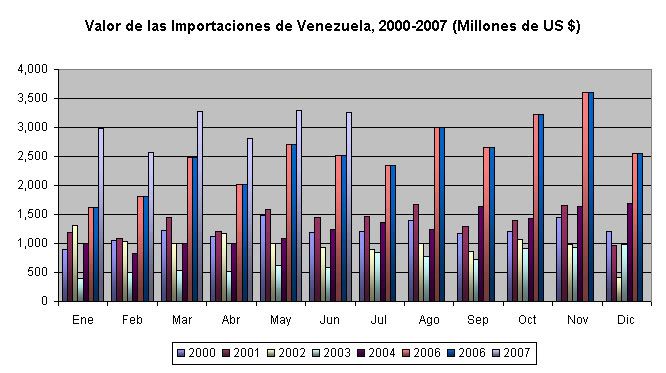
The fastest growth was in communications at 24.3% followed by commerce at 18.4% and then transportation at 15.5%. The lagging sectors were manufacturing at 7.7% and construction at 4%. Note that both manufacturing and contruction were both slower than growth in the economy as a whole. Clearly the increasing overvaluation of the Venezuelan economy is stunting manufacturing growth and keeping it below what it should be.
Interstingly the bank noted that agricultural production as been increasing at an average of 15% since 2005. So what shortages there are clearly result from increased demand not falling output.
In more general numbers imports were up 30.9% (is this good or bad?), consumption by consumers is up 20.4% (I guess this makes for happy voters), and fixed capital investment is up 17.3% which the government attributes to increased imports of machinery. However, for some time now we have seen investment go way up while production seems to be increasing but at a much slower rate. ("Yawn," Oil Wars, 15 November 2007)
It looks like the day when the minister can buy at home everything he can possibly want is far from close, and he is not personally setting a great example of swadeshi for the rest of the nation to follow.
The unfortunate spectacle of Louis Vuitton socialism came at about the same time as the news of removal of the price controls on long-life milk and shortly after the defeat of the Constitutional Reform. The beginning of December 2007 may be remembered as the time when contradictions of resource populism in Venezuela became more visible than before. Chavistas will have to overcome them to stay in power and further transform the nation. But how?
1 Some Venezuelan leftists, however, may not let the minister off the hook so easily on the hypocrisy question:
Y con una corbata Louis Vuitton y unos zapatos Gucci tú no puedes venir a decirme que estás poniendo los intereses colectivos por encima de los individuales, mucho menos si tu respuesta a las críticas es que en Venezuela "no se fabrican" corbatas ni zapatos. . . no me jodas, que en estos momentos tengo puestos unos zapatos venezolanos Vic Matic bien bonitos, que cuestan 120 mil bolívares y me han durado 2 años ya. [And with a Louis Vuitton tie and Gucci shoes on, you can't come to tell me that you are putting collective interests above individual ones, much less if you respond to your critics by saying that ties and shoes are "not being manufactured" in Venezuela. . . . Don't kid me. At this very moment I am wearing very pretty Vic Matic Venezuelan shoes, which cost me 120,000 bolivars and have lasted for the last two years] (Luigino Bracci Roa, "Pedro Carreño y la corbata Louis Vuitton, o cuando la oposición tiene toda la razón. . . ," El espacio de Lubrio, 13 December 2007)
Is it time for Venezuelan officials to begin to emulate the sartorial rectitude of their Iranian counterparts who still frown upon the kravati?
But news from the department of government procurement is worse than news from the fashion department: the Venezuelan government just gave KBR a $57 million dollar contract to build an ammonia plant ("When Will They Put Their Money Where Their Mouths Are?" Oil Wars, 14 December 2007).
Update
Read it in Spanish: Yoshie Furuhashi, "¿Socialismo Louis Vuitton en Venezuela?" Traducción de Julio Fernández Baraibar, Critical Montages, 19 December 2007.
Labels: capitalism, class, venezuela
3:37:00 pm |
Permalink |
Comments thread |
|
Print |
Digg |
del.icio.us |
reddit |
StumbleUpon |
Tweet|
Share|
Saturday, December 08, 2007
"¡Más Chavista que nunca!" (More Chavista than ever!) posted by Richard Seymour
Guest post by elpresidenteThere follows a list of quotes translated from the original Spanish from Venezuelan politicians and activists discussing the recent referendum.
 In 2006, President Chávez won the presidential elections with 62 per cent of the vote, obtaining the support of 7,309,000 people. A year later, the president’s Constitutional Reform only received 4,380,000 votes in favour, which allows the simple observation that some 3 million people who voted for President Chávez in 2006 decided not to vote for his Constitutional Reform proposal.
In contrast, in 2006, Chávez’s closest competitor, the opposition candidate Manuel Rosales, obtained 4,292,000 votes. In 2007, those who were opposed to the reform numbered 4,504,000 - two hundred thousand more people than had voted for the opposition in 2006.
En 2006, el Presidente Chávez ganó las elecciones presidenciales con un 62 por ciento de los votos, obteniendo el apoyo de 7.309.000 personas. Un año después, la Reforma Constitucional del Presidente Chávez sólo logró 4.380.000 votos a favor, lo que a simple vista denota que unas 3 millones de personas que habían votado por el Presidente Chávez en 2006 decidieron no votar por su propuesta de Reforma Constitucional.
En contraste, en 2006 el más cercano competidor de Chávez, el opositor Manuel Rosales, obtuvo 4.292.000 votos. En 2007, quienes se opusieron a su propuesta de Reforma fueron 4.504.000 personas, doscientas mil personas más que quienes votaron por la oposición en 2006.
What is to be done? To leave this situation and ensure that the revolutionary process overcomes this moment and can deepen, it is essential that all power should pass to the people and their organisations.
The Partido Socialista Unido de Venezuela (PSUV) congress should become a more democratic organisation where all could think, propose, criticise and decide the best course for the Bolivarian revolution, without the restrictions or bureaucratic interference that prevents free discussion.
We have immense confidence that hundreds of thousands of Venezuelans will continue advancing the socialist project, and will confront on this road any attacks the right may try to make. But this confidence must be accompanied by unity and organisation, and the construction of a space to debate all these themes.
¿Qué se va hacer? Para salir de esta situación y que el proceso revolucionario supere este momento y pueda profundizarse, verdaderamente todo el poder debe pasar al pueblo y a sus organizaciones.
El Congreso del Partido Socialista Unido de Venezuela (PSUV) debe transformarse en la más democrática instancia donde todos podamos opinar, proponer, criticar y decidir lo mejor para la revolución bolivariana, sin restricciones y sin injerencias burocráticas que impidan una libre discusión.
Tenemos inmensa confianza en que cientos de miles de compatriotas podemos seguir con el proyecto socialista y enfrentar en ese camino cualquier intento que la derecha pretenda realizar. Pero a la confianza hay que acompañarla de unidad y de organización, construyendo un espacio común para debatir todos estos temas.
Stalin Pérez, Vilma Vivas, Marco García e Ismael Hernández, Unión Nacional de Trabajadores (UNT) sindicalistas, Caracas
For so long the President has been favouring people with scarce resources and proposing actions to continue helping the poorest such as through the Consejos Comunales, and I believe that the abstention was a result of complacency, a lack of political maturity, and ingratitude, but the real problem is the situation of criminality and gangsterism in the barrios.
(The campaign) failed to organize regular political debates to explain and compare the advantages and disadvantages between socialism and capitalism. Some just wanted to take from the revolution, and for these, it doesn’t matter whether they vote or not. As such, those who abstained have to accept their irresponsibility.
A estas alturas del tiempo que lleva el Presidente favoreciendo a la gente de menores recursos y proponiendo acciones para seguir ayudandolos como es el caso de los Consejos Comunales, creo que la abstención obedece a la comodidad, falta de madurez política e ingratitud de la gente, pero un problema real es la situación en los barrios con visos de criminalidad y pandillerismo.
Falta realizar, como rutina, talleres de ideología que explique y confronte ventajas y desventajas entre socialismo y capitalismo. Algunos sólo quieren vivir de la revolución y por ello les da lo mismo votar o no. Así que los abstencionistas asuman su irresponsabilidad.
Dalia Pérez, Barquisimeto
I hope the President counter attacks… it seems to me that the politicians were overconfident in the campaign, but now we should advance on the attack.
Aspiro que el presidente haga lo que más el contraataque… ahí se crece… me parece que en la campaña hubo exceso de confianza de parte del políticos, pero ahora debemos avanzar al ataque.
José Rojas, Barrio El Junquito, Caracas
We have to find out what happened with this Chavismo Lite that stayed at home, we have to see what is going on with the people.
Furthermore, we have to make sure that its not just politicians in the media influencing this mystical public opinion, but that all Venezuelans are involved in politics.
We have to organize ourselves, go into the streets, construct this community, these consejos… we have to respect our President and bring the confused abstainers to the polls.
The fight continues comrades - this hasn’t finished, and he who doesn’t believe that doesn’t deserve to be called a revolutionary.
Tenemos que ver que pasa con ese Chavismo Light que se quedo en su casa, tenemos que ver que esta pasando en el pueblo.
Además tenemos que demostrar que no es político solo el que habla en medios y crea esa mitificada opinión publica, sino todos y todas las venezolanas y venezolanos, todos tenemos que estar inmiscuidos en problemas políticos.
Tenemos que organizarnos, salir a las calles, construir esa comunidad, esos consejos… tenemos que velar por nuestro presidente y llevar a las urnas a esos abstinentes confundidos.
La lucha sigue camaradas - esto no ha terminado, y el que lo crea así, no merece ser llamado revolucionario.
Pablo Trinidad, Cua, Venezuela
This is a clear message that the Venezuelan opposition has nothing assured, that it wasn’t a convincing victory, and much less an end to the hope of a new, more just, economic and political future.
Nothing has been lost, we will continue and we will advance.
Este es un claro mensaje a la oposición venezolana, que indica que no tienen nada asegurado, que no fue una victoria contundente y mucho menos un final a la esperanza de un nuevo furturo económico y político más justo.
Nada se ha perdido, continuemos, avancemos.
Ángela, Barrio 23 de enero, Caracas
I think that one of the reasons (for the defeat) was the scattered efforts to organize the PSUV on one side, and on the other, the discussion about the reform.
Of six million members, only one million and a bit attend meetings… the PSUV has not been organized, and this confrontation especially found it poorly prepared.
I believe in the PSUV, I believe it is necessary, but also I think it was a mistake to leave the organisation of the party until after the referendum.
Creo que una de las razones fue la dispersion de esfuerzos por un lado con la corformacion del PSUV y por el otro la discusion de la reforma.
De seis millones de inscritos solo asistian a las reuniones un millon y piquito… el PSUV no estaba organizado, y especialmente para esta confrontacion no se encontraba debidamente preparado.
Creo en el PSUV, creo que es necesario, pero tambien creo que ha podido posponerse su conformacion hasta pasar el referendum.
Francisco Acuña, Valencia
Union leaders and workers have to take to the streets to mobilize and fight for the 6 hour work day and the inclusion of the workers in the informal sector.
Our revolutionary process requires and deserves a profound and urgent change. There is no time or possibility for superficial changes. A debate on the great political and economic decisions has to be started with the masses, with social, popular and political organisations, and we need a revolutionary newspaper.
There has to be no more appointed functionaries who are interested in their own personal gain. The role of the Ministers of Popular Power must be usurped, so that the decisions referred to them are debated and decided by those who will be affected by these decisions.
There must be no more salaries that allow (state) bureaucrats to live as though in Saudi Venezuela, buying properties and staying in luxurious hotels. This has nothing to do with socialism, and the workers demand that all those involved in this (corruption), all the inefficient and unscrupulous functionaries are fired.
Those who work for the process (the revolution) those that sacrifice each day, the true workers’ leaders and the social leaders in the barrios, that are part of, and reflect the people, have to be involved.
Los dirigentes sindicales y los trabajadores tenemos que salir a movilizarnos y a conquistar hoy las 6 horas de trabajo y la inclusión de los informales.
Nuestro proceso revolucionario necesita y se merece un cambio profundo y urgente. Ya no hay tiempo ni posibilidades de cambios superficiales. Hay que abrir el debate de las grandes decisiones políticas y económicas con las bases, con las organizaciones sociales, populares y políticas del proceso, y necesitamos un periódico revolucionario.
Hay que terminar con los funcionarios elegidos a dedo que no reflejan más que sus intereses personales. Replantearse el rol de los Ministros del Poder Popular, para que todas las decisiones referidas a cada uno sean debatidas y decididas por las bases involucradas.
Hay que terminar con los salarios de funcionarios que viven como en Venezuela Saudita, que compran propiedades y duermen en lujosos hoteles. Eso nada tiene que ver con un proyecto socialista, y las bases reclamamos la salida de todos los involucrados en este proceso, la renuncia de estos ineficientes e inescrupulosos funcionarios.
Hay que darle paso a los que trabajan por el proceso, a los que se sacrifican a diario desde las bases, a los verdaderos liderazgos obreros y los populares en los barrios, que son parte y reflejo directo de sus sectores sociales.
Union Nacional de Trabajadores sindicalistas, Venezuela
Democratisation of communication is the way that the people can participate in the production and distribution of information through the media, and undercut the 80 per cent of the media that reflects the priorities of capitalism.
This revolutionary form of communication should spread from the masses who support the government - from each battalion, in each consejo comunal, in every community.
La democratización de la comunicación es la vía para que el pueblo participe en la producción y distribución de los mensajes mediáticos, de darse esto no importará que más del 80 por ciento de los medios informativos respondan al modo de producción capitalista. Esta forma revolucionaria de comunicación debe desplegarse desde las bases de quienes apoyan al gobierno - en cada batallón, en cada consejo comunal, en cada pueblo.
María Rivas, Barrio Catia, Caracas
We are not going to hear those opinionated commentators who accused Chávez of being a dictator, an autocrat, a manipulator, gorilla or Castrocommunist - all the insults and lies of the politicians, café society, columnists and editorialists - apologise after the President immediately accepted without any objection the adverse result, but in 2 seconds - crash! - the entire media slander collapsed.
If only Colombia or México could show the same confidence and trust in their (electoral) institutions!
This is the moment to attend to the democratic capacity of the PSUV, changing a strategy that had prioritised quantity over quality, and that had hindered the activists from participating. This is the moment to make internal discussion - the multiplicity of dissident opinions - a democratic requisite.
No vamos a escuchar al grueso de los opinólogos que han acusado a Chávez de dictador, autócrata, manipulador, gorila o castrocomunista - todos los insultos y calumnias de políticos, tertulianos, columnistas y editorialistas - entonar un mea culpa después de que el Presidente aceptara de inmediato y sin ningún reparo el resultado adverso, pero en dos segundos - ¡derrumbó! - la calumnia mediática fracasó.
¡Ojala mostrara el ejército la misma fidelidad institucional en Colombia, en México!
Es el momento de mimar la capacidad democrática del PSUV, revirtiendo una estrategia que ha primado la cantidad a la calidad y que ha impedido que sea la base quien se encuentre con su verdadero instrumento de emancipación. Es el momento de hacer de la discusión interna un requisito democrático, de multiplicar las disidencias.
Juan Carlos Monedero, Madrid, España
What did the opposition win? Not much really. The opposition simply achieved to slow down a little the revolution’s advance that continues as before.
And what did the opposition lose? They lost the few cards they had left - the claims that elections can’t be trusted, that President Chávez wouldn’t recognize the result, that Chavistas are violent. And now, furthermore, they have now declared themselves fervent defenders of the Bolivarian Constitution, which is more a victory for us.
¿Qué ganó la oposición? No mucho, realmente. La oposición simplemente logró frenar un poco el avance de la revolución para quedar igual que antes.
¿Y qué perdieron? Perdieron algunas banderas de las muy pocas que disponían.
Que el árbitro no es confiable, que el presidente Chávez no reconocería su triunfo, que los chavistas son violentos. Y ahora, además, se han declarado fervientes defensores de la constitución Bolivariana, lo cual es más bien un triunfo para nosotros.
What did the revolutionaries lose? A tool to accelerate the advance of the revolution, that maybe wasn’t well explained or was proposed at the wrong moment.
And what did we gain? An increase in our international prestige as an eminently democratic people, with a great democratic leader, and the opportunity to reflect, improve and rectify our strategies before it becomes too late.
¿Qué perdimos los revolucionarios? Una herramienta para aligerar el avance de la revolución, que tal vez no fue bien sustentada o se propuso en el momento equivocado.
¿Y que ganamos? Aumento de nuestro prestigio internacional como pueblo eminentemente democrático, con un gran líder demócrata, y la oportunidad de reflexionar, pulir y rectificar las estrategias antes de que sea demasiado tarde.
What happened was the best thing that could have happened. Considering the adversary that we faced, it wouldn’t have suited us to win the referendum with a small margin. If we were not going to win with a sufficient margin, it was better to lose.
The rapid recognition of our adversary’s victory, without any scheming, was taken by our entire movement in a disciplined manner and saved the country from who knows how much unnecessary violence.
Lo que pasó fue lo mejor que pudo pasar. Ante un adversario como el que enfrentamos, de ninguna manera nos convenía ganar el referendo con un margen estrecho. Si no ganábamos con suficiente ventaja, era mejor perder.
El rápido reconocimiento del triunfo del adversario, sin ninguna mezquindad, fue asumido por todo nuestro movimiento de manera disciplinada y le ahorró al país no se sabe cuantos actos de violencia innecesarios.
Ramón Prada, Caracas
One learns more from defeats than from victories.
The victory of the No could be considered a triumph of fear, of manipulation, terror, ignorance and disinformation.
Now, we should do away with easy slogans and take the ideological battle to the heart of the people.
De las derrotas se aprende más que de las victorias.
El triunfo del No podría ser considerado un triunfo del miedo, de la manipulación, del terror, de la ignorancia y de la desinformación.
Ahora, debemos derribar el slogan fácil y debemos ir a la batalla ideológica profunda en el seno de nuestro pueblo.
Oscar Figuera, Partido Comunista de Venezuela (PCV), Caracas
The opposition still has no direction, coherence or respect as a political force.
Should the right retake the presidency someday, ensure that revolutionary organisation on the ground, in the barrios, in workplaces, remains strong and independent to protect the gains that have been made.
Colombians expected Chávez, on hearing that the vote was lost, to declare martial law, send tanks onto the streets and soldiers into the TV studios.
To see this guy talking without formalities, without notes, with humour and grace, telling the opposition to enjoy their evening, and even debating the impact of the result in interactions with the people in the audience, openly and honestly, left Colombians a little disorientated.
I think this defeat and the grace in which the Chávistas have taken it will actually go a long way towards undercutting the propaganda war against the revolution.
La oposición todavía no tiene ninguna dirección, coherencia o respeto como una fuerza política.
Los derechistas deben toma la presidencia algún día, asegurar que la organisación revolucionaria - en los barrios, en los lugares de trabajo - permanezca fuerte e independiente para proteger los logros que han hecho.
Los colombianos esperaron que Chávez, cuando el escuchó que el voto había sido perdido, declarara la ley martial, enviando tanques a las calles, y soldados a los estudios de televisión.
Para mirar este man hablando sin formalidades, sin notas, y con humor y gracia, diciéndole a la oposición que disfrutaran su tarde, y aún debatiendo el impacto de los resultados con la audencia, abierta y honestamente, dejando a los colombianos un poco desorientados.
Yo creo que esta derrota y la gracia con lo que los Chavistas han aceptado, realmente lo hará disminuir la guerra de propaganda contra la revolución.
Rocío Jiménez, Bogotá, Colombia
We have been unable to achieve a revolutionary process from below, with high levels of popular protagonism, and the Bolivarian revolution is still essentially led from the top.
Lots of people that are with the revolution, refrained this time from voting because they are being increasingly marginalized by a centralized State revolutionary process. They feel it is not their revolution.
It is a revolution that being handed down to them. They are not the subjects of the process, but its mere objects. And this is what disenfranchised and alienated 3 million potential supporters. This is the wrong path that led us into defeat.
 Nosotros no hemos podido lograr un proceso revolucionario desde abajo, con altos niveles de protagonismo popular, y la revolución Bolivariana esta todavía dirigida desde la cima.
Mucha gente que está con la revolución se abstuvo, esta vez, de votar porque ellos están siendo aumentados marginalmente por un proceso revolucionario y centralizado del estado. Ellos sienten que no es su revolución.
Es una revolución que está dándoles a ellos. Ellos no son los sujetos del proceso, pero son los meros objectos. Y esto es lo que causado el disenfranchisimiento y la alienación de tres millones de partidarios. Este es el camino errado que ha dirigido a la derrota.
Teresa Arraíz, Ciudad Bolívar
How can the opposition move beyond its stupid, monotonous and shallow ‘anti-dictator’ mantra? They can't, because they have nothing of substance beyond it to offer.
The revolution has occupied, with its vast and deep program of social reforms, all possible political space.
Besides, as soon as the opposition tries to agree on a proposal that is not just tired propaganda, they will explode into a myriad of fragments.
Nothing truly strategic and positive holds together the opposition's fragile concoction of contradictory and petty motives.
¿Cómo puede la oposición moverse por encima de la mantra estúpida, monótona y superficial de ‘contra-dictador’? No pueden, porque no tienen nada de substancia para ofrecer.
La revolución ha ocupado, con su programa de inmensas y profundas reformas sociales, todo el espacio político posible..
Además, tan pronto como la opocisión intenta estar de acuerdo en un propuesta que no es propaganda cansada, ellos estallarán en una miríada de fragmentos.
Nada verdadamente estratégico y positivo sostiene juntos la mezcla frágil de los motivos contradictorios e insignificantes de la opocisión.
Augusto Piñango, Santa Rosalía, Portuguesa
We haven’t lost anything - just a possibility, but we are going to convince our compañeros, those who have doubts, those who have fears… raise the socialist standard, learn more, unite together, teach, and continue demonstrating through action - more than through theories - what socialism is.
No hemos perdido nada, en verdad perdimos sí una posibilidad, pero vamos a convencer a los compañeros, a los habitantes, a los que tienen dudas, a los que tienen temores… levanta la bandera del socialismo, estudiemos más, compactémonos mucho más, expliquemos más y sigamos ahora demostrando en los hechos en qué consiste, más allá de la teoría, la propuesta socialista.
President Hugo Chávez
Chavez's concession speech:
 I prefer it like this. I prefer that it ends like this.
Lo prefiero así. Yo prefiero que haya terminado así.
I am calm, as I hope all Venezuelans are at this moment. Let us all be proud with what we have done, and continue to respect each other.
Now, we must all recognize the decision, the very tiny margin. I say this to emphasis all those who voted Sí and to say to the leaders of the opposition - I sincerely hope you know how to deal with this success.
Estoy tranquilo, como espero que los venezolanos, a partir de este momento, también lo hagan. Estemos todos orgullosos con lo que hemos hecho, cada quien en su ámbito, con sus posiciones, respetando al otro.
Ahora, todos debemos reconocer que es una decisión ahí, muy chiquitica. Digo esto para recordar a quienes votaron por el Sí y a los dirigentes de oposición, mi sincera recomendación de que sepan administrar esa victoria.
I will sleep tranquilly. Those who are going to celebrate should know how to manage their victory. You gained it, but I wouldn’t have wanted such a pyrrhic victory… the vote totals are irreversible, and I recognize that.
I congratulate my adversaries on this victory - it was a hard fight.
For now, we couldn’t… (but) the reform proposal is still alive, it hasn’t died.
Yo dormiré tranquilo. Los que vayan a celebrar que sepan administrar su victoria. Ustedes se la ganaron, pero yo esa victoria pírrica no la hubiera querido. Más bien prefiero que las cifras hayan llegado al nivel de irreversibilidad y sentarme delante de todos ustedes a reconocerlo.
Felicito a mis adversarios por esa victoria; nosotros estamos hechos para una batalla larga. Por ahora no pudimos… La propuesta de reforma está viva, no ha muerto.
I assume the responsibility for not achieving 50 per cent plus one for the proposal - but it nearly achieved it.
It has to be accepted: in Venezuela, despite all the scheming and lies, as President Castro described it a few days ago, a people under fire - under an intense artillery fire of lies and fears - still voted 49 per cent for the socialist project. Despite everything, this is a great political advance.
Yo asumo la responsabilidad de esta propuesta, que no logró el 50 por ciento más uno; pero casi lo logro.
Hay que aceptarlo: venimos de una situación donde en Venezuela no había rumbo político, a pesar de todas las artimañas y mentiras que circularon, como el Presidente Castro lo describió hace unos días, un pueblo bajo fuego - fue sometido a un intenso fuego de artillería de mentiras y temores - sin embargo, que haya votado 49 por ciento por el proyecto socialista, a pesar de todo es un gran paso político.
We continue the battle to construct socialism, within the Constitution. In the proposal there are very audacious ideas, without precedents.
I will not erase a single comma of this proposal. The proposal continues…
Nosotros seguimos en la batalla por la construcción del socialismo, en el marco de la Constitución. En la propuesta hay ideas muy audaces, sin precedentes.
Ni una sola coma de esta propuesta, yo la retiro. La propuesta la continúo haciendo…
We lost 3 million votes - for what reasons? It is necessary to evaluate, although I am completely confident that the immense majority of those people continue with us, those who did not vote Sí. They abstained; had doubts, fears, no time - there was no chance to explain….There are many political factors that we must take into account in this battle… we respected the rules of the game… (and) it is not the first time.
A nosotros nos faltaron 3 millones de votos de personas que no fueron a votar. ¿Por cuáles razones? Hay que evaluarlo, estoy completamente seguro que la inmensa mayoría de esas personas sigue con nosotros, que no votaron por el Sí; se abstuvieron: dudas, temores, faltó tiempo, capacidad para explicar….Hay bastantes elementos políticos que debemos tomar en cuenta en esta batalla… respetamos las reglas del juego… No es la primera vez.
The Chief of State invited the foreign journalists present to this concession, to observe how Venezuela continues speaking openly, with freedom of expression, criticism and demonstrations - as it has always done - and so to cause the accusations of a supposed dictatorship in Venezuela to crumble.
El Jefe de estado conminó a los periodistas extranjeros presentes en la alocución, a observar cómo en Venezuela se continuará hablando abiertamente, libertad de expresión, críticas y manifestaciones, como siempre ha sido, con lo que se desmoronan las acusaciones de una supuesta dictadura en Venezuela.
No more in Venezuela will there be elections as in the past… when the (workers’) Communist vote was torn between Acción Democrática and COPEI. This vote is a demonstration of the credibility and confidence that we have in our Constitution and in the institutions (misions and consejos comunales) that have been created as part of our Bolivarian democracy.
Ya nunca se verá en Venezuela lo que veíamos nosotros en las elecciones del pasado…cuando el Partido Comunista se lo repartían entre la Acción Democrática y el COPEI. Esta es una demostración de la credibilidad que debemos tener en nuestra Constitución y en las instituciones que ha creado, en nuestro sistema político de la democracia bolivariana.
I congratulate those who voted for the proposal and those who rejected it - to those who had doubts, this one (democracy) is the way… I hope they will now spurn, for ever, their nihilistic road to violence, destabilization and ignorance.
Venezuelan democracy is becoming mature and each process that we experience, each political moment, is allowing our country to continue advancing this new Bolivarian project that began in 1999.
Felicito a quienes votaron por la propuesta y quienes la rechazaron - a aquellos que tenían dudas, éste es el camino y ojalá se olviden, para siempre, de las trochas, los saltos al vacío, de los caminos de la violencia, de la desestabilización y el desconocimiento.
La democracia venezolano va madurando y cada proceso que vivimos, cada jornada política, va permitiendo que nuestro país continúe madurando, en este nuevo proyecto Bolivariano que comenzó en 1999.
To paraphrase the Liberator, Simón Bolivar, who, at the moment of presenting the text of Bolivia’s Constitution, said that if it was not accepted, he would bequeath it for the future, the reform proposal is entrusted to the immediate future.
(With this vote) our Bolivarian Constitution, so hard fought for, has finally been recognised by the opposition.
The opposition have to defend the Constitution… I hope (the opposition’s participation in the vote) hasn’t been a momentary political tactic. I want to have faith. We are going to construct the Venezuela that the Constitution reflects.
Parafrasear al Libertador Simón Bolívar, cuando en la oportunidad de entregar el texto de la Constitución de Bolivia, dicho que si no lo aceptaban lo legaría para el futuro, esta propuesta de Reforma la lega para un futuro inmediato.
Nuestra tan luchada constitución…que por cierto, uno de los grandes logros es que la oposición reconoció esta Constitución Bolivariana.
Han salido a defenderla. Espero que no haya sido un recurso momentáneo y manejo electorero. Quiero creer en la buena fe. Vamos a construir la Venezuela que aquí esta reflejada.
9:10:00 pm |
Permalink |
Comments thread |
|
Print |
Digg |
del.icio.us |
reddit |
StumbleUpon |
Tweet|
Share|
Monday, December 03, 2007
Chavez loses referendum posted by Richard Seymour
According to the Hands off Venezuela blog, the CNE has announced a narrow victory for NO. Chavez has accepted the result. HOV comments:in relation to the 2006 presidential elections, the opposition has only increased less than 100,000 votes (thought this is not yet 100% count), while Chávez loses 2.8 million which go to abstention.
Independent polls suggested beforehand that among likely voters, Chavez would probably win it, and furthermore that Chavez's call for socialism to be made part of the constitution was broadly supported. Leaving aside the probably limited effect of 'Operation Pliers', the reality is probably that Chavez's supporters were simply unwilling to turn out to vote for a constitution among whose main priorities was to enhance executive power. This was always the most problematic aspect of Chavez's reforms. Unfortunately, this result will probably strengthen the rightist opposition, despite the continuing popularity of Chavez and his other reforms.
7:29:00 am |
Permalink |
Comments thread |
|
Print |
Digg |
del.icio.us |
reddit |
StumbleUpon |
Tweet|
Share|
Thursday, November 29, 2007
Venezuela: hammer, anvil and pliers. posted by Richard Seymour
Entirely predictable and unshocking revelations about the CIA's anti-Chavez campaign have emerged, as I'm sure you've all seen. Chavez is to be assailed on all fronts through violent subversion, electoral chicanery, and the CIA is even looking for a left-flank in Trotskyist opposition to some of Chavez's policies. Bad news for the CIA: the polls (not those from the guys who want Chavez killed), suggest that socialism is supported by most Venezuelans; Chavez is still very popular; and he will probably overwhelmingly win the vote on his constitutional changes. Not all of Chavez's changes are to the good - it is a complex mix, with some measures to consolidate the ten percent of the economy that is common property and bolster grassroots democracy, and other centralising measures that militate against this. Yet, only in the CIA's condescending analysis could it be the case that left-wing criticism of government policy will turn the masses into a despondent, apathetic bloc. Far more worrying is the call for coordinated action with military attaches. This is unlikely to lead to a successful coup on the model of 1973, since Chavez has much of the military on his side. Yet, it can destabilise the society enough, along with contrived economic chaos, to derail the society and force Chavez into a bunkered, bureaucratic corner. As ever, only the combined power of the Venezuelan working class can save the situation: Mike Gonzales has a sharp analysis of the broader political issues here.
7:56:00 pm |
Permalink |
Comments thread |
|
Print |
Digg |
del.icio.us |
reddit |
StumbleUpon |
Tweet|
Share|
Friday, November 23, 2007
Colombians devastated at Chávez’s "dismissal" posted by Richard Seymour
Guest post by elpresidente:
On Wednesday, Chávez was in his office in Caracas’s Miraflores Presidential Palace with Colombian Senator Piedad Córdoba, who had been personally chosen by Uribe to conduct negotiations together with Chávez, in the hope of reaching an agreement to exchange guerrilla prisoners in jail for politicians and soldiers held by the Farc.
Córdoba was making a round of telephone calls to inform Colombian politicians and the families of kidnap victims of the latest progress in the negotiations. When she called General Montoya, Córdoba passed the phone to Chávez, who then asked the question he must have asked everyone since being invited by Uribe to help with the humanitarian agreement.
That Uribe has now used this 30 second telephone call to claim Chávez is interfering in Colombia’s internal politics, and that it warrants an abrupt end, not just to the Venezuelan President’s efforts, but also Senator Córdoba’s work towards an agreement to free those kidnapped, has been met with confusion, disbelief and dismay by Colombians hopeful that an agreement, and even, eventually, an end to the war, had become a real possibility.
Chávez’s question is a relevant and pertinent one - particularly as no-one seems to know exactly how many hostages are held by the Farc. Humanitarian organisations that assist the families of kidnap victims in Colombia, such as País Libre, estimate the guerrillas are holding 2,000, including police, soldiers, local politicians and also high profile hostages such as 2002 presidential candidate Íngrid Betancourt, but a definitive figure is not known.

The reaction from the hostages’ families to Uribe’s unilateral decision to end the negotiations has been heartbreaking. ‘Mr President, please reconsider,’ implored Marleny Orjuela, a mother of one kidnap victim, ‘put yourself in our shoes for one minute - just a single minute - to understand how we feel.’
‘Please don’t take away our hope,’ read a hurriedly written placard at an impromptu demonstration in Bogotá’s central plaza, but a statement issued by the presidential palace declared Uribe’s decision to be ‘irreversible.’
While the French government stated that ‘President Chávez’s involvement is the best option to liberate the hostages’, Chávez himself went on Venezuelan television to say that although he ‘respected President Uribe’s decision, I feel sorry for all those prisoners in the hands of the Farc, the guerrillas in jail, their families and loved ones, and also for Colombia.’

Chávez continued, saying that he believed peace would ‘return to Colombia’, and that he would talk with Uribe to try to convince him to reconsider his decision. Declaring his ‘love for our sister country’, Chávez said he was ready to do everything he could to ‘alleviate the suffering of the Colombian people.’
For Carlos Lozano, Voz newspaper editor in Bogotá, Uribe’s ‘dismissal’ of Chávez as a negotiator shows that the Colombian government is ‘not interested in peace.’ Citing Uribe’s recent declaration that he had ordered the military to kill any Farc commanders who emerged from the jungle to participate in negotiations, Lozano said, ‘he wants the war to continue - this is clear.’
Labels: chavez, colombia, death squads, venezuela
7:11:00 am |
Permalink |
Comments thread |
|
Print |
Digg |
del.icio.us |
reddit |
StumbleUpon |
Tweet|
Share|
Friday, November 16, 2007
Mike Gonzales on Venezuela posted by Richard Seymour
A great discussion of Chavez, the opposition, and socialist strategy in Venezuela:
4:34:00 pm |
Permalink |
Comments thread |
|
Print |
Digg |
del.icio.us |
reddit |
StumbleUpon |
Tweet|
Share|
Sunday, November 11, 2007
The war on formal democracy. posted by Richard Seymour
Bush unta stimulates wave of terror in Venezuela. Venezuela is unique in that students have long been largely, though not exclusively, pawns of the right, and these ones are tied to far right opposition strong-holds with plenty of cash coming in from Washington DC. The Venezuelan government are naturally suspicious.Now, I want you to pay close attention to this:
Venezuelan President Hugo Chavez's proposed constitutional changes go far beyond "reforms." The 69 amendments blessed by the Chavez-controlled legislature last week would eliminate the vestiges of democracy yet remaining in the government.
Chavez could run for re-election indefinitely and concentrate virtually all state power in his hands. Democratically elected in 1998, he could rule as a dictator for decades.
Chavez could run for re-election indefinitely, and yet still be a dictator. Meanwhile, the Spanish King tells President Chavez to shut up in the name of democracy.
Labels: chavez, US imperialism, venezuela
8:12:00 am |
Permalink |
Comments thread |
|
Print |
Digg |
del.icio.us |
reddit |
StumbleUpon |
Tweet|
Share|
Thursday, August 23, 2007
Pilger: War on Democracy posted by Richard Seymour
In case you missed it:Labels: bolivia, chavez, chile, pilger, venezuela, war on democracy
7:28:00 am |
Permalink |
Comments thread |
|
Print |
Digg |
del.icio.us |
reddit |
StumbleUpon |
Tweet|
Share|
Saturday, June 23, 2007
Whitey's planet, whitey's rules: on those unfit for self-government posted by Richard Seymour

Ignatieff complains, repeatedly, of Woodrow Wilson's legacy, for having embedded the concept of self-determination in liberal discourse. He thinks that it has failed, that the dream of national sovereignty is over and that the American empire will have to take over and live up to, or down to, his own liberal ideals (which, by the way, include defense of the state's inalienable right to torture suspects, until it becomes an electoral liability). If he had actually read a little bit of Wilson, or knew what he was talking about - which I can assure you he doesn't - he would know that he is actually very close to being a Wilsonian, but that this is no compliment. His was a doctrine mainly about those unfit for self-government and who could, at best, be redeemed after a training course under the despotism of whitey. Wilson was, as I think I briefly indicated elsewhere, for the sternest repression of the 'savage' races of the earth. He wasn't alone in it, and I only mention it again because he in particular has such a mountainous reputation. Well, they have never stopped with the white despotism, and are even today preparing for more of the same.
Consider: This has passed at the start of the year. That is a Congressional resolution calling upon the UN to "charge Iranian President Mahmoud Ahmadinejad with violating the 1948 Convention on the Prevention and Punishment of the Crime of Genocide and the United Nations Charter because of his calls for the destruction of the State of Israel." Genocide. This passed with bipartisan support. Wanna see how they support the claim of genocide? Well: "the 1948 Convention on the Prevention and Punishment of the Crime of Genocide (commonly referred to as the `Genocide Convention') defines genocide as, among other things, the act of killing members of a national, ethnic, racial, or religious group with the intent to destroy, in whole or in part, the targeted group, and it also prohibits conspiracy to commit genocide, as well as `direct and public incitement to commit genocide'".
Seriously? Apparently so. It goes on to imply that Iran has threatened to use force against Israel, and then to elide the distinction between the threat of force and genocide; and then it repeats the 'wiped off the map' bullshit. This has been comprehensively debunked more times than the average US congressperson could count. The resolution also recites a mutilated quote from the Modern Right reformer Hashemi Rafsanjani, which has been bruited widely on the scum blogs and most reactionary news sites. The quote as rendered in the resolution is: "[i]f one day, the Islamic world is also equipped with weapons like those that Israel possesses now, then the imperialists' strategy will reach a standstill because the use of even one nuclear bomb inside Israel will destroy everything [in Israel], while it will merely harm the Islamic world". Now, I don't expect much rhetorical maturity from American politicians, but I expect a little bit of sophistication. The quote is taken from a 2001 speech, (you can read all of it here), and it clearly doesn't signal an intent to harm Israel or destroy it. All to what end? Well, if the United Nations should consider a country guilty of breaching the genocide convention, that is a mountainous cassus belli, and would legitimise intervention - perhaps by the state of Israel - to thwart this 'genocide'. The news now is: IAF preparing for Iran strike. The Wahabbi Jundullah militia based in Pakistan have been probing and softening targets in the south of Iran on behalf of Washington, and have even been honoured on Voice of America as the leaders of a popular Iranian resistance movement. Their atrocities have easily matched the various assaults by people calling themselves 'Al Qaeda' affiliates in Europe, but who ever thinks to ask a White House spokesperson why they are supporting what Bush called in a moment of puerile demagogery, "Islamic fascism", in the Middle East, and why - if they are so concerned with the well-being of Iranians - they think it is more permissible to murder them than New Yorkers? Wouldn't Iran be entitled to its own 'war on terror', including retaliatory strikes on American military buildings, or a full-scale invasion if America refused to hand over the people who ordered this horror? What news corporation would allow a reporter of theirs to ask such a question, and broadcast the reply?
In Afghanistan, where the massacres pile up daily, they expect to stay for decades: the white man's tutelage was as long in the Philippines, and didn't ever completely end, even to this date. Similarly, in Iraq, the plan is to make a Korea out of it. If they could ever get troops to the heart of Tehran, you could be sure that it too would be temporary to begin with, transitional for a few years, and then mandatory for the ensuing decades. And recently, as Eli pointed out recently, the House of Representatives approved new money for 'democracy promotion' in both Venezuela and Cuba. In both cases, their allies for democracy are ultra-rightists nostalgic for Phillipine monarchy, adamant supporters of racial hierarchy, putschists and opponents of all forms of genuine democracy. Nor will they allow Somalia to govern itself, unless it accepts self-government to mean the rule of a clutch of warlords. Haiti, following a coup and multinational governance under the especial auspices and direction of the United States, France and Canada, is only now - after the invasion of death squads, after the overthrow of the elected government, after several massacres by the UN troops, after the empowering of former genocidaires, after the locking up of thousands of political prisoners, and after the destruction of cities - taking tentative moves toward getting its own security forces, that might "one day" replace the MINUSTAH forces. Although Haitian resistance ensured that they couldn't restore completely the butchers of Raboteau, Haiti is secured once more in North America's 'free trade' circuit, with the sporting goods and t-shirts flooding into US and Canadian markets on the back of the cheapest labour possible. You will recall also that in Nicaragua, the US government was even unwilling to leave the Nicaraguans to elect their own government in peace last year, since they feared that the winner would be one of the people who helped overthrow the dynastic autocracy that US forces imposed in 1937. The repeated, unveiled threats probably did much to alter the election result, as their combination of death squad terror and bribery decided the result of the 1990 election in favour of Chamorro. They are doing all possible to finish off even the prospect of real Palestinian self-government. And they are now worried, terribly, that Pakistanis and Egyptians may achieve self-government.
This résumé, far from comprehensive, describes a current and pressing state of affairs. In the first decade of the twenty-first century, the lives and conditions of millions of people not living in the United States are determined in part by a largely Anglo-Saxon ruling class, which has learned not to openly espouse the principles of white supremacy and 'race' hierarchy, but operates on them nevertheless. Such an order cannot but be organised through the repeated and perpetual application of extreme violence - which task is effected not only by legions of amphetamined Alabama-bred eighteen year olds pumped up on racism and pornography, but also by the private contingent, the warlords and mercenaries and shock troops of different fundamentalisms. Now they are settled on decades of jackboot rule in several strategically important areas, mandate-style colonial governance with a few nods toward representation, as was very much the style in the old days. Apopthegmatically, of course, those who resist that order and support such resistance are evil, inhumane, and anti-democratic. Such people hate freedom, even their own, and abjure it every time they refuse whitey's rule.
Labels: cuba, genocide, haiti, iran, nicaragua, somalia, US imperialism, venezuela, white man's burden
9:17:00 pm |
Permalink |
Comments thread |
|
Print |
Digg |
del.icio.us |
reddit |
StumbleUpon |
Tweet|
Share|