Saturday, February 19, 2011
Bahrain, and the Anglo-American oil frontier posted by Richard Seymour
Bahrain, off the eastern shore of the Saudi Kingdom, had been subject to many of the same basic forms of state and market formation as the Saudi monarchy itself. Its commercial markets were first penetrated by British capitalism when East India company adventurers first arrived in the eighteenth century. It became a British 'protectorate', courtesy of gunboat diplomacy, in 1861. When I say 'gunboat diplomacy', I am being quite literal. The British had first imposed a 'General Treaty of Peace' on Gulf states, signalling their subordination to British power in the 1820s. This stated that Bahrain was not permitted to dispose of its territory except to the United Kingdom, or get involved in a relationship with any government without British consent. It was a way of keeping competing European powers out of the Gulf. The British later imposed their own 'Resident in the Persian Gulf' to manage their growing paramountcy in the region through a series of local advisors in Bahrain, Qatar, and Kuwait. All of this was supported and maintained by a large naval squadron. In return Britain promised to support the rule of Shaikh Al Khalifa, which established the UK's tradition of supporting Sunni dynastic rule over a largely Shia population. This system of rule was later centred on the British Raj, which maintained a Shaikhdom in Bahrain, and used the islands-state as a base for defending its regional interests, particularly during WWI.
Until the discovery and use of oil, Bahrain's major trades had included pearling, but throughout the 19th Century it diversified sufficiently for Manama to become the dominant trading city in the Gulf region, overtaking Basra and Kuwait. When oil was discovered in 1932, however, and Bahrain began exporting in 1934, it was just as traditional industries were suffering a severe decline amid global Depression. Unemployment had been soaring, and the pearl industry sinking. The sudden availability of oil revenues, a third of which were nominally controlled by the Shaikdom, paid for state-led capitalist development. Bahrain became what some social scientists call a 'rentier state', inasmuch as it depended by far on revenues derived from the sale of its oil on international markets than from the productive efforts of the society as a whole. The modern state of Saudi Arabia was formed under King Abdul Aziz bin Saud with British support in 1932, and it too began to export oil, with the industry taking off in 1938. This is when the current ties with the Saudi kingdom and US capital were first forged.
When Socal and Texaco initially combined in 1936 to form Aramco, the subsidiary was intended to run the oil concessions in both Saudi Arabia and Bahrain. Aramco, we know from Robert Vitalis, simultaneously created a public identity for itself as a partner in development and modernization, and reproduced the Jim Crow labour market structures then prevalent in the United States. The racial hierarchies maintained in the labour force, with white American workers at the apex and migrant workers from southern Asia at the bottom, still have operative effects in Bahrain's political system today. But the PR efforts, which involved paying a platoon of journalists, writers and scholars, building up research centres. Writers like Wallace Stegner took the 'myth of the frontier' elaborated by Frederick Jackson Turner, in which America's rugged democratic experiment was held to depend on the restless advance westward as hardy American citizens settled and improved otherwise empty land (oh yeah), and applied it to the oil frontiers. There, the oil companies were the pioneering heroes of civilization, the natives barely registering except as grateful recipients of racial uplift. At the same time, the British established more bases on the islands to entrench its control.
In partnership with British imperialism, represented in the person of 'advisor' Charles Belgrave, the oil firms helped construct forms of governance, geographies of accumulation, and market structures that guaranteed that this miraculous substance of myriad uses, this black gold, this vital source of industrialisation and advancement, would be controlled and directed by the 'West'. Bahrain, along with other Gulf states, was controlled from British India until 1947. In the postwar era, Britain maintained its 'informal' empire in the Gulf through a system of local advisors and client regimes backed by military force. Modernisation projects, such as the creation of a national education system, were built under British imperial tutelage. Challenges to the regime were assisted by British weaponry, as during the suppression of anti-British riots in the immediate post-war years, the containment of strikes by the left-wing National Union Committee, the crushing of pro-Egyptian demonstrations in 1956, and the putting down of the pro-independence March Intifada in 1965.
Until 1971, then, the British provided the security and patronage framework within which US oil capital operated. Under the banner of 'guided development', the British ruling class cultivated sterling-based networks of regional clients, and developed internal security apparati (mukhabarat) to sustain regimes which would operate only minimally within the integument of formal sovereignty. This model could occasionally conflict with US strategy. If American planners were not keen for rapid decolonization, fearing not just the exclusion of US investors but also the emergence of a worldwide systemic alternative to capitalism, they nonetheless had a conception of geographical accumulation, based substantially on the work of geographer Isaiah Bowman and other social scientists in light of their own experiments in direct colonial rule, which did not necessarily depend on direct territorial control. A global hierarchy of sovereign states operating an 'open door' policy was in principle compatible with US imperial hegemony, provided there was no revolutionary challenge to that hegemony. As such, the US had not initially worried overly about the Free Officers taking over Egypt in 1952, or Iraq in 1958. The real worry came later, in the 1960s, when Arab nationalism took a radical leftist turn. And though one context of Britain's declaration of withdrawal from its 'East of Suez' engagements was a traumatic defeat for Arab nationalism, there was still no certainty that ensuing movements and regimes would provide favourable territories for continued US capital accumulation. Britain's retreat from its imperial commitments 'East of Suez reflected defeat of a similar kind to that being inflicted on the US in Vietnam - this despite often brutal counterinsurgency campaigns in Malaysia and Aden (Yemen). Because of the growing political and economic costs of these commitments for a crisis-hit British capitalism, the Conservatives pledged to honour Wilson's withdrawal plans.
The US strategy in the Gulf was thus to engage in a Metternichian 'power-balancing' strategy. This involved strengthening its ally, the Shah, who asserted an Iranian claim to Bahrain, while also working to bolster the opposing Ba'athist regime in Iraq. With respect to Bahrain, a US naval squadron took up where the British navy departed. The formally independent emirate of Bahrain maintained its cosy relationship with Anglo-American power. Despite the creation of a parliament elected solely by male voters in 1973, the monarch retained the ability to impose laws by decree, such as the highly repressive State Security Law. Surging oil revenues in the 1970s contributed to the restoration of relative political stability, and attracted waves of migrant workers from civil war struck Lebanon and from southern Asia. The decline of the Left and of Arab nationalism in the same period opened the field of dissent to Islamists inspired by the Iranian revolution of 1979, and the Islamic Front for the Liberation of Bahrain attempted a coup in 1981. In this context, the Anglo-American archipelago became an important counter-weight to the Islamic Republic, as its hosting of the US Navy's 'Fifth Fleet' provided a basis for the US military to threaten and contain Iran while Saddam Hussein mounted his invasion.
The ties with the Saudi kingdom, which was engaged in a region-wide struggle to prevent the influence of the Iranian revolution from spreading, were crucial in helping the Bahrain monarch defeat the Islamist challenge. In 1981, the Gulf Cooperation Council was forged to coordinate economic and political strategies among six key Gulf states, under Saudi hegemony. Economic associations were created to avoid the duplication of outlay. The Saudi-Kuwaiti-Bahraini Petrochemicals Company (Gulf Petrochemicals Company) was also formed. The Saudi-Bahrain connection was even rendered manifest by the King Fahd Causeway, a World Bank supported white elephant which has connected the Aramco city of Dahran to the refineries of Bahrain since completion in 1986. When oil prices collapsed in the 1990s, unemployment protests culminated in a wave of uprisings took place lasting from 1994 to 2000. The challenge to the monarchy united leftists, Islamists and liberals, and was met with much the same forms of indiscriminate violence by Saudi-backed security forces as we have witnessed recently. In fact, 'indiscriminate' may not be quite the word I'm looking for - the attacks were clearly targeted at Shi'ite areas. The uprising only ended when a new emir promised a series of liberalising political reforms specified in the National Action Charter, which - while carefully conserving private property and the market - included some promises of social justice, the defence of public property, and the extension of democracy. The official state of emergency imposed since 1975 was dropped, and women were permitted to vote for the first time in 2002. This reform was intended to do what repression had not succeeded in doing, conserving the power of the ruling clan. And it was supported by over 98% of the population in a nationwide referendum.
While these reforms did not turn Bahrain into a democracy, they did permit previously covert opposition groups to emerge into the open. Nationwide protests and strikes favouring real democracy and opposing the demeaning, racist treatment of migrant workers, have been a regular occurrence since, often defying official protest bans. These have combined the Shi'ite opposition with leftist and Arab nationalist opposition currents. Official racism, not only discriminating against and repressing the majority Shia population, who are deprived of all military-oriented jobs as well as roles in strategically important government positions, but also attempting to 'reclaim' Manama 'for Bahrainis' has been part of the conservative response to these protests. In the 2000s, the al-Wefaq (Islamic National Accord) party has been the major political vehicle through which the Shi'ite majority has attempted to resist discrimination. Though they boycotted the 2002 elections in protest at the dominance of royal-appointed placemen in the upper chamber, their participation in the 2006 elections saw 16 of their 17 candidates for a 40-seat lower chamber get elected. Al-Wefaq's support for greater democracy, the decentralisation of power and the redistribution of wealth and resources has always posed at least a latent challenge to the ruling royals. In place of governorates, it aims to transfer considerable power to municipal councils which would be controlled by the Shia majority. In place of a royal-dominated upper chamber, it seeks to place legislative power decisively in the hands of the elected majority and will work with other opposition parties to this end. Meanwhile its socially conservative 'morality' campaigns challenge the avowedly secular culture of the regime. Its emergence and support in the mosques is significant given the traditionally quietist role of religious authorities schooled in the conservative Akhbari Shia tradition. The biggest leftist bloc is National Democratic Action, which also boycotted the 2002 elections and has participated in the major protest movements. It is rooted in workers movements and womens' associations. In terms of members and votes, it is smaller than al-Wefaq, but both have been willing to work together in parliamentary and extra-parliamentary battles. The 'Democratic Bloc', formerly the Communist Party of Bahrain, did stand in the 2002 elections and received a decent share of the vote. There are also Sunni Islamist and salafist groups which are occasionally oppositional, and a relatively large liberal-right parliamentary group called the 'Economists Bloc' which supports the status quo.
The uprising in Bahrain began on the 10th anniversary of the National Action Charter being passed by referendum. The accumulated grievances over the lack of democracy, discrimination against the Shia, the use of torture and repression, and the lack of workers' rights were already producing a serious challenge to the monarchy. But then, Tunisia. Then, Egypt. As protests were prepared for 14th February, the regime panicked. The kingdom ordered that every family be given 1000 Bahraini dinars (equivalent to $2,600) to celebrate the anniversary of the National Action Charter. But the bribe didn't work. Nor did the King's gesture of releasing 450 political prisoners. The police used tear gas and rubber bullets on 14th February. On 15th, they fired on the funeral of a protester killed the previous day. Protesters took control of the Pearl Roundabout in Manama. On 16th, the protests grew larger. On 17th, hundreds were injured and dozens killed as police attacked the occupation of Pearl Square. The government imposed a state of emergency. Yesterday, security forces crackdowns included the murder of paramedics tending to injured protesters. Today, weapons from Britain and the US sustain Bahrain's crackdown, and the Saudi kingdom is reported to be supporting the repression in Bahrain. So, as in Egypt, Tunisia, and elsewhere in the Middle East - above all Palestine - what the rebels are up against is not just their own state but a global configuration of power predicated on oil flows that stands behind it. It is that system of power based on neoliberal accumulation and oil capital If the Bahrain monarchy falls, then the crisis of US imperialism is intensified. The country may cease to host the US Navy. Saudi Arabia may no longer have its junior ally, and its own population, not least the Shia majority, may start to build on the protests already in evidence. At some point, the US will have to up its ante. But what will it do? Invade? Let Israel off the leash? And if it does either of these things, what are the chances that it may just radicalise and spread the revolution further still?
Labels: bahrain, british empire, dictatorship, Israel, middle east, oil, palestine, Saudi Arabia, US imperialism
1:07:00 pm |
Permalink |
Comments thread |
|
Print |
Digg |
del.icio.us |
reddit |
StumbleUpon |
 Tweet|
Share|
Tweet|
Share|

Monday, January 04, 2010
Obama in Aden. posted by Richard Seymour
What is this actually about? In one light, the conflict could be seen as a proxy war between Saudi Arabia and Iran, the latter accused (though I have seen no evidence for the accusation) of sponsoring the Houthi rebels, who are in turn accused of having engaged in a cross-border raid on Saudi Arabia. In another light, it is simply about the breakdown of the Yemen polity, which is increasingly de-funded as oil and tourism revenues tumble. President Ali Abdellah Saleh's resort to reliance on Saudi air power against the Houthi rebels reflects the inability of the nothern ruling class, represented by Saleh, to maintain their dominance in response to various regional challenges despite having won the civil war in 1994. As is so often the case, though, it is not possible to extricate the internal conflict from imperialist pressure, as the US shores up the regime and attacks both Sunni and Shia rebels, the latter through Saudi strikes. One thing it isn't about is 'Al Qaida'. The radical Sunni militias that helped the north to victory in 1994 may have turned against their former allies, and there may be organisations there dedicated to attacking US interests in the Middle East. However, to characterise such groups as 'Al Qaida' is to buy into a brand myth. There is no 'Al Qaida' in the sense of a coherent movement with a shared organisation, a clear set of goals and a consistent ideology.
The roots of the current crisis of the Yemeni state are to be found in its construction from a polity divided between British imperial rule, and Ottoman rule. The Arab nationalist and leftist movements sweeping the Middle East since the 1920s did not take root in Yemen until relatively late, only becoming strong among the Adenis in the south by 1956, though a number of oppositional clubs had been founded. Typically, such nationalist groupings demanded not only the unity of southern Yemen, but also unification with the north: this was the position of the group around the an-Nahda (Renaissance) publication, and that around al-Fajr (Dawn). But the independence movement was given a radicalised edge by proletarianisation and the emergence of a militant trade union movement (the Adeni Trade Union Congress). It was this movement that gave a cutting edge to the emerging forms of anticolonial nationalism, as the organised working class rallied to Nasser's Egypt when it was attacked by Britain, France and Israel in 1956. It had successfully organised election boycotts, scuppered attempts by the British to circumvent anticolonial unity by creating a 'Federation' linking traditional sultan rule in the 'hinterland' of southern Yemen to British capital in Aden, and formed the basis of the People's Socialist Party. Despite ferocious repression by the British authorities, they were able to win major reforms and pose the anti-colonial question in a compelling way.
Meanwhile in the north of Yemen, the lead was taken by Nasirists. In 1962, the newly crowned King, Muhammad al-Badr, had attempted to check opposition by appointing a Zeidi and a nationalist, Abdullah as-Sallal, as head of his bodyguards. But he owed al-Badr no loyalty, and began preparing a coup. A separate group of Nasirists had also developed in the army officers' corp, a typical social base for modernising Arab nationalists. They had been planning their own coup for September 1962, but were beaten to the punch by as-Sallal, whose tanks shelled the palace in Sanaa, the capital of the north, taking control of the city. They declared a Yemen Arab Republic in the north, quashed the Imamate, liquidated the property of some landowners, outlawed slavery, and set up a new currency as well as a series of institutions to help transform the north into an independent centre of capital accumulation. Badr fled to Saudi Araba from where he launched a royalist counterattack, with Prince Hassan returning from New York to rally opposition to the royalists' side. At the same time, a number of local tribal leaders took the opportunity to declare their own Imamates. There began a civil war that consumed approximately 4% of the North Yemen population, with Egypt and the USSR backing the Republicans, and the US and Saudi Arabia backing the royalists. But the royalists had the greater resources at their disposal, and as territories held by the YAR fell, Egypt's involvement in the war became very unpopular domestically, as well as among some tribal forces constituting themselves as a 'third force' hostile to both the royalists and Egyptian involvement. Nasir decided to cut a bargain with the Saudis, pledging to withdraw his troops if the Saudis would stop aiding the royalists. There were also said to be unpublished agreements that would limit the scope of anti-British resistance in southern Yemen. When as-Sallal flew to Cairo to protest against a deal which they were not party to, they locked him up and imposed a new leadership on the YAR. This particular deal collapsed, but the fact that Egypt continued to prosecute the war in the old ways - attempting to control the republicans bureaucratically, containing their efforts in ways congruent with the interests of the Egyptian state - weakened the YAR's chances, strengthening the 'third forces' who would eventually cut a deal with the royalists and turn North Yemen into a Saudi sattelite.
In southern Yemen, it was the left that took the lead. The anti-colonial insurgency had been given a shot in the arm by the declaration of the YAR, although it would probably have received little support from the north were it not for Britain's decision to back the royalists. The socialist Left had until that time relied on more or less peaceful metods of mass mobilisation, but it now became apparent that a military solution was called for. It had to spread well beyond the capital into the 'hinterland', and embrace forces beyond the left. So, a new National Liberation Front was formed, comprising army officers, pro-republican tribal leaders, workers and intellectuals. It sought to mobilised the hinterland and develop a 'popular revolutionary army', quite distinct from the kind of professionalised army that was in power in Egypt and intervening in north Yemen. The guerilla war it launched sought to tax the British army by drawing it into a territory, hammering it, then vacating as troop concentrations became overwhelming, whereupon a new offensive would begin elsewhere. The policy of igniting the mountainous and rural areas of the 'hinterland' was effective. The British had relied on traditional sultan rule to counterbalance the militancy of workers in Aden and the Gulf. Now they had lost control of the countryside, and the insurgency was about to go urban. Attempts by the incoming Labour government in 1964 to coopt the leadership, appointing a nationalist (albeit a right-wing one) as Prime Minister and putting on a conciliatory face, were futile. They were committed to maintaining the 'Federation' and their base, but the NLF was not willing to accept this as the basis for any agreement. British military repression, and the torture of local residents intended to extract information, were insufficient to quell the rebellion.
In 1966, the Labour government accepted that it could no longer hold the base and included withdrawal from Aden in a Defence White Paper. This did not mean that they would relent on trying to ensure a pro-British government remained in power. And, in fact, when Egypt was defeated in the Six Day War in June 1967, they took this as the cue to reverse course, declare that they would increase aid for the 'Federation' government, and maintain their military presence for at least six months after 'independence'. Meanwhile, the NLF was radicalising, having refused to subordinate itself to Egyptian interests by uniting with the more right-wing bourgeois nationalist group, the Front for the Liberation of South Yemen (FLOSY). Its leadership began to speak of 'Marxism-Leninism', had studied the guerilla tactics of Mao and the Viet Cong, and was preparing for a much more radical struggle for power. Instead of depending on the Egyptians for funding, they would expropriate the bourgeoisie (bank and jewellery shop robberies), and raise whatever contributions they could from supporters. The FLOSY, backed by the Egyptians, began to attack the NLF using their new paramilitary units, to little avail. A right-wing faction within the NLF favoured negotiating with the FLOSY, but this was unacceptable to most NLF militants. And even as Britain was back-tracking on its commitment to withdrawal, an uprising in Crater took place in which the police and army corps rebelled against the British. This threatened Britain's last credible instrument of power, the South Arabian army. The NLF governed Crater for thirteen days, freeing prisoners, distributing propaganda, and handing over British owned villas to the local population. Moreover, the British had failed to anticipate one effect of Egypt's defeat in the Six Day War, which was to discredit the Nasirists and hand the initiative to the most radical currents in the NLF. The British had to flee, and by 29 November 1967 their troops had vacated. At midnight, the People's Republic of South Yemen was created.
The NLF left wanted to take the struggle much futher. They wanted a new kind of state, in which the army was a popular militia, and in which political power rested on popular committees in each locality, which in turn would elect officials to higher bodies. Abdullah Fatah Ismail, writing for the NLF left, maintained that the new state could either be dominated by the petty bourgeoisie and become a capitalist state using socialist phrases, or it could be a state of workers, poor peasants and partisans. Eventually, the NLF left mobilised to defeat the relatively right-wing leadership in June 1969, and the country was renamed the People's Democratic Republic of Yemen.
Thus, the north and south of Yemen were divided along political and geopolitical lines. They embodied, appaarently, competing social systems, the former pro-capitalist and pro-Western, the latter aspiring toward socialism and pro-USSR. But that division notwithstanding, the majority favoured Yemen unity, and such unity was nominally sought by both northern and southern states. However, that usually took the form of one side trying to impose its version of unity on the other. Thus, in 1972, the north invaded the south with Saudi support. Then, in 1979, the south invaded the north. No dice either way. The southern state was never to achieve any of its radical aims - it was a poor state, its leadership fractious, its politics expressed increasingly in the dogmatic canards of 'Marxism-Leninism'. In 1990, after the collapse of the USSR, it agreed to unity with the north's military leader, Field Marshall Ali Abdullah al-Saleh, who it agreed would by head of the new state.
But, again, the northern elite ought unity on its own terms. The south's oil riches were there to be exploited only by the northern bourgeoisie. So in 1994, when the south looked like seceding, al-Saleh embarked on a preemptive civil war against the former rulers of the south, the Yemeni Socialist Party, purging them and pillaging Aden at the end of a ruthless seventy day assault. Al-Saleh, himself a member of the Zeidi Shi'a sect, did not hesitate to use right-wing Sunni Islamists such as the 'Aden-Abyan Islamic Army' in order to win that war. (It was they who were later supposed to have organised the bombing of the USS Cole in 2000, and it is groups like this who are often referred to as 'Al Qaida'. It was supposedly a group like this that trained that numpty who didn't quite blow up an airplane in Detroit). Even following that victory, however, the northern ruling class could not prevent the emergence of regional, tribal and confessional challenges, often taking the form of armed insurgency.
This brings us to the present impasse. The model of Yemen unity that has been imposed since 1994 clearly isn't sustainable, nor does it have the remotest resemblance to the democratic and egalitarian promise of the 1960s. And where the old left and nationalist currents have failed, Islamist currents - often right-wing ones - sometimes took their place. And these in turn intersect with regional disaffection, as the geography of capital accumulation favours a central ruling class, while leaving substantial territories impoverished. That is what has happened in Yemen. The current stale regime, having encouraged Islamist currents in order to purge the left, now finds itself on the receiving end of their fire. Certainly, Sunni Islamists have some support in Yemen, and their numbers may be augmented by support from some refugees from the Somalian civil war, and US aggression there. However, while their ability to act speaks to the weakeness of the regime, they do not pose a serious threat to the state, and nor are they the targets of the Saudi bombings. That would be the Houthi rebellion, which is led by the Shabab al Moumineen group, whose members are Zeidi, and which calls for a Shi'a state in Yemen. They are also hostile to US and Israeli domination, and especially to the state's over-dependence on Saudi Arabia. Far from representing a localised insurgency centred on a single family, as the Yemeni authorities prefer to maintain, they do pose a comprehensive challenge to the authority of the state.
At the same time, a secessionist movement in the south has resumed, as southerners claim - with some justice - that they are subject to severe discrimination by the current rulers. The fact that they have been butchered while holding peaceful protests (eg) has tended to deepen their conviction. The Southern Movement is not an armed insurgency but, with a state in fiscal crisis and with unemployment at 40%, its success would certainly deprive the northern rulers of revenue (notably oil revenue) that they intend to keep. They are not Islamists, but nor are they exactly leftists, though they do have support from exiled leaders of the Yemen Socialist Party. Now, the US is committing $70m to upholding the present Yemen regime, and while its back-up artillery might take out some groupuscule leader deemed 'Al Qaida'. the basic aim of its funding and military intervention is to defend the incumbent regime against far more cohesive opponents. The result will be to encourage the regime to continue to brutalise and slaughter its opponents - indeed, help them to do so - rather than attempting any reforms that might be necessary to integrate them. The US doesn't care, of course. Suffice to say they don't have an alternative to the present model of Yemen unity, any more than al-Saleh does. They want to conserve a pro-American regime in Yemen as a de facto Saudi sattelite, and can't be expected to worry about the petty grievances of these little people with their absurd ideas about self-government and autonomy.
Labels: 'al qaeda', aden, british empire, iran, obama, oil, Saudi Arabia, US imperialism, yemen
6:20:00 pm |
Permalink |
Comments thread |
|
Print |
Digg |
del.icio.us |
reddit |
StumbleUpon |
Tweet|
Share|
Wednesday, August 13, 2008
Putin wins (confirmed) posted by Richard Seymour

We have just watched the world become more dangerous. I'll come back to this point later, but here is the deal as it stands: Georgia will abjure violence as a means of resolving the South Ossetian conflict, withdraw all forces from South Ossetia and no longer be part of the 'peacekeeping' force, and permit referendums to allow South Ossetia and Abkhazia to join Russia. In return for this, Russian tanks and jets will not raze Georgia to the ground. In addition, the conclusion to the conflict has confirmed a shift in the balance of power in the region. US and allied forces are busy holding down Iraq and Afghanistan, thus freeing up Russia to be far more aggressive. Georgia stupidly gave the Russian government the opportunity to close the deal in South Ossetia with a brutal and humiliating military assault, and evidently no one had any power to stop it. Any efforts at punishing Russia's aggression are likely to be symbolic (not to mention utterly hypocritical). So, I guess the war games conducted by the US military in Georgia last month were futile. My sense is that, like the manoeuvres we keep hearing about in the Gulf, such activities are intended as much to intimidate as to gain experience for a potential attack, but Saakashvili evidently blew away any leverage this gave Georgia with his crazy attack on South Ossetia. And he has been rapidly frittering away his remaining credibility by making absurd claims like this one. First, Russia is planning genocide that mysteriously doesn't come to pass, then its bombing pipelines that BP says are intact, then it has invaded and taken control of the majority of the Georgian land mass without being spotted doing so. Now, if he could get BHL and Medicins du Monde to make these claims on his behalf, then he might be getting somewhere.
Georgia's NATO bid, by the way, is also finished for the time being. Saakashvili has quixotically decided to leave the CIS in anticipation of America being able to accelerate the country's membership of NATO, but let's be serious. Forget what the AP says, forget what the NATO Secretary-General says, and forget what John McCain says - NATO is not going to be swooning for Saakashvili right now. And if it was divided before, the balance of opinion in the alliance is now likely to be strongly against even leaving the door open for a future Georgia bid. Even the Secretary-General merely confirms in a vague, diplomatic fashion that the Bucharest communique, which allows Georgia to potentially be a member at some point in the indefinite future, stands. This is how a sceptical EU official puts it today:
"I think the current conflict has moved us away from the MAP plan. Moving forward wouldn't be a great idea," says one European Union official. "When you look at it, we feel validated."
The violence this week, and the events that precipitated it, have raised some new concerns as well. "It makes you ask about Georgia's motives for joining NATO," adds the official, positing that one motive might be an expectation of protection on the heels of its attempts to retake by force its breakaway region of South Ossetia, which has expressed a desire to become part of Russia. And the willingness to undertake such military campaigns is not what NATO is currently looking for in expanding its membership. "This," he says, "is an alliance of responsibility."
The ubiquitous "analysts" are also agreed that this crisis has checked NATO's eastward expansion for the time being. However, this doesn't mean the crisis is over. The longer term effect of this war will be to sharpen the struggle for energy resources and to increase America's determination to somehow rein in the local power. Russia will almost certainly throw its weight around a lot more in the Caucasus and Central Asia, probably arming and subsidising local proxies. America and those who support it globally will flood regional allies with weapons and money, build up the 'lily-pads', support any potentially secessionist current within Russia, anything that might be destabilising and drain resources, try to lure the country into a war it can't win, and so on. In short, as I've said, we've just watched the world become more dangerous. Those who thought it would improve stability if US power was 'balanced' by two, three, many imperialisms were mistaken. Watch the arms race resume, see that new generation of nuclear weapons proliferate, observe as the mini-conflicts and conflagrations sponsored by different players leave thousands dead, and witness the deadly escalation in global tensions... and then you'll see what I mean.
Labels: energy, gas, Georgia, oil, russia, south ossetia, US imperialism
7:34:00 am |
Permalink |
Comments thread |
|
Print |
Digg |
del.icio.us |
reddit |
StumbleUpon |
Tweet|
Share|
Thursday, July 17, 2008
Now You're Talking . . . to Iran! posted by Yoshie
Among all the factors impacting oil prices -- many years of underinvestment and little spare production capacity, expectations of long-term demand growth in China and other countries in the South, dollar depreciation, pension funds and others investing in commodity futures, failure to massively invest in energy conservation and renewable fuels, etc. -- the only one that is entirely and immediately under Washington's control is some of the geopolitical risk premiums that it has foolishly created itself. Most importantly, it can tell Israel to shut up, and accept nuclear Iran. Maybe even the Bush administration has finally realized that: Elaine Sciolino and Steven Lee Myers, "Policy Shift Seen in U.S. Decision on Iran Talks" (New York Times, 17 July 2008); and Ewen MacAskill, "US Plans to Station Diplomats in Iran for First Time since 1979" (Guardian, 17 July 2008).Update
See? It's already working: "'There's been a lot of talk about what the administration would have to do to lower oil prices,' [John] Kilduff [vice president of risk management at MF Global Ltd. in New York] said. 'Making a peace overture to Iran is doing the job'" (Mark Shenk, "Oil Falls for a Fourth Day as Iran Talks Ease Supply Concern," Bloomberg, 18 July 2008). Fast relief!
Be sure to communicate this message to the White House and the Congress: no peace, no oil. Make peace with Iran, whether or not it suspends uranium enrichment.
Labels: american empire, imperialism, iran, oil, stop the war
7:54:00 am |
Permalink |
Comments thread |
|
Print |
Digg |
del.icio.us |
reddit |
StumbleUpon |
Tweet|
Share|
Saturday, June 07, 2008
Israel Threatens Iran, and Oil Prices Skyrocket posted by Yoshie
We have to come up with a way of making clear to the US power elite: no, we can't afford Israel any more. Otherwise, we'll all go bankrupt. Look:
- "Oil prices had their biggest gains ever on Friday, jumping nearly $11 to a new record above $138 a barrel, after a senior Israeli politician raised the specter of an attack on Iran and the dollar fell sharply against the euro" (Jad Mouawad, "Oil Prices Skyrocket, Taking Biggest Jump Ever," New York Times, 7 June 2008).
- "Oil prices surged almost 8 percent, to $138.54 a barrel after a senior Israeli politician raised the specter of an attack on Iran and the dollar fell against the euro. 'As soon as that news hit the tape, oil spiked about $6,' said David Kovacs, an investment strategist at Turner Investment Partners" (Abha Bhattarai, "Dow Slides Nearly 400 Points; Oil Surges," New York Times, 7 June 2008).
Since the decades of neoliberal capitalism have led to public and private underinvestment in key industries and infrastructure, including oil, the margin of error is narrow, and we can't let the power elite of Israel make any stupid move.
If the Americans were smarter, they would be demanding that, instead of backing Israel no matter what, the USG withdraw troops from Iraq and Afghanistan (which the Iranians, the Syrians, the Turks, the Pakistanis, the Indians, the Russians, and other interested parties in the region can collaboratively manage on behalf of the world) and invest the money saved ($165 billion from now through June 2009) into oil field development to cover the estimated investment shortfall ($95 billion, according to Platts). Technology to raise oil production exists -- what's lacking is the political will to transfer it, as well as money, into the right hands (i.e., the hands of those who own most existing and potential oil reserves, the national oil companies of the global South).
Meanwhile, "the unemployment rate [in the United States] in May had its highest monthly increase in 22 years" (Bhattarai, 7 June 2008). Will the Fed stick to its promise not to cut rates again any time soon and to defend the dollar? Cut the rates to revive economy,1 and the Fed will stoke inflation and risk imperiling the dollar's status as the world's reserve currency2 (of which US Treasury Secretary Henry Paulson recently had to reassure the Gulf Arab ruling class3); raise the rates to attack inflation and restore confidence in the dollar, and the Fed will risk plunging economy into a depression.
1 More fundamentally, cutting the rates, i.e., treating the credit crisis as if it were a crisis of liquidity, doesn't touch the heart of the financial darkness: banks' inability to trust each other (cf. Joseph Halevi, "Los bancos centrales ya no tienen margen de maniobra. . . ," Sin Permiso, 30 December 2007). Hence the crisis continues: "Banking Group Won't Change Way Libor Measure Is Set" (Bloomberg News, 30 May 2008); Michael Mackenzie and Gillian Tett, "Libor Remarks Fail to Put Unease to Rest" (Financial Times, 2 June 2008); Tony Jackson, "Lack of Trust Lurks at the Heart of Banking Trouble" (Financial Times, 2 June 2008); Sean Farrell, "The Next Banking Crisis?" (Independent, 3 June 2008); "Why Interest Rates Are Higher than You Think" (Money Week, 5 June 2006).
2
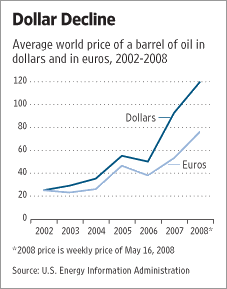 The European Central Bank has been more hawkish on inflation than the Federal Reserve. There is no coherent international policy on inflation and economic growth, even among the power elites of the US-led multinational empire, which makes it difficult for the Fed to perform its balancing act.
 Moreover, a great part of the recent oil price rises has been due to the dollar's weakness. Those oil producers, like the Gulf states, whose currencies are pegged to the dollar (but most of whose imports come from Europe), are thus forced to adopt a pro-cyclical policy against their interests. Bretton Woods II has ceased to make sense even on capitalist terms (to say nothing of the social costs to the South of accumulating dollar reserves and financing the US economy at the expense of domestic investment).
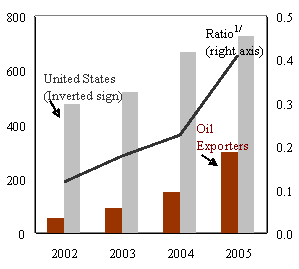
3 See how crucial petrodollar recycling has become to plug the US current account deficit:
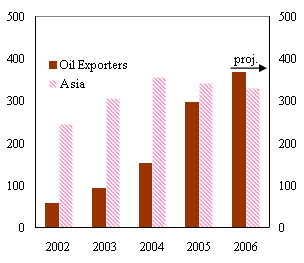
As a result of the recent rise in oil prices, oil exporters have become important counterparts to the United States in the ownership of foreign savings. Their current account surplus represented in 2005 some 40 percent of the U.S. current account deficit, nearly doubling in one year (Chart 2).Chart 2
Current Account Positions
(in billions of US$)
1Ratio of current account of oil exporters to current account of the United States (in percent, right axis).
Oil exporters are close to becoming more important than Asia in the holding of net savings outside the United States (Chart 3). While Asia's current account surplus is projected to have risen to US$341 billion in 2005 (equivalent to 47 percent of the United States' current account deficit), that of oil exporters is projected to have reached US$296 billion (equivalent to 41 percent of the United States' current account deficit). Relative positions are expected to reverse in 2006. According to IMF projections, oil exporters' current account surplus would amount to 46 percent of the U.S. deficit in 2006, while the figure for Asia would drop to 41 percent.
Chart 3
Foreign Savings
(Current account surplus, US$ billion)
(Saleh M. Nsouli, Director, Offices in Europe, International Monetary Fund, "Petrodollar Recycling and Global Imbalances," Presentation at the CESifo's International Spring Conference, Berlin, 23-24 March 2006)
Labels: empire, iran, Israel, oil, ruling class, stop the war
1:00:00 am |
Permalink |
Comments thread |
|
Print |
Digg |
del.icio.us |
reddit |
StumbleUpon |
Tweet|
Share|
Tuesday, March 25, 2008
The Battle of Basra posted by Richard Seymour

The BBC and The Guardian report gun battles in the streets of Basra. There is a template for reporting on this is already fairly well developed: the 'Iraqi forces' are cracking down on intra-sectarian warfare, trying to bring peace to the streets of Iraq's southernmost region, the Basra Governate. This warfare is between three players - the Al-Fadhila party (an offshoot of Sadrism), the Mahdi Army, and the Supreme Islamic Iraqi Council (SIIC). The latter, of course, currently occupies the Interior Ministry on behalf of the invading armies, so the implication that the 'Iraqi forces' are taking a neutral role in this struggle is palpably absurd. It is also the main party to the coalition government with the Dawa Party, which also hopes to co-dominate the southern regions. Reporters know perfectly well that this is not a neutral crackdown on some sectarian rivalry that is simply getting out of hand, and perhaps by the time you read this that pretense will have been given up.
So what is this apparently 'regional' struggle about? A few things, I think. Sadr's movement has recently broken its ceasefire and launched a series of attacks against the occupying forces, including - so it is believed - rocket attacks into the Green Zone. (General Petraeus is saying that Iran is behind these attacks, but then he would). They have been organising cross-sectarian meetings demanding the end of the occupation. The occupiers will probably be encouraging its most avid collaborators to crack down on this tendency, especially given that the Mahdi ceasefire has been one of the most important bases for the recently declared success. If the 'Iraqi forces' can't do the job, look out for a redeployment of British troops, over 4,000 of whom are currently bunkered down in Basra airport. Secondly, in the past few days Sadrists have accused the Dawa Party and its government allies of waging a war of liquidation against the Sadrist movement in the central and southern regions, in anticipation of the implementation of the federalism laws written by the US and pushed through in 2006, and the upcoming provincial elections which the Sadrists could very well win. The SIIC has recently made a bid to consolidate its control of the Basra Governate by getting a motion of no confidence passed against Mohammed al-Waili, the governor of the province and a prominent Al-Fadhila member, which explains why the latter are fighting their corner. Thirdly, the Sadrists are threatening a no-confidence vote in Maliki's government and a campaign of civil disobedience against the occupation forces. Maliki doesn't have to put up with a vote of no-confidence so long as the confidence of the occupiers, and the occupiers don't put up with anything so long as they still rule.
Finally, and most importantly, the new provincial powers will help overcome long-running obstacles to a new oil law [pdf draft], just as Chevron are getting in on the act (any access to new oil fields "would require passage of the long-stalled oil law"). Essentially, the oil benchmark they seek would allow two thirds of Iraq's oil fields to be owned by US corporations. It would place executive decision-making power in a body, the Iraqi Federal Oil and Gas Council, which could include foreign oil companies. Iraqis overwhelmingly oppose these plans, and the Council of Representatives has consistently obstructed them on the grounds that they are too extreme. The US has used every manner of bribery and threat to try and get the law passed [pdf]. They need it to be passed now, and for Production Sharing Agreements to be developed across the board in order for the US to have long-term leverage over the oil. Even if the US permitted the oil to be developed and sold by non-US firms, their access would be dependent on the political authority of the US, and its ability to wield effective violence. The trouble is, even the occupiers' Iraqi allies can't be trusted with strong central power, as they demonstrated by inviting Ahmadinejad. Breaking up the power structure along sectarian lines while maintaing a nominal central government with weak legitimacy, depending on US troops for its self-defence and encased in a Xanadu-like unreality next to a mammoth US embassy is the best remedy for that. Now there is a Provincial Powers Law in preparation, which will define the relationship between the central government and the provinces. It has to be supported by the Council of Representatives and backed by the Presidency Committee (led by US ally Jalal Talabani) and so far it has not been. As Missing Links points out, these powers are the subject of extensive horse trading and are seen by the US authorities as a key means of gaining acquiescence among key allies for the oil law.
Now, here's the trouble. If the anti-federalist forces win the elections, succeed in generating a national civil disobedience campaign against the occupation, and form alliances to break down the sectarian partition including its geographical expressions - those walls that have cut through Baghdad regions against the will of the local populations - then the US will be facing a crisis just at the time when a domestic election could decisively shape the future direction of the war. The regional-sectarian war is thus a struggle over how the most important property forms in the 'New Iraq' will be elaborated and under whose political control. Bear in mind that oil has historically been the number one source of revenue in Iraq, reaching 90% of total revenues at one point, and will the basis upon which necessary imports are purchased and the regeneration and development of Iraq after two especially miserable decades is carried out.
Sadr is calling for 'civil revolt'. Although his forces have been opportunistic at times, brutal at others, the Sadrist movement is perhaps the only major Shi'ite political formation capable of overcoming the sectarian drift of Iraqi politics. Sadr has been one of the few Shi'ite leaders to try and make alliances with Sunni resistance groups and one of the few to oppose the sectarian partition of Iraq. But now the US wants British troops to launch a 'surge' across the south to destroy its enemies. Since Sadr can mobilise a serious revolt, and since the Iraqi army and police are probably not well placed to crush it, even with the Badr corps auxiliaries and the Special Police Commandos working away, British troops might well end up doing as the US is asking. However, bear in mind also that these 'Awakening Councils' are threatening to fall apart - they are threatening a 'strike' if the US doesn't pay up its debts, and the whole thing has always been based on money and convenience. That being the case, the US might not really need a major conflagration might now.
11:42:00 am |
Permalink |
Comments thread |
|
Print |
Digg |
del.icio.us |
reddit |
StumbleUpon |
Tweet|
Share|
Saturday, May 19, 2007
"Capital bequeated to man by other living beings". posted by Richard Seymour
Savonarola's petropolitical research...Labels: 'war on terror', energy, iraq, oil, petropolitics, US imperialism
12:06:00 pm |
Permalink |
Comments thread |
|
Print |
Digg |
del.icio.us |
reddit |
StumbleUpon |
Tweet|
Share|